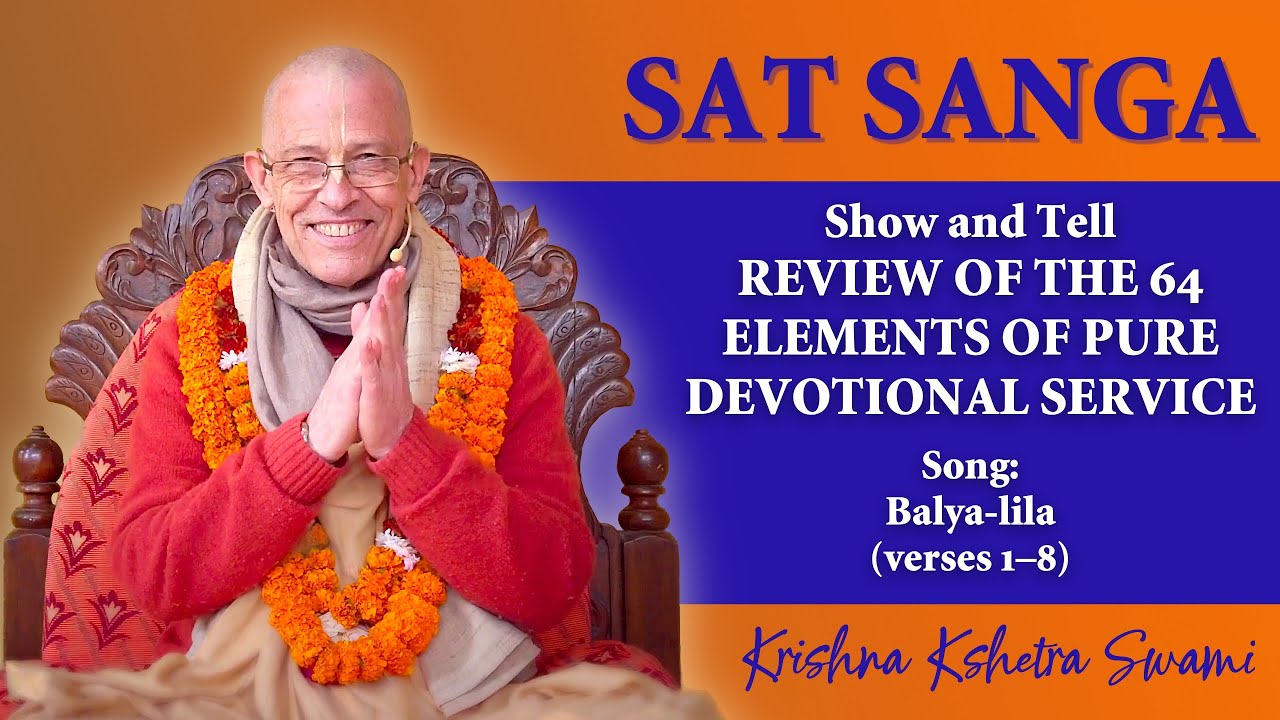
On January 10, 2026, at Go-druma Bhavan, Mayapur, India, HH Krishna Kshetra Swami guided a Sat Sanga titled “Show and Tell Review of the 64 Elements of Pure Devotional Service,” presenting a rigorous and compassionate re-examination of classical bhakti practice. The session foregrounded how foundational disciplines of devotional service can be understood as a coherent pathway for daily spiritual life.
The gathering opened with the song Balya-lila (verses 1–8), from Srila Locana Dasa Thakura’s Sri Caitanya Mangala The Loving Pastimes of Sri Caitanya Mahaprabhu, situating the review within a deeply emotive and scripturally grounded frame. The poetic evocation of Sri Caitanya Mahaprabhu’s early pastimes created a contemplative atmosphere that invited embodied remembrance, not merely conceptual understanding.
The “Review of the 64 Elements of Pure Devotional Service” emphasized practical synthesis: how injunctions traditionally enumerated in the bhakti literature become living habits through steady sat sanga, nama-kirtana, study, and service. Attention to ethics, humility, mindful speech, and reverence for sacred spaces was presented as integral, enabling devotion to mature from intention into sustained practice.
The “Show and Tell” format encouraged reflective participation, where lived examples clarified subtle principlessuch as aligning daily routines with sacred time, integrating seva with learning, and refining focus in prayer and meditation. This method translated comprehensive teachings into relatable, incremental steps, encouraging participants to map the 64 elements onto personal sadhana.
While rooted in the Gaudiya Vaishnava tradition, the core insights resonated across dharmic pathwaysHinduism, Buddhism, Jainism, and Sikhismthrough shared values of compassion, discipline, truthfulness, and community-centered practice. The session advanced a constructive vision of unity in spiritual diversity, affirming that ethical refinement and devoted remembrance are common anchors in these traditions.
Key practical takeaways included building a gentle daily checklist (sacred sound, scriptural study, reflective silence, and service), anchoring practice in sat sanga for accountability, and approaching the 64 elements with patient, cumulative discipline. The setting of Mayapur reinforced attentiveness, transforming the review into a contemplative retreat as much as a study session.
Overall, the Sat Sanga in Go-druma Bhavan served as both an academic review and a devotional immersion. By weaving Balya-lila with a structured exploration of the 64 elements, HH Krishna Kshetra Swami offered a clear, compassionate framework for sustaining Pure Devotional Service throughout the yeargrounded in tradition, oriented toward practice, and open to a dharmic spirit of unity.
Inspired by this post on Dandavats.