
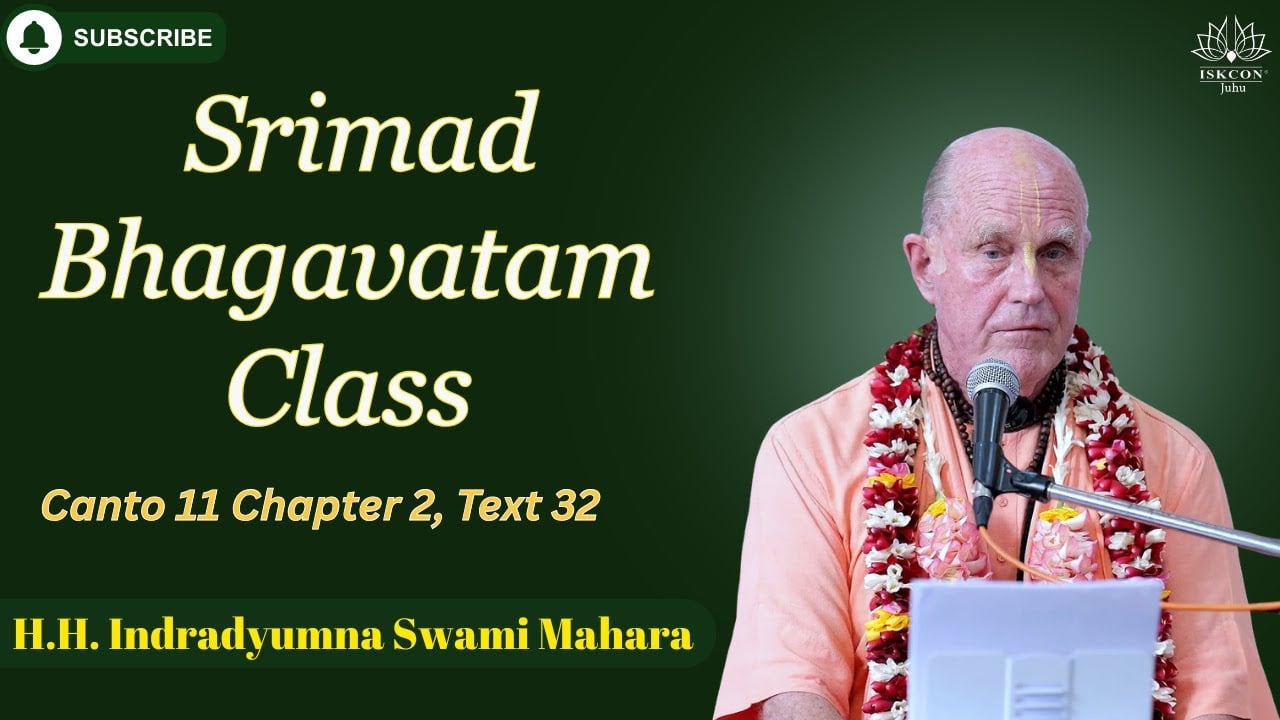
Delivered on 15 January 2026 at ISKCON Juhu, H.H. Indradyumna Swami’s discourse on Srimad Bhagavatam 11.2.32 offered a rigorous and uplifting exploration of leadership, devotion, and the practical application of Krishna consciousness in contemporary society. Framed within a Vaishnava understanding of ethics and governance, the talk emphasized how spiritual wisdom can guide decisions in families, institutions, and public life.
Anchoring the discussion in the exchange between Maharaja Nimi and the Nine Yogendras, the discourse highlighted a Vedic ideal: rulers and decision-makers should humbly seek counsel from saintly devotees and learned brahmanas. This model of leadershiprooted in humility, accountability, and devotionstands as a corrective to ego-driven governance and a blueprint for spiritual governance informed by Srimad Bhagavatam 11.2.32.
The analysis connected inner cultivation and outward responsibility. Inner disciplines such as sadhana, scriptural study, and satsanga foster qualities of compassion, steadiness, and self-regulation; outward responsibilities include transparent decision-making, protection of the vulnerable, and service-oriented policy. In this framework, Krishna consciousness becomes directly actionable: devotion (bhakti) guides priorities, while wisdom traditions offer reliable criteria for ethical choices.
The principles discussed resonate across the dharmic spectrum. The humility of Maharaja Nimi aligns with Buddhist karuna and right intention, Jain ahimsa and aparigraha, and Sikh seva and sarbat da bhala. This shared ethical core affirms unity among Hinduism, Buddhism, Jainism, and Sikhism, while honoring diverse practices. Rather than promoting a single rigid path, the discourse underscored respectful pluralism and the convergence of values that sustain social harmony.
Listeners frequently respond to this narrative with a sense of clarity and reassurance: the call for consultative leadership evokes trust, while the example of King Nimi encourages introspection about power and responsibility. The emotional register of the discoursewhile composed and academicinvites a personal connection to dharma, devotion, and service, making complex theological concepts relatable to everyday leadership challenges.
Practical applications arose naturally from the text: seek guidance from spiritually grounded counselors before pivotal decisions; institutionalize ethical review and accountability; privilege welfare over prestige and short-term gains; cultivate daily remembrance through nama-sankirtana and attentive japa; and measure success by character, service (seva), and the long-term well-being of all stakeholders. In personal, organizational, and civic contexts alike, these steps operationalize the teachings of Srimad Bhagavatam 11.2.32.
Overall, the discourse at ISKCON Juhu presented a coherent model of dharmic leadership that is simultaneously traditional and timely. By uniting devotion with ethical rigor, and by aligning Vaishnava insights with the shared moral language of the broader dharmic family, the talk demonstrated how Krishna consciousness can inform wise governance, resilient communities, and inclusive spiritual culture.
Inspired by this post on Dandavats.







