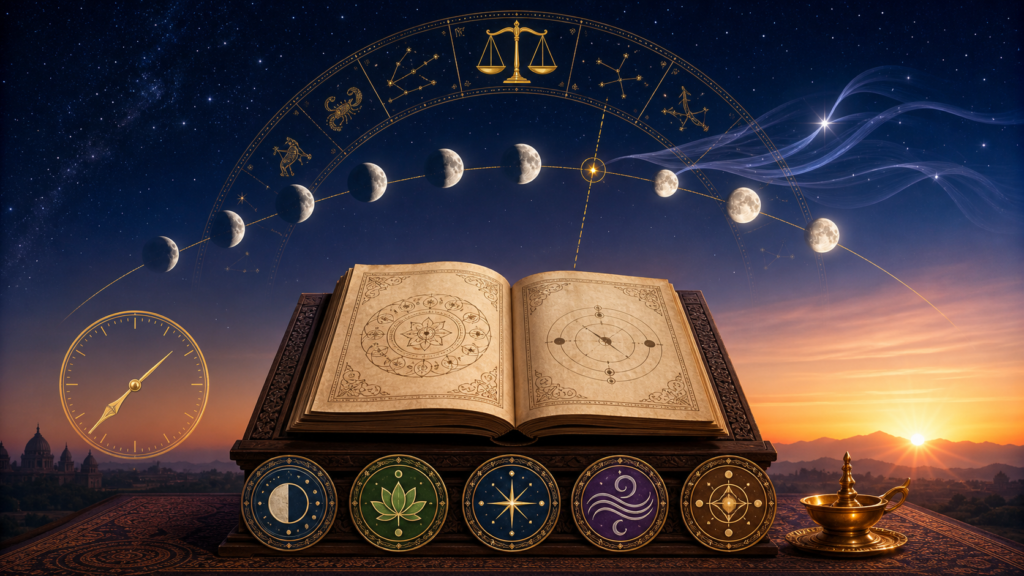
Humans often mistake partial views for the whole, attempting to understand the universe with limited senses and intellect. Hinduism has long articulated this insight with clarity: perception filtered through the five indriyassight, hearing, touch, taste, and smellcaptures only a narrow slice of reality. This recognition does not deny knowledge; rather, it asks for humility, disciplined inquiry, and methods that refine the mind’s capacity to see more truly.
Modern science converges with this perspective. Cognitive biases, optical illusions, and the bounded range of human sensation reveal that pratyaksha (sense perception) is necessary yet insufficient. Hindu philosophy situates perception within a broader epistemology that also includes anumana (inference) and shabda (authoritative testimony), offering a framework to test, triangulate, and expand understanding beyond immediate appearances.
The Upanishadic vision explains the veil of experience through concepts such as Maya (appearance or misapprehension) and Avidya (ignorance). These are not mere abstractions; they describe how the mind constructs a world through habits, memories, and expectations. When buddhi (discernment) is clouded, even accurate sensory data can be misread. Hence, Hindu philosophy emphasizes cultivating viveka (discrimination) so that intellect becomes a reliable instrument rather than an echo of prior conditioning.
This philosophical stance encourages practical refinement. Yogic disciplinespratyahara (withdrawing the senses), dhyana (meditative absorption), and mindful regulation of pranasystematically calm mental fluctuations. As the mind steadies, attention grows more precise, and subtle aspects of experience become observable. In this process, perception matures from scattered impressions into one-pointed, contextualized knowledge that honors both evidence and meaning.
Everyday life offers relatable confirmations. Many people recall moments of misjudgmenthearing only part of a conversation, interpreting a facial expression out of context, or drawing sweeping conclusions from a single news headline. Such instances mirror classical examples like the mirage: a phenomenon that appears real until examined carefully. Hindu philosophy does not condemn these errors; it treats them as invitations to refine pramana (means of knowing) through patient observation, sound reasoning, and respectful learning from trusted sources.
This commitment to intellectual humility and methodical inquiry is shared across the dharmic traditions. Buddhism analyzes Avidya and the conditioned mind with remarkable rigor, encouraging mindfulness and insight (vipassana) to see phenomena as they are. Jainism’s Anekantavada (many-sidedness) teaches that truth is layered and perspective-bound, calling for synthesis rather than absolutism. Sikhism, too, cautions against Maya and haumai (ego), directing attention to truthful living grounded in remembrance and service. Together, these traditions affirm a unifying principle: expand understanding by refining perception and softening certainty.
In an age of information abundance, this dharmic consensus becomes practically empowering. It motivates seeking multiple perspectives, distinguishing data from interpretation, and engaging in dialogue that welcomes correction. It values shabda when it comes from a trustworthy lineage, anumana when disciplined by logic, and pratyaksha when carefully contextualized. The result is not skepticism for its own sake but a confident humility that guards against misleading certainty.
Hinduism’s message, shared by Buddhism, Jainism, and Sikhism, is ultimately constructive: human senses and intellect are limited, yet trainable. By cultivating discernment, stabilizing attention, and honoring diverse pramanas, understanding becomes deeper and more compassionate. In that spirit, unity among dharmic traditions emerges naturallynot by erasing differences, but by recognizing a shared dedication to truth-seeking that is both rigorous and humane.
Inspired by this post on Hindu Blog.