The Narmada river occupies a revered place in the sacred geography of Bharat, celebrated in Puranic lore as a manifestation of Shiva’s grace and as a perennial source of spiritual purification. Within Hindu storytelling grounded in scripture and pilgrimage, the Narmada’s origin is narrated alongside the emergence of the naturally formed Banalingaaniconic Shivalinga stones discovered along the riverbedtogether symbolizing renewal, redemption, and the enduring continuity of Sanatana traditions.
According to ancient narratives, there was an age when moral decline weighed heavily upon the world and the equilibrium of dharma appeared endangered. In these tellings, the suffering of beings called forth divine compassion. Bhagavan Vishnu, the preserver of the universe, is remembered as turning his attention to the fragility of the cosmic order, inspiring a rebalancing in which austerity (tapas), compassion (karuṇa), and sacred rivers play a vital role in humanity’s redemption.
In many traditions, the Narmada is intimately linked to Shiva’s tapas. Some accounts describe the river as arising from Shiva’s jata (matted locks), where nectar-like amrita symbolically streamed forth, transforming spiritual potency into a life-giving current. Other Puranic variations evoke Shiva’s tears or sweat during profound meditation or cosmic dance as the source, each version affirming a shared theological message: the river is a conduit of purifying grace that restores inner and outer harmony. By acknowledging these variants without privileging one exclusively, the tradition emphasizes the universality of the underlying insight rather than a singular literal detail.
Along the Narmada’s banks appear the Banalinga stonesnaturally rounded, smooth forms shaped by the river’s flow and venerated as aniconic manifestations of Shiva. These sacred stones, discussed in the broader context of aniconic-shiva-linga-meaning, embody the principle that divinity can be realized in simple, uncarved forms. Their presence has nurtured household worship and temple traditions alike, reinforcing the accessibility of the sacred beyond elaborate iconography.
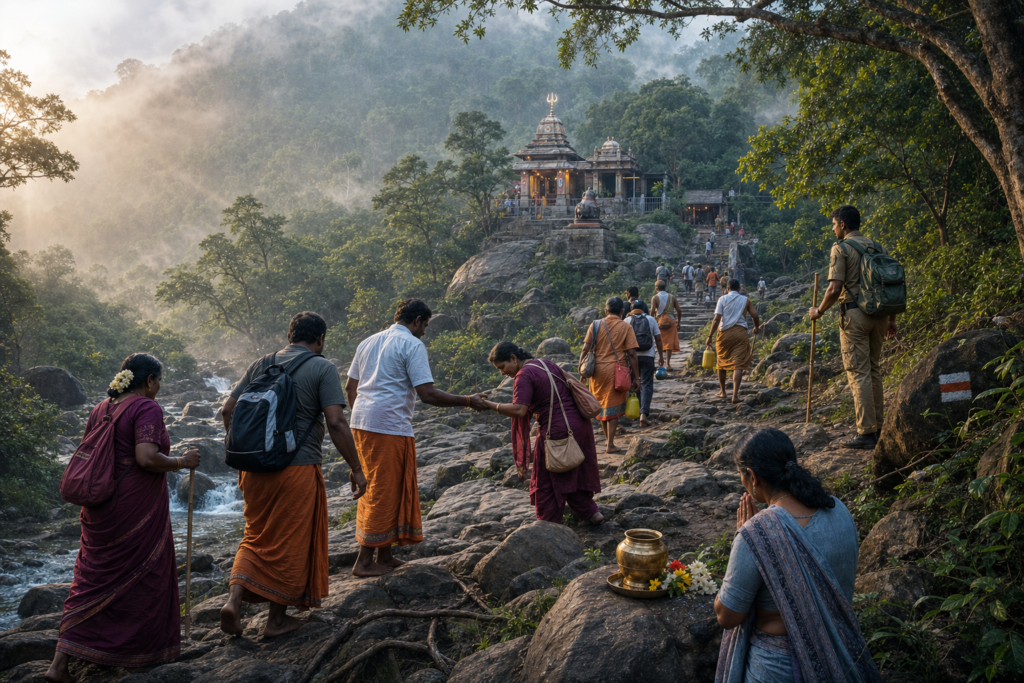
Across centuries, the Narmada has guided pilgrimage practices such as Narmada Parikrama, where seekers undertake a disciplined circumambulation of the river’s course. This journey functions as a living scripture, cultivating inner restraint, ecological reverence, and continuity with ancestral dharma. The custom integrates scriptural remembrance with embodied practice, illustrating how Hindu spirituality weaves philosophy, ethics, and landscape into one coherent path.
Read through an academic lens, the symbolism is clear: Vishnu’s compassion signals the necessity of sustaining cosmic balance, while Shiva’s grace channels transforming energy into the world as purifying water. The Narmada’s origin thus encodes a theological synthesispreservation and transformationwhere the divine addresses human frailty not by withdrawal but by sanctifying the very elements that sustain life.
These themes resonate well beyond sectarian boundaries. In the dharmic family of Hinduism, Buddhism, Jainism, and Sikhism, water symbolizes purity, restraint, and compassion. Jaina traditions emphasize non-violence and mindful stewardship, values reflected in river reverence. Buddhist monastic networks historically flourished near riverine corridors, aligning contemplative life with ecological interdependence. Sikh practice venerates sacred waters and sarovars that cultivate inner clarity and communal service. Through such convergences, the Narmada’s sanctity becomes a shared civilizational heritage, encouraging unity in diversity and mutual respect among dharmic paths.
From the standpoint of cultural heritage, the Narmada’s story situates the river among the sacred rivers of India, connecting local landscapes with pan-Indian pilgrimage, temple networks, and scriptural memory. References across the Puranas, including narratives associated with the Skanda Purana, illuminate how sacred geography functions as a living archiveone that binds communities to ethical action, ritual discipline, and ecological care.
For many seekers today, standing upon the river’s ghats elicits a palpable sense of serenity and responsibility. The gentle rhythm of the current, the quiet devotion of Banalinga worship, and the collective memory of Vishnu’s compassionate gaze and Shiva’s transformative power invite contemplative renewal. In this way, the Narmada’s origin tale remains immediately relevant: it offers a practical ethic of purificationof mind, speech, and actionaligned with the timeless quest for harmony within oneself and with the wider world.
Inspired by this post on Hindu Blog.