The Shivling stands as a profound symbol of creation and dissolution within Sanatana Dharma, uniting metaphysics with living ritual. At its base rests the Gauripatta—also known as the yoni or Argha—representing the divine feminine energy of Goddess Parvati. In traditional temple architecture and home shrines, this sacred component is typically oriented toward the north, a practice that integrates cosmology, ritual function, and Vastu Shastra.
The northward orientation carries layered symbolism. In Indic cosmology, the north (uttara) evokes stability and ascent—linked to Dhruva (the pole star), Kubera (guardian of wealth), and the Himalaya, the natal realm of Pārvatī. Aligning the Gauripatta to the north honors this sacred geography and the balanced union of Shiva and Shakti. Across dharmic traditions—Hinduism, Buddhism, Jainism, and Sikhism—cardinal directions guide movement, meditation, and attention; the emphasis differs by lineage, yet the unifying intent is mindful alignment with the cosmos.
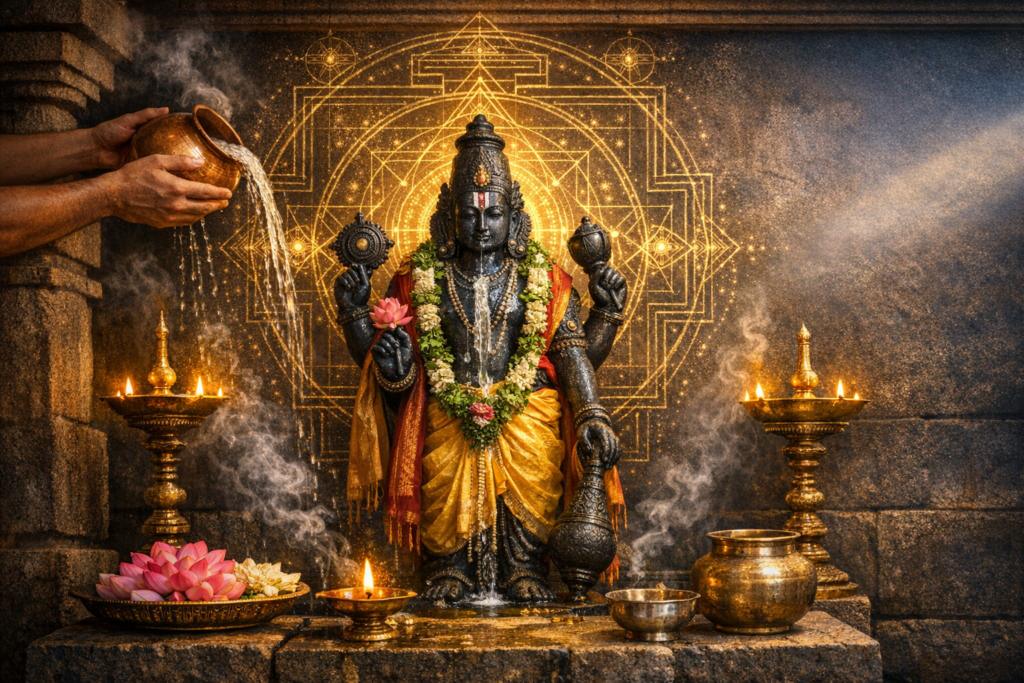
Ritual practice reinforces this orientation. During abhisheka, the libations offered to the Shivling flow through the Somasutra (the outlet or gomukha) built into the Gauripatta. Placing this outlet toward the north preserves a clear east–west darshan axis between Nandi and the Linga and prevents devotees from inadvertently crossing the consecrated drainage channel. Function and sanctity thus converge: the sacred stream is directed to a designated tirtha or receptacle, while movement within the garbhagriha remains orderly and reverent.
Agama prescriptions and Vastu Shastra inform this design. Saiva Agamas commonly describe the yoni pīṭhikā with the Somasutra facing north, while acknowledging context-driven exceptions. Vastu associates the north with auspicious flows, balanced light, and ease of maintenance—practical considerations for continuous ritual use. The result is a layout where symbolic meaning, environmental logic, and ritual hygiene reinforce one another.
Regional traditions demonstrate thoughtful variation. Some temples orient the outlet eastward or adjust the layout due to site constraints, local śākhās, or established pilgrimage patterns. The governing principle remains consistent: uphold the sanctity of abhisheka, protect devotees’ movement, and sustain a clear darshan line. This fidelity to first principles mirrors a broader unity across dharmic spaces, where cardinal alignment fosters focus and contemplative depth, even as forms differ.
Devotees often report a quiet assurance when noticing the Gauripatta facing north, as the orientation becomes a cue for inner alignment. Observing the northward flow during abhisheka can serve as a contemplative aid—recalling the descent of the Ganga, the presence of Pārvatī, and the aspirational journey of uttarāyana, the inward movement from restlessness to stillness. Practical etiquette follows naturally: stand along the east–west axis for darshan, avoid stepping over the Somasutra, and offer water or milk so that it flows gently toward the designated outlet.
In sum, the north-facing Gauripatta is not merely a convention; it is a synthesis of sacred geometry, scriptural guidance, and compassionate design. It honors the feminine principle, supports uninterrupted worship, and situates everyday devotion within a cosmic map shared—though differently expressed—across Hindu, Buddhist, Jain, and Sikh traditions. The practice deepens understanding while inviting a shared reverence that strengthens unity among dharmic paths.
Inspired by this post on Hindu Blog.