Among the many enigmatic figures that populate the sculptural programs of South Asian temples, the Vishkanya (also rendered as Vishakanyaka, literally “poison maiden”) has held a singular grip on the historical imagination. In Hindu temple iconography, this figure appears not merely as a beautiful woman but as a layered symbol that straddles statecraft, ethics, psychology, and aesthetics. The motif’s auraboth alluring and unsettlinginvites a reading that moves beyond sensational folklore to a subtler understanding of how premodern societies visualized danger, desire, and discernment at the threshold of the sacred.
Etymologically, viṣa denotes poison and kanyā denotes a maiden. The combined term signals a paradox: the life-giving potential associated with femininity refracted through a discourse on toxicity and peril. Temple artists and patrons used this paradox to good effect, placing such figures within broader narrative and symbolic cycles that teach vigilance, self-mastery, and wise governance, even as they celebrate beauty and sophisticated craftsmanship.
Textual traditions associated with polity and espionage, especially the corpus attributed to Kauṭilya (Arthaśāstra, redacted between antiquity and the early Common Era), have long been read to suggest the possibility of trained “poison maidens” as instruments of assassination. Within these treatises, poisons, antidotes, and covert operations occupy detailed registers of statecraft, and the viṣakanyā appears in discussions of extraordinary measures taken to neutralize existential threats. Whether such practices were common or rare is debated; what matters for iconography is the enduring cultural memory that associated beauty weaponized by intrigue with the precariousness of power.
Drama and narrative literature helped cement this association. In the political play Mudrārākṣasa (commonly ascribed to Viśākhadatta), a poison maiden becomes a pivotal device within a broader narrative of alliance, betrayal, and realpolitik. Pan-Indic story cyclessuch as those compiled in the Kathāsaritsāgaraand later courtly anecdotes echo the theme: seduction, when harnessed to lethal intent, becomes a cautionary tale about rulers who misread appearances. These texts ensured that the figure of the Vishkanya travelled from the sphere of technical statecraft into popular moral imagination.
Premodern Indian knowledge systems also contribute an important backdrop. Ayurveda’s branch of toxicology, agada-tantra, studied venoms, poisons, and antidotes, and premodern cultures widely entertained the possibility of gradual conditioning to noxious substances (a notion often compared to “mithridatism”). Even if the literal claim of contact-induced toxicity remains physiologically contested, the intellectual milieusteeped in discussions of toxins, immunity, and antidotesmade the Vishkanya a compelling allegory. Within this frame, images of the poison maiden signal not only political peril but also the ethical toxins of greed, lust, and delusion that aspirants are asked to master en route to the sanctum.
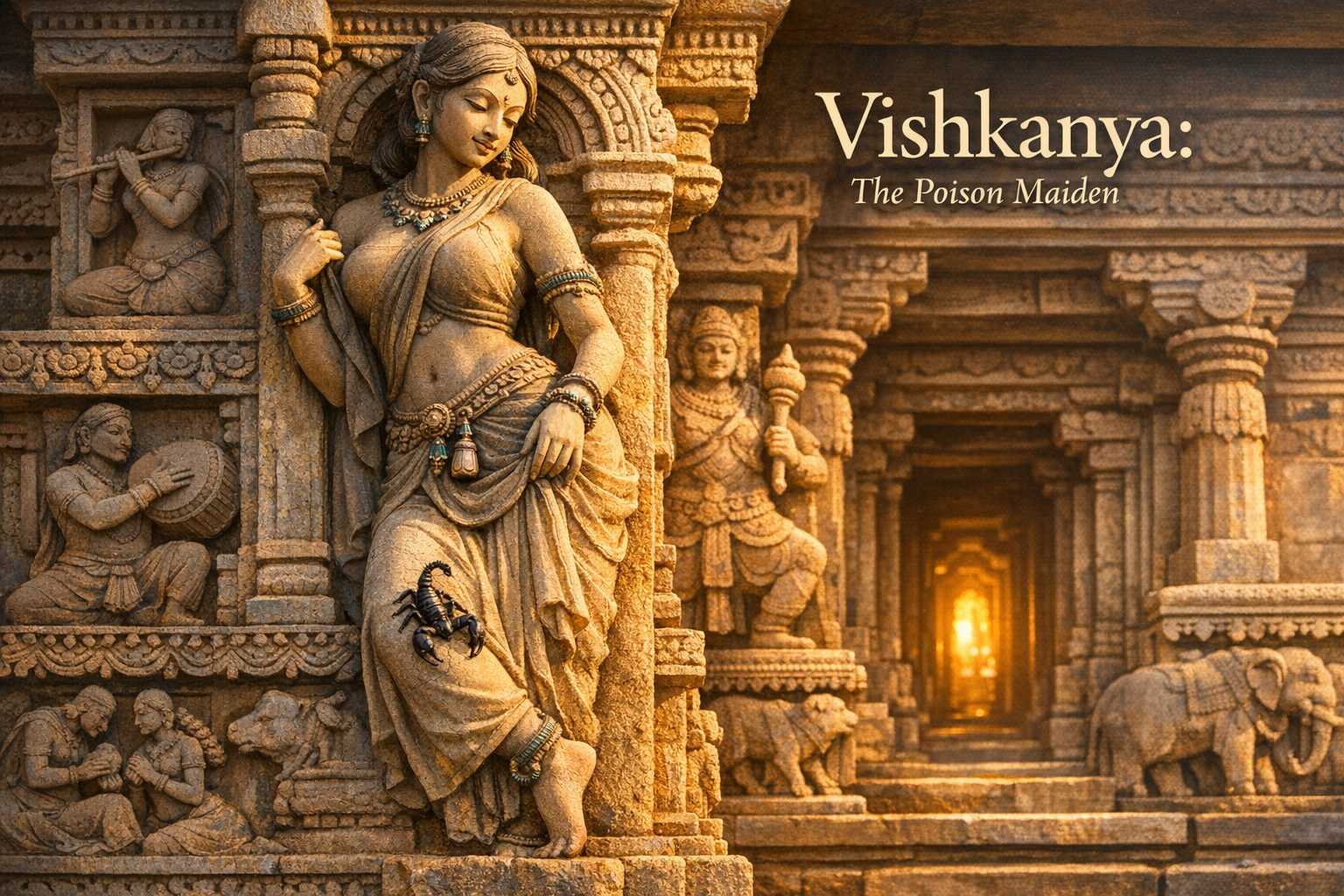
In temple sculpture, identifying a Vishkanya depends on iconographic cues more than inscriptions, as epigraphic labels are rare. The figure often appears as part of the wider repertoire of devāṅganās, śālabhañjikās, madanikas, or alasā-kanyāsfemale figures that animate exterior walls with motifs of dance, beauty, music, and everyday vignettes. What sets the Vishkanya apart are specific markers: a scorpion poised on the thigh, serpent anklets or bracelets, a small vial or cup suggestive of potions, or an otherwise serene beauty paired with a subtle emblem of danger. Such cueswhile not uniform across regionsinvite a double-take, converting shṛṅgāra (erotic charm) into bhayānaka (the frisson of fear) in a single glance.
Odisha’s medieval temples and Central Indian sites have preserved some of the most discussed examples. At Konark’s Sun Temple, guides and local art-historical traditions point to female figures attended by scorpions and serpents; popular exegesis reads these as Vishkanyas set within a grand pedagogical facade that also displays warriors, musicians, celestial couples, and animal friezes. Khajuraho’s sculptural program, celebrated for its virtuoso treatment of bodies and rasa, includes a “scorpion-bite” motif in which a woman reacts to a creature on her thighan image interpreted variously as a sensual frisson, a comedic vignette, or, in some readings, a cautionary emblem aligned with the Vishkanya theme.
In Hoysala temples such as Belur and Halebid, connoisseurs often single out madanika brackets for their breathtaking grace and narrative detail. Among them, a figure with a scorpion has frequently been folded into the Vishkanya discourse by local lore and visitors, even if scholars remind audiences that bracket figures are polyvalent and not always reducible to a single textual label. Across all these regions, the shared artistic strategy is unmistakable: adorn the exterior with beauty that also warns; display allure and then disclose the price of unexamined desire.
The placement logic strengthens this reading. Outer walls customarily stage the full theater of lifecommerce, love, music, martial exploits, animals, and mythical beingsbefore one crosses into progressively sacred zones. Encountering the Vishkanya (or scorpion-bite motif) in this liminal belt acts as a ritualized cognitive nudge: the senses, untrained, lunge toward surfaces; the wise, guided by dharma, peer through them. As circumambulation proceeds, imagery shifts from the centrifugal pull of the world to the centripetal call of the sanctum, mirroring the inner journey from pratyāhāra (withdrawal of the senses) to dhyāna (contemplation).
Interpreted semiotically, the Vishkanya operates on at least four registers. Politically, she is a memento mori for rulers and administrators: infiltration thrives wherever discernment lapses. Ethically and psychologically, she embodies the “poisons of the mind”craving, aversion, and delusionthat corrode judgment. Aesthetically, she demonstrates how śilpins could yoke shṛṅgāra and bhayānaka to trigger awareness rather than titillation. Epistemically, she cautions viewers about hermeneutic humility: images can both reveal and mislead; only sustained attention decodes their intent.
Dharmic traditions converge around this core pedagogy of discernment. Hindu darśanas speak of overcoming rāga–dveṣa; Buddhist teachings warn against taṇhā (craving) and the snares of māra; Jain nīti literature cautions against the kashāyas (passions) that cloud right knowledge; Sikh teachings frequently describe the pull of māyā as a subtle poison that distracts from truthful living. Placed in this shared horizon, the Vishkanya is not a gendered indictment but a cross-traditional allegory of vigilancean artistic upāya (skillful means) urging self-mastery and non-harm as one approaches the divine.
Scholars also counsel methodological care. The term “Vishkanya” is sometimes applied retroactively by modern guides and enthusiasts to any female figure with a scorpion or serpent, even when local śilpa-śāstra prescriptions are complex and regionally variable. Epigraphy seldom captions these figures. Consequently, responsible interpretation balances textual references (Arthaśāstra and narrative literature), regional art manuals, workshop conventions, and the broader iconographic context in which a sculpture is set. The absence of a one-to-one textual “label” does not diminish the interpretive power of the motif; rather, it underscores the sophistication of a visual language designed to operate through suggestion.
For many visitors, the first encounter with a scorpion-poised figure on an otherwise serene body generates a quiet, memorable unease. Docents and priests often observe that this emotional pivotfrom attraction to alertnessis precisely the point. Families, students of art history, and pilgrims alike report how, after this moment, exterior walls feel less like ornament and more like a living syllabus, drilling lessons in perception before the gaze turns inward. Such experiences demonstrate that the Vishkanya motif still performs its didactic work, long after the political intrigues that inspired it have faded.
Historicity remains a legitimate question. Biomedically, the notion that bodily contact alone could transmit lethal doses of a generalized toxin remains doubtful. Yet ancient and medieval courts did possess sophisticated knowledge of plant alkaloids and contact poisons (for example, aconite and related preparations), and deploying courtesans, dancers, or envoys as covert operatives is amply documented across cultures. The Vishkanya figure crystallizes this entire spectrumscience and superstition, espionage and ethicsinto a single emblem that temples could redeploy for moral instruction.
Contextualized within temple programs, the Vishkanya also participates in a larger pedagogy about power. Kingship in the dharmic imagination is legitimate only when yoked to dharma and self-restraint. By showing beauty that conceals harm, the sculptural program reminds rulers and citizens that adharma often arrives pleasingly wrapped. This is less a misogynistic trope than a sober political counsel: sovereignty without discernment is structurally vulnerable to flattery, espionage, and ethical decay.
The feminine presence on temple walls is remarkably diverse: yoginīs, goddesses, musicians, dancers, mothers, huntresses, and śālabhañjikās. Within this spectrum, the Vishkanya’s inclusion underscores not a reductive view of womanhood but an acknowledgment that powerlike beautycan heal or harm depending on intent. Many iconographic cycles deliberately juxtapose nurturing and cautionary feminine figures to signal that śakti is ethically ambivalent until directed by dharma.
Modern relevance is difficult to miss. Information warfare, social engineering, and “honey-trap” operations in contemporary security discourse mirror premodern anxieties conveyed by the Vishkanya. The motif’s lasting value lies in how it trains attention: do not outsource discernment. Whether in politics, personal life, or digital spaces, the symbol urges the viewerquietly but firmlyto test appearances, verify motives, and choose the path of non-harm.
For those exploring temples in Odisha, Madhya Pradesh, or Karnataka, a practical approach aids responsible viewing. Look first for the broader narrative band: how are musicians, guardians, vyālas, amorous couples, and daily-life scenes arranged? Then note the specific cuea scorpion, a serpent, or a small vialthat introduces ambivalence into an otherwise graceful figure. Finally, relate the image to its architectural position: exterior bands often teach worldly lessons; inner registers intensify devotional focus. Read this triadmotif, context, placementand the Vishkanya begins to speak with clarity.
Ultimately, the Vishkanya in Hindu temple iconography is best understood as an interpretive node where art, ethics, and polity intersect. Anchored in the intellectual world of the Arthaśāstra and enlivened by narrative literature, the motif became a sculptural shorthand for vigilance amid allure. In harmony with the wider dharmic ethos shared across Hinduism, Buddhism, Jainism, and Sikhism, it champions self-mastery, compassionate conduct, and truthful living. When seen this way, the “poison maiden” ceases to be a sensational curiosity and emerges as a profound teacherreminding all who circle the sanctum that the subtlest toxins are those that cloud the mind.
Inspired by this post on Hindu Blog.