
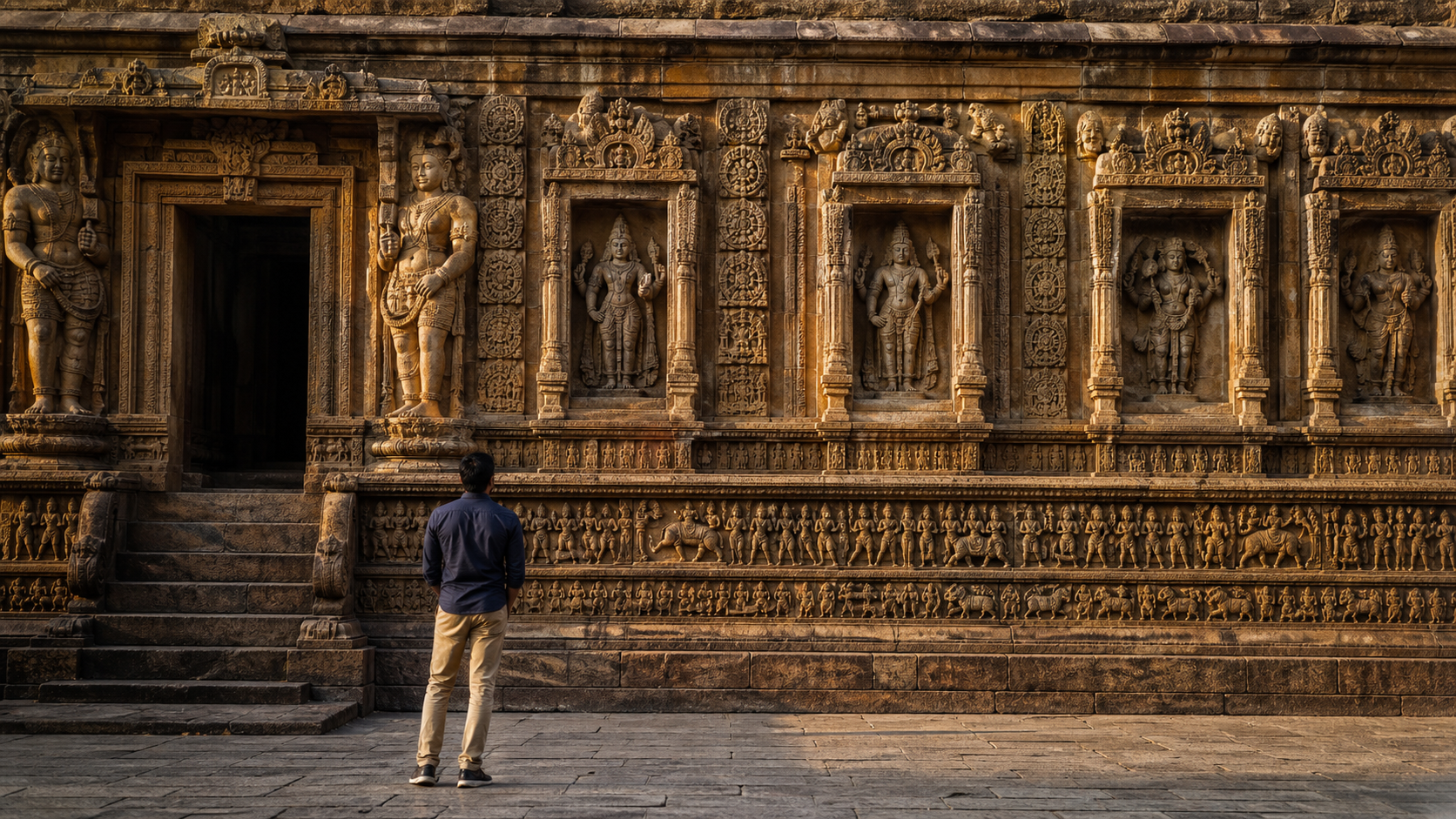
You stand before a temple wall crowded with deities, dancers, animals, guardians, vines, weapons, flames, and unfamiliar beings. A guide supplies a dramatic name, someone nearby offers a spiritual meaning, and an online image search produces three more answers. How do you tell what the sculptor actually showed from what later viewers have projected onto it?
Begin by treating the temple as an ordered encounter, not a picture dictionary. Location, attributes, surrounding figures, emotional tone, and ritual use work together. Once you read those layers in the right order, the imagery becomes more intelligible without being reduced to a single slogan.
Location is the first part of a symbol’s meaning
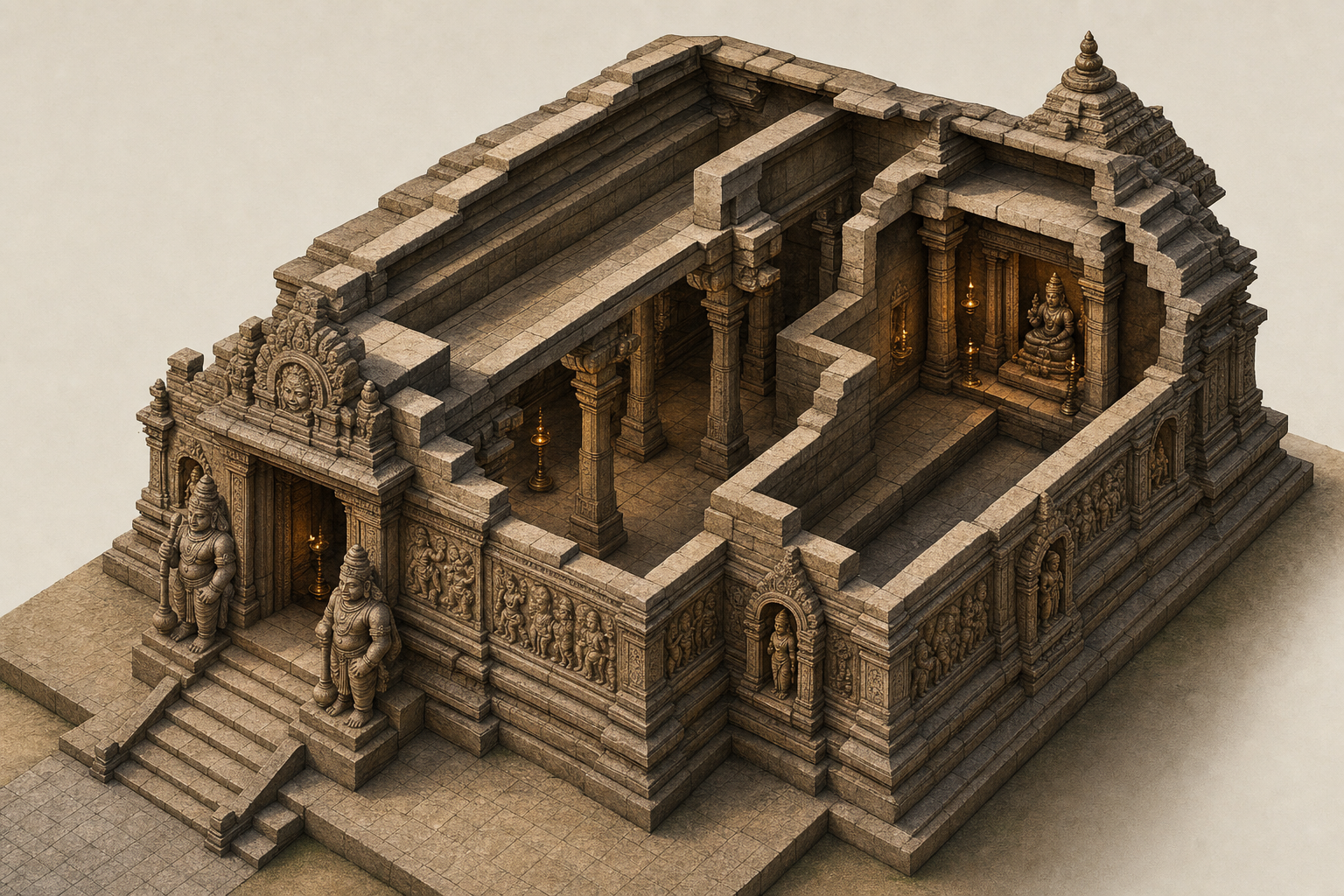
Before naming a figure, ask where it stands. An image on an exterior wall does a different job from one guarding a doorway, framing the principal murti, occupying a narrative band, or receiving worship in the garbhagriha. The same serpent, flame, flower, or leonine face can carry a different emphasis in each position.
Temple exteriors can present the breadth of embodied life: music, dance, courtship, warfare, animals, occupations, celestial beings, danger, beauty, and humor. This abundance is not necessarily a distraction from the sacred. It can show the world through which the devotee must move. As circumambulation turns the body around the sacred center and the route approaches more concentrated spaces, the visual journey can mirror an inward movement from sensory engagement toward contemplation.
This is why an alluring or unsettling exterior figure should not be interpreted in isolation. A beautiful woman accompanied by a scorpion may create a deliberate turn from attraction to alertness. Within the liminal sculptural belt between ordinary life and the sacred center, that emotional reversal can teach discernment before the devotee reaches the sanctum.
Context also includes height and direction. Look above the figure for an apex motif, below it for a pedestal, and to either side for companions or repeated forms. Check whether the image faces a doorway, belongs to a sequence, mirrors another panel, or interrupts a regular pattern. Repetition usually establishes a visual category; a deliberate break often marks the detail that deserves attention.
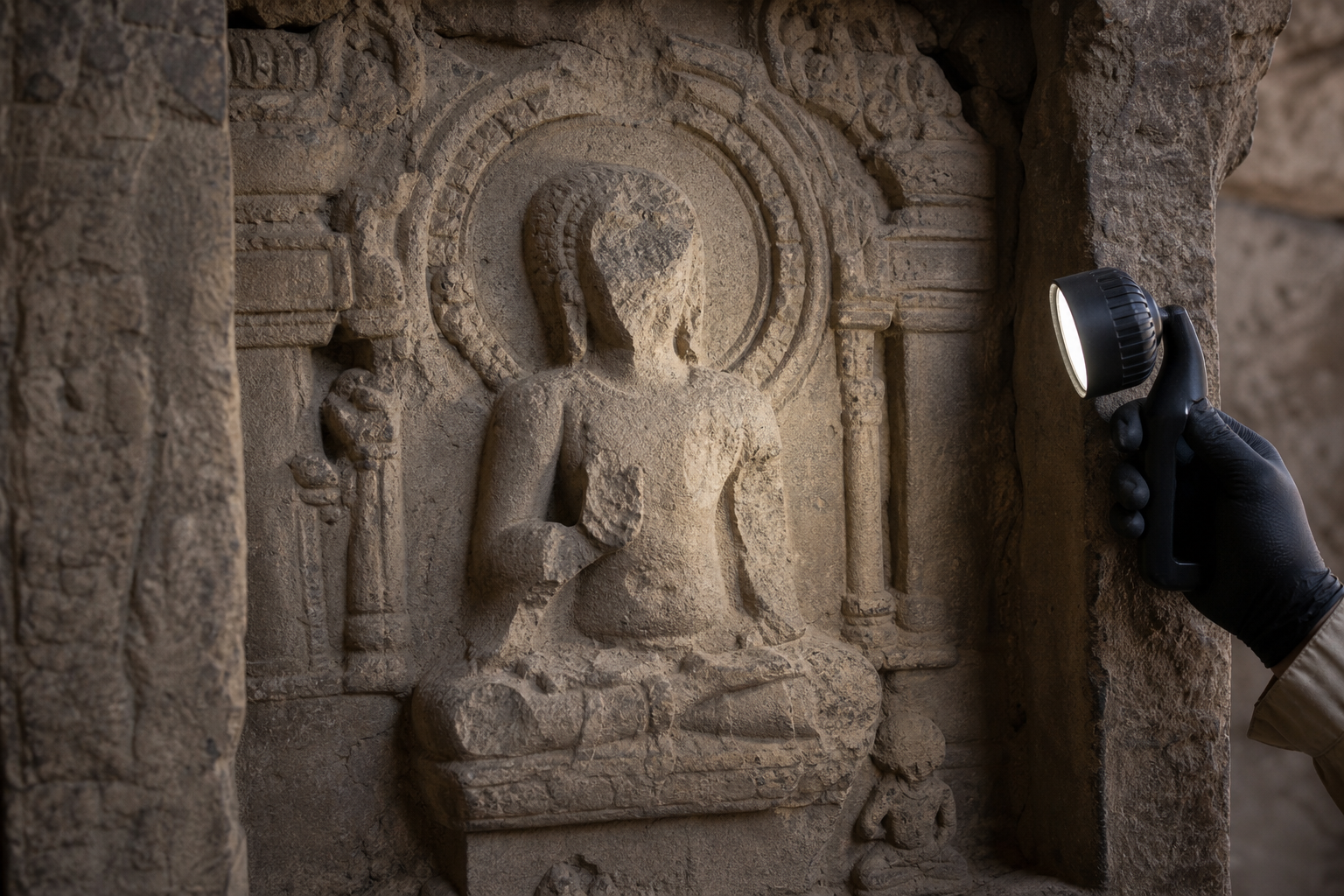
When photography is permitted, take one contextual photograph before a close-up. Include the whole panel, the architectural band, the base, the upper frame, and at least one neighboring image. A tightly cropped attribute may help with identification, but it can erase the evidence needed for interpretation.
Read the image in layers, from observation to inference
Begin with what you can see without interpretation
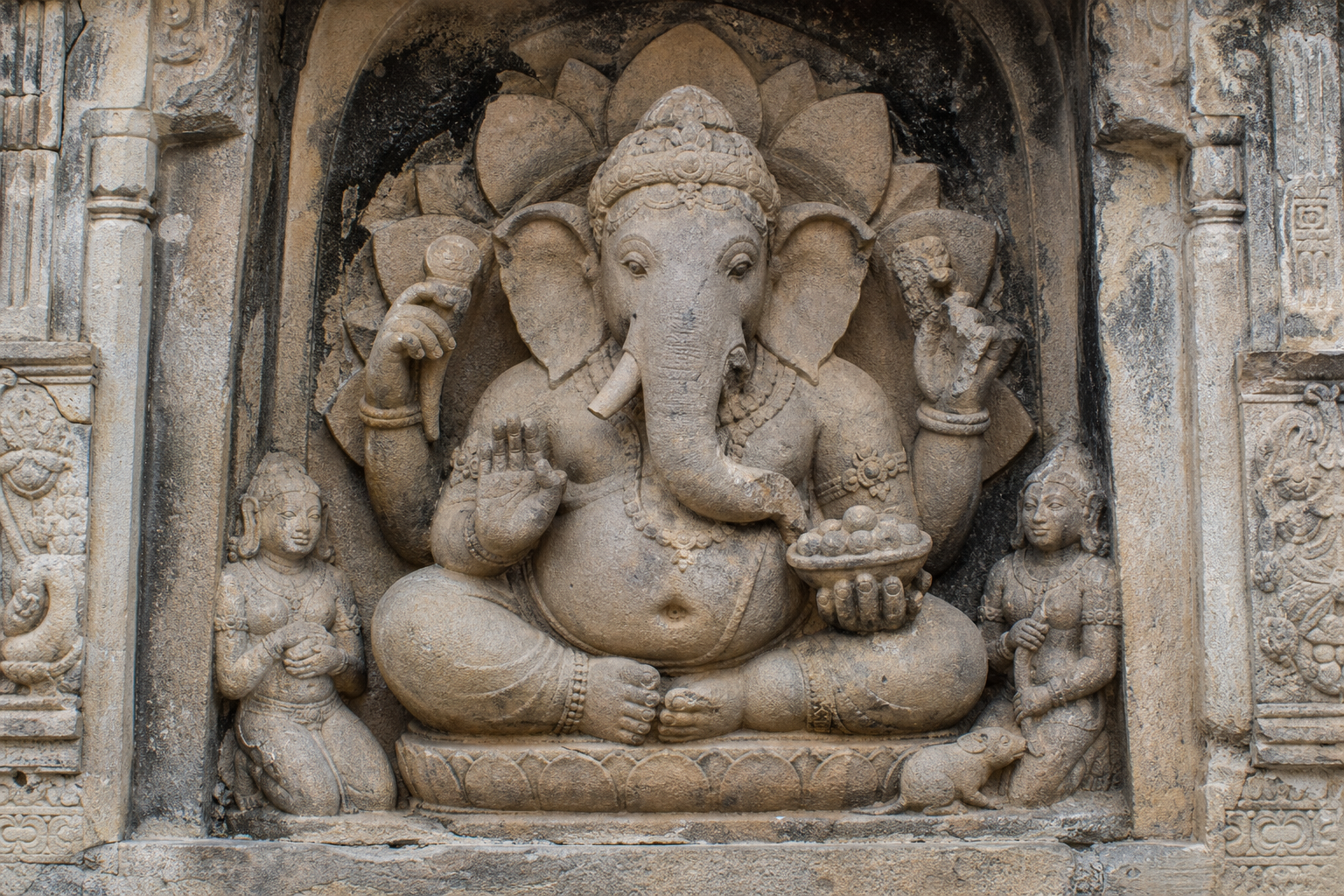
Describe the image in plain language before assigning a name. Note the number of arms and heads, posture, direction of gaze, hand gestures, objects held, animals present, ornaments, facial expression, clothing, pedestal, arch, and neighboring figures. Record damage as well. A missing hand or eroded attribute can turn a confident identification into guesswork.
This first pass protects you from a common error: seeing one familiar object and forcing the entire image to fit it. An isolated serpent does not automatically identify a specific deity. A halo does not by itself settle the identity of the person it surrounds. A scorpion near a female figure does not automatically prove that she is a Vishkanya. An attribute is evidence, not a complete verdict.
Identify relationships, not just objects
Next ask how the elements relate. Is a creature serving as a vehicle, ornament, adversary, guardian, or narrative participant? Is a small figure worshipping the central one, supporting a throne, fleeing from danger, or taking part in a story? Does an arch merely surround the murti, or does its apex, vegetation, and flame pattern extend the theology of the central form?
Scale is relational rather than photographic. A larger central figure usually signals importance, not bodily size. A tiny attendant may identify the central deity more securely than an ornate crown does. The best reading therefore joins attribute, action, hierarchy, and placement instead of relying on one visual clue.
Notice the change in rasa
Temple sculpture communicates through the response it produces as well as through the objects it depicts. Does the panel evoke serenity, wonder, tenderness, erotic attraction, heroism, humor, fear, or revulsion? More importantly, does its emotional register change as you look longer?
A transition from shringara, the experience of beauty or erotic charm, to bhayanaka, the sensation of fear or danger, can be the central mechanism of an image. The viewer is first drawn toward a graceful form and then made to notice the serpent, scorpion, weapon, or threatening companion. Meaning resides in that double-take. The image demonstrates how a pleasant surface can capture attention before discernment catches up.
Do not translate rasa into a simplistic moral such as beauty is bad. Dharmic art can celebrate beauty while warning against ungoverned attachment to appearances. The practical question is not whether the senses are enemies, but whether perception has become clear enough to recognize what else is present.
Two worked readings show how the method changes the answer
Prabhavali: the frame is part of the deity’s presence
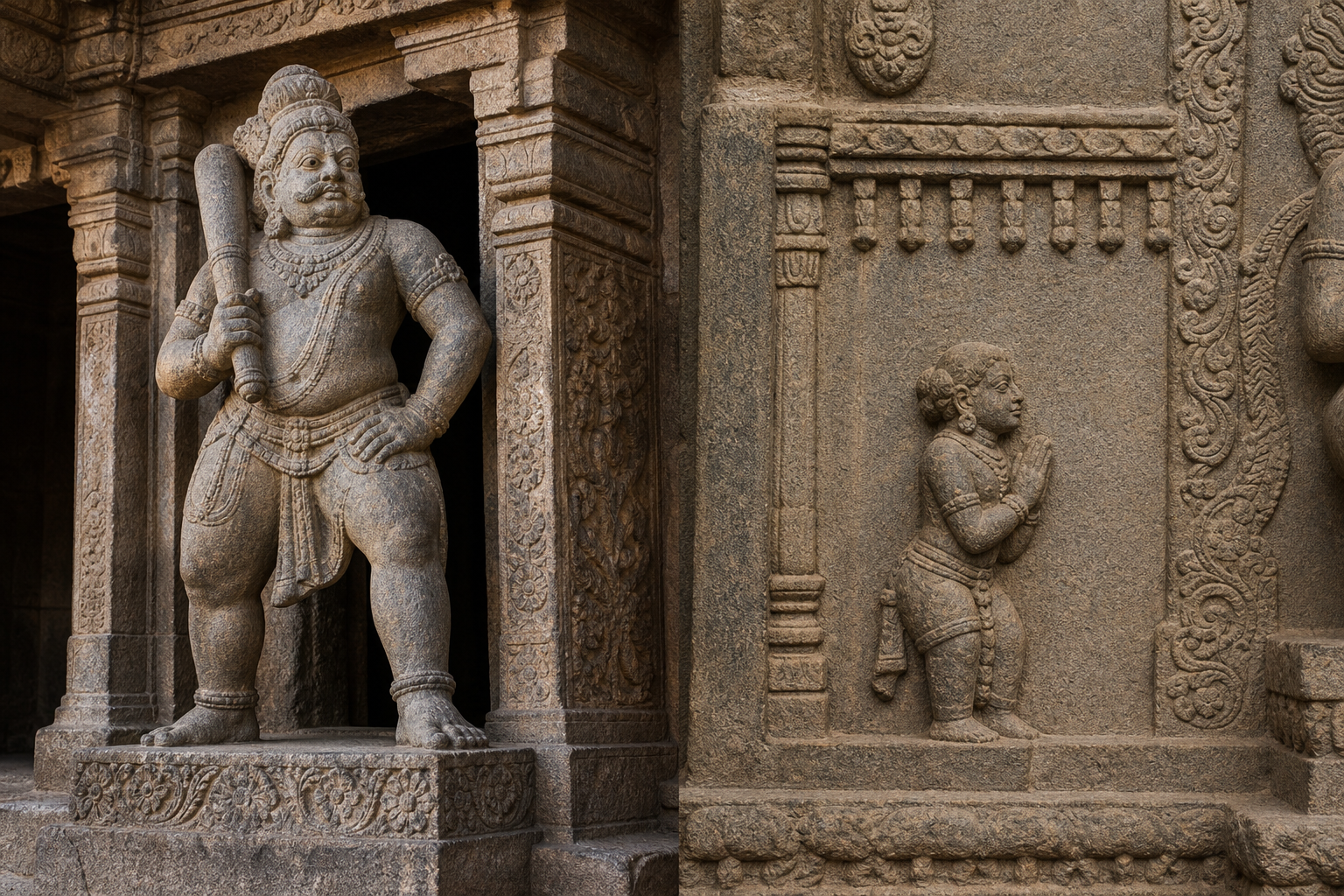
A prabhavali or prabhamandala may appear as a circular halo behind the head or as a full-body arch around a murti. If you treat it as decorative furniture, you miss much of the ensemble. It establishes a luminous field, marks the sacred image off from ordinary space, concentrates the viewer’s gaze, and can add deity-specific signs to the central form.
Read a full-body prabhavali from base to apex. A kirtimukha at the summit can act as a protective presence while recalling kala, time that consumes all finite forms. Makaras disgorging vines connect the arch with generative waters, abundance, and fertility. Vaishnava examples may carry the shankha, chakra, Garuda, or hamsa; Shaiva examples may employ the trishula, damaru, or ganas; Shakta ensembles may intensify the boundary with fierce guardians and tongues of flame. These signs should agree with the murti and shrine rather than be read as an independent catalogue.
Nataraja offers the clearest demonstration. The surrounding flames are not a generic halo pasted behind Shiva. The ring makes movement, dissolution, and renewal visible around the dancing form. Central figure and aureole complete one theological statement. Cropping out the ring does not merely weaken the composition; it removes part of what the image says.
Material and ritual use add another layer. A stone arch carved into a back slab belongs to a stationary architectural setting. A detachable metal prabhavali fitted to an utsava murti can travel in procession. In the lamplit garbhagriha, relief catches the shifting glow of ghee lamps, making the field around the murti appear active during darshan. The relationship among aureole, lamp, sightline, pedestal, and sacred image is therefore visual, architectural, and ritual at once.
Regional style changes the appearance without cancelling the underlying function. Chola metalwork can emphasize a taut rhythm of flames, while Hoysala back slabs favor dense carving; makara-toranas develop other regional accents in Odisha, Rajasthan, and beyond. Use local workshop style to refine a reading, not to assume that every region executed the same form identically.
Related halos and full-body aureoles also appear around Buddhas, Bodhisattvas, and Jain Tirthankaras, while Sikh paintings may surround Gurus with radiance. This family resemblance points to a broad Dharmic language of luminosity and awakened presence. It does not make the traditions interchangeable. Read the shared form first, then ask what illumination means in the specific community, image, and ritual setting before you.
Vishkanya: describe the danger before fixing the label
Now consider a graceful female figure with a scorpion on or near her thigh. The dramatic identification is Vishkanya, the poison maiden. It may be appropriate, but it should not be your first sentence. Female figures on temple walls belong to a broad repertoire that includes devanganas, shalabhanjikas, madanikas, and alasa-kanyas. Inscriptions rarely label the supposedly poisonous figure, and regional sculptural conventions are not uniform.
Start with the secure description: a female figure, her posture and action, and the position of the scorpion. Then look for supporting signs such as serpents worn as ornaments or a small vessel suggestive of a potion. Ask whether she appears within a group of courtly women, bracket figures, cautionary scenes, or narrative panels. One dangerous creature creates a possibility; several mutually reinforcing features create a stronger identification.
The label also carries several possible registers. The Arthaśāstra’s world of poisons, antidotes, espionage, and covert action, together with the political drama Mudrarakshasa and later narrative traditions, gave the poison maiden a durable association with beauty weaponized through intrigue. In that register she warns rulers that power fails when desire disables judgment.
On an ethical and psychological level, the visible poison can stand for craving, aversion, delusion, and other passions that corrupt perception from within. Aesthetically, the image joins attraction and danger so that the viewer experiences the lesson rather than merely hearing it. Spatially, its exterior placement can make it part of the preparation for approaching the sacred: look closely, govern the senses, and do not confuse appearance with truth.
This interpretation should never become a gendered accusation against women. The feminine figure gives memorable form to a danger that concerns every viewer. Hindu teachings on raga and dvesha, Buddhist warnings about craving, Jain accounts of passions that obstruct right knowledge, and Sikh reflections on maya all place the real problem in undisciplined perception and attachment. The ethical target is delusion, not femininity.
Literal history requires equal care. Premodern India possessed developed traditions of toxicology, and courts imagined or employed poisons within statecraft. Yet the claim that ordinary contact with a generally poisonous person’s body could deliver a lethal dose remains physiologically doubtful. You do not need to defend that literal mechanism to understand the iconography. A culturally powerful image can teach political and moral vigilance even when its most sensational biological reading is uncertain.
Site labels should reflect that uncertainty. At Khajuraho, a woman reacting to a scorpion can be read as a sensual or comic vignette as well as a warning associated with the Vishkanya theme. At Belur and Halebid, local tradition may attach the Vishkanya name to a scorpion-bearing madanika, but the bracket figure remains capable of more than one reading. At Konark, scorpions and serpents can support the association without functioning as an inscribed name. In each case, the responsible caption preserves what is visible and marks the interpretive label as probable or possible.
Use a confidence ladder instead of pretending every image has one answer
Observation: say what the stone or metal securely shows
The first level contains features another careful viewer could verify: a four-armed central figure, a damaged right hand, a scorpion beside the thigh, flames around an arch, a kirtimukha at the apex, or two makaras producing vegetal scrolls. This level should remain stable even when scholars disagree about meaning.
Identification: join several features within a tradition and place
The second level names the figure or form by combining evidence. A full-body aureole surrounding a murti can securely be identified as a prabhavali when its structure and shrine context agree. A female figure with a scorpion may warrant the description scorpion-bearing madanika before it warrants the narrower name Vishkanya. Regional style, neighboring panels, surviving attributes, temple affiliation, and ritual use all affect confidence.
Interpretation: explain the reading and retain alternatives
The third level asks what the form does. A flaming aureole can express divine radiance and, around Nataraja, the cycle of dissolution and renewal. A scorpion beside an alluring body can turn attraction into vigilance. These readings are persuasive because placement, form, and emotional effect support them together. They become weaker when detached from the full ensemble.
A sound caption makes the levels visible: Female bracket figure reacting to a scorpion on her thigh; often associated with the Vishkanya motif, though a madanika or scorpion-bite vignette remains possible. That wording is more useful than either extreme. It neither strips the image of meaning nor presents folklore as an epigraphic certainty.
Avoid four shortcuts. Do not assign one universal meaning to a symbol wherever it appears. Do not crop out the architectural frame. Do not convert a guide’s confident story into an ancient label unless inscriptional or contextual evidence supports it. And do not flatten a polyvalent image into a moral slogan when political, aesthetic, ritual, and psychological readings can operate together.
Hermeneutic humility is not indecision. It means being precise about the strength of each claim. You can distinguish a secure visual fact, a conventional identification, and a thematic possibility while still offering a rich interpretation.
Key takeaways for your next temple visit
- Locate the image first. Record whether it belongs to an exterior wall, doorway, mandapa, sanctum, narrative band, back slab, or processional ensemble.
- Describe before naming. Note posture, gesture, attributes, animals, companions, damage, pedestal, arch, and direction of gaze.
- Read relationships. Decide whether surrounding forms serve as vehicles, guardians, opponents, attendants, narrative actors, or extensions of the central theology.
- Include rasa. Notice whether your response stays serene or changes from attraction to fear, wonder to humility, or movement to stillness.
- Preserve the frame. A prabhavali, kirtimukha, makara-torana, flame ring, and pedestal may carry as much meaning as the central figure.
- State confidence honestly. Separate what is visible, what is conventionally identifiable, and what remains an interpretive possibility.
On your next visit, choose one panel and resist searching for its name immediately. Follow its position, central form, attributes, neighbors, frame, and emotional turn through one permitted circumambulation. Only then compare labels. That small change in sequence turns temple viewing from a hunt for exotic symbols into the disciplined darshan of an integrated sacred world.
References
- DharmaRenaissance Blog — Vishkanya in Hindu Temples: Unmasking the Haunting Symbolism, Statecraft, and Ethics
- DharmaRenaissance Blog — Prabhavali or Prabhamandala: The Sacred Arch of Light, Protection, and Cosmic Order in Temples
