Tripurantaka, the form of Shiva who annihilates the three cities of Tripura, stands as a masterclass in sacred iconography, theological synthesis, and visual pedagogy. In murti and temple relief, this form does not merely recall a mythic victory; it encodes a complete system of metaphysics and practice, inviting viewers to contemplate how cosmic order and inner discipline converge in a single, perfectly loosed arrow.
Classical narratives in the Shiva Purana, Linga Purana, and other Purāṇic corpora recount how three aerial citadels were built by the architect Maya for the sons of the asura Taraka. Fashioned of gold, silver, and iron and stationed across heaven, mid-sky, and earth, these cities aligned but once in a great cycle. The devas sought refuge in Shiva, who assumed the role of Tripurantaka and, at the exact moment of alignment, destroyed all three with a single, unfailing shaft.
Across textual variants, common features persist: the asuras become invincible through boons, the tri-cities symbolize a systemically reinforced disorder, and the resolution requires one decisive act of perfectly timed insight. The epithet Tripurāri, often applied to Shiva in hymn and liturgy, captures this victorious aspect and appears in inscriptions and poetry across early and medieval India.
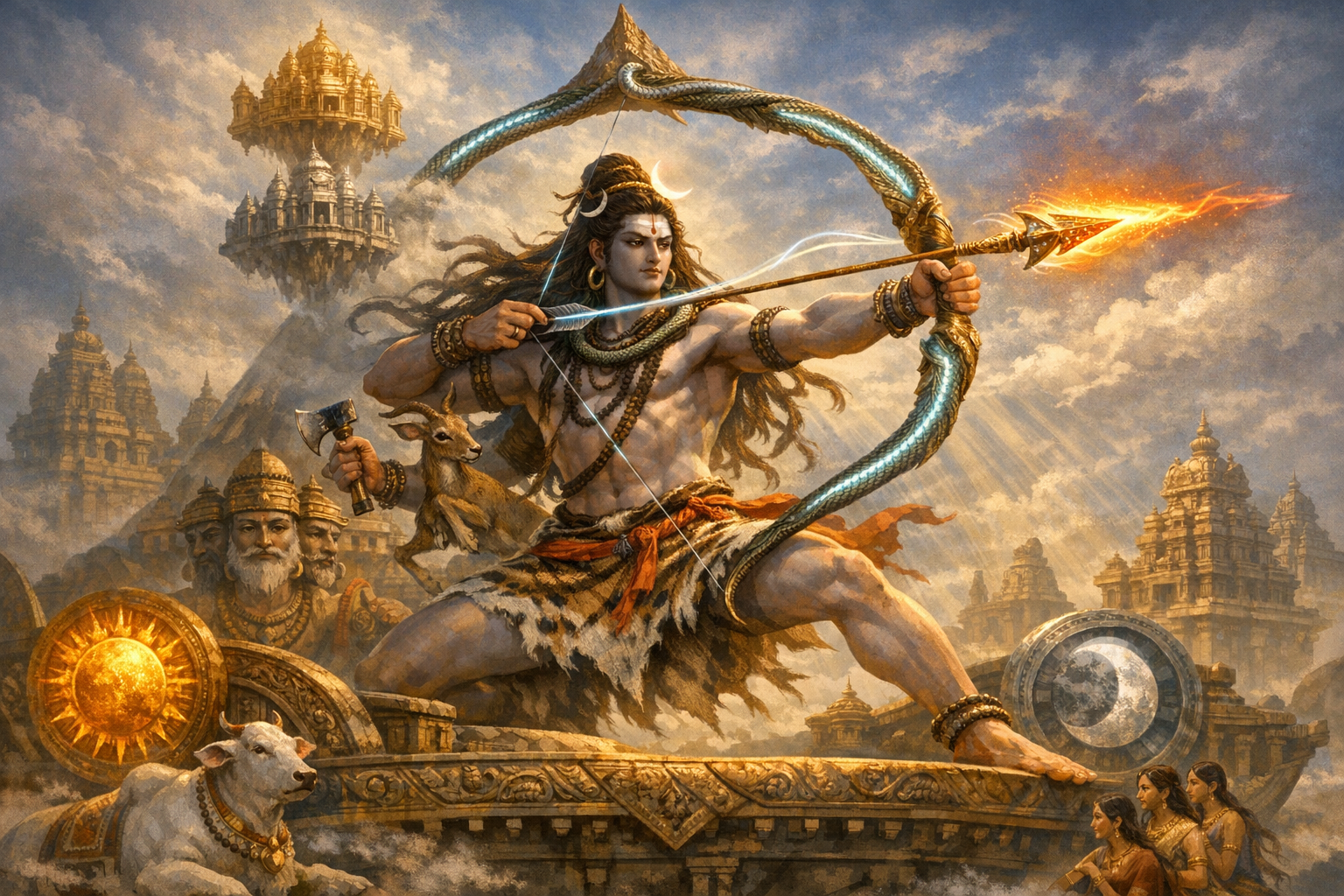
Sacred descriptions intricately recast the cosmos as Shiva’s own armament. In widely transmitted accounts, the earth becomes the chariot, the Sun and Moon the wheels, Brahma the charioteer, Mount Meru the bow, the serpent Vasuki the bowstring, and Vishnu the arrow; the arrowhead is Agni and the fletching Vāyu. While details vary by Purana and Agama, the shared intention is unmistakable: the entirety of existence coheres as the instrument of dharma when wielded by sovereign consciousness.
Murti-lakshana, or the canons of iconographic proportion and attribute, portray Tripurantaka with a resolute archer’s bearing. He is typically shown with two or four arms: the principal pair nock and draw the mighty Pinaka-bow, while the ancillary hands may hold the axe or the antelope. Matted locks arranged as a jata-mukuta, the third eye, a tiger-skin garment at the waist, and serpentine ornaments complete the visual grammar that identifies this as a Shaiva form of heroic resolve.
The stance is most often alidha or pratyalidha, the dynamic archer posture known to the shilpa and natya traditions. Sculptors emphasize a torsional rhythm through the hips and shoulders that compresses time into a lucid instant of release. The result is a palpable sense of imminent motion: the universe itself seems to pause and align, as if waiting on the arc of Shiva’s irrefragable will.
Facial modeling alternates between serene omniscience and concentrated raudra-vira intensity. In South Indian bronzes, the eyes may be lowered in yogic inwardness, while in stone reliefs the gaze is often keen and outriding the bow. The contrast communicates a vital teaching: the stillness of awareness and the force of action are not contraries but complementary modes of the same consciousness.
Parikar elements and attendants frequently enrich the field. Nandi may anchor the base, ganas may flank the scene, and in narrative panels the chariot, the devas, and the disoriented Tripurasuras appear in orchestrated tiers. The best ensembles function as visual commentaries, guiding the eye from cosmological instrument to ethical outcome.
Regional schools introduce distinct variations. In Chola-period bronzes, the lost-wax panchaloha method yields warm, tensile surfaces with delicately chased bowstrings and formidable but balanced anatomies. Hoysala and later Vijayanagara ateliers favor densely carved relief with crisp jewelry and narrative detail, while early medieval Deccan and western Indian temples often emphasize the chariot allegory with confident architectural framing.
Temple art preserves this narrative across the subcontinent. Notable depictions appear at Ellora’s Kailasanatha complex, in Kanchipuram’s Kailasanathar Temple, and in Chola heartland monuments where Tripura Samhara reliefs and bronzes punctuate circumambulatory paths. South Indian shrines associated with Shiva’s heroic exploits, the Ashta Veerattana Kshetras, also sustain ritual and visual memory of this episode.
Agamic texts and manuals of sacred art situate Tripurantaka among Shiva’s iconic emanations, prescribing proportions, mudras, and attributes while allowing room for regional idiom. The Agamas further integrate ritual sequence with visualization, so that the act of darshan converges with meditative recollection of the single arrow that undoes manifold error.
Ritually, Tripurari Purnima, widely observed on Kartika Purnima, remembers Tripura Samhara with dipa offerings and Shiva abhisheka. Processional bronzes, yajnas, and collective recitation of hymns from the Shaiva canon reinforce the ethic of luminous discernment: one decisive, integrated effort grounded in devotion and wisdom overcomes even the most elaborate constructions of ignorance.
Philosophically, the tripartite cities can be read as the three impurities of Shaiva thought anava, karma, and maya or as the triad of bodies, states of consciousness, or gunas. In each lens, multiplicity entrenches limitation, and Shiva’s single arrow represents undivided awareness that penetrates and integrates, rather than fragmenting or suppressing.
Yogic readings align the bow with embodied prana, the string with the polarity of ida and pingala, and the arrow with sushumna’s axial ascent. The moment of release becomes the upsurge of one-pointed concentration that resolves inner dualities. Thus, Tripurantaka is not only a deity to be revered but a contemplative template for practice.
Resonances appear across dharmic traditions in complementary keys. Buddhism identifies three poisons greed, aversion, and delusion whose transformation culminates in liberation; Jain philosophy expounds the tri-ratna of right knowledge, right faith, and right conduct to overcome karmic accretions; Sikh teachings emphasize the dissolution of egoic haumai through remembrance and righteous action. Though doctrinal frameworks differ, the shared aspiration to pierce through compounded ignorance underscores a civilizational unity of purpose.
From an aesthetic standpoint, the murti expertly balances raudra and vira rasa. The terrible is sublimated into the heroic, and that heroism is itself sanctified by composure and grace. Connoisseurs often note how the visual economy of line and volume communicates ethical economy: one arrow; no waste.
Materials and technique are integral to meaning. The panchaloha alloy of South Indian bronzes, ritually enlivened through pranapratishtha, yields images that are both museum masterpieces and living presences in temple processions. In stone, precise undercutting around bow and forearm dramatizes the drawn string, while shallow reliefs convey narrative breadth without sacrificing the focal intensity of the archer.
Viewers frequently report a visceral response when encountering Tripurantaka. The body recognizes the tensile poise of the draw before the mind formulates the doctrine it signifies. That somatic recognition invites inner alignment: breath steadies, attention gathers, and the scene becomes a mirror for one’s own moment of needed clarity.
Reading a Tripura Samhara panel becomes a learned, enriching exercise. Identify the chariot and its cosmic components, trace the alignment of the three cities, locate the devas and the asuras in their respective roles, and return to the archer whose action collapses narrative time into an immediate teaching. Temple art thus functions as an open library of dharma, equally available to devotee, pilgrim, and scholar.
In contemporary spiritual life, Tripurantaka’s lesson is exacting but hopeful. Complex problems may appear to demand complex solutions, yet the tradition counsels an integral act of insight and courage the single arrow that reforms the whole. Whether read as ethical resolve, contemplative one-pointedness, or social harmony grounded in mutual respect among dharmic paths, the image speaks with undiminished relevance.
Textual memory, artistic mastery, ritual performance, and lived reception converge in the Tripurantaka murti. It is at once an idol, an icon of theology, and a contemplative diagram of inner alchemy. In its presence, the tradition suggests that order is restored not by multiplying force but by integrating knowledge, compassion, and disciplined action into one luminous aim.
Ultimately, Tripurantaka affirms the perennial insight shared across India’s spiritual heritage: when awareness becomes whole, fragmentation yields. The three cities fall, and what remains is the clear sky of consciousness in which diverse paths can flourish together in dignity and peace.
Inspired by this post on Hindu Blog.