
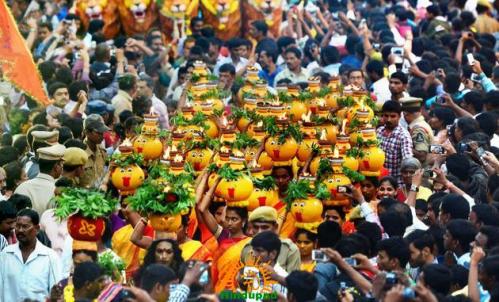
Bonalu 2026 will be observed across Hyderabad, Secunderabad, and other parts of Telangana as a major Shakti-centered Hindu festival dedicated to Goddess Mahankali and related forms of the Mother Goddess. The principal Bonalu 2026 dates are July 19, July 26, August 2, and August 9. Among these observances, the Secunderabad Ujjaini Mahankali Bonalu 2026 date is August 2, a Sunday, and it is expected to draw large numbers of devotees to Sri Ujjaini Mahankali Temple and surrounding localities.
Bonalu Jatara is also known as Mahankali Bonalu Jatara, Mahankali Jathara, Lashkar Bonalu in the Secunderabad context, and Ashada Jatara Utsavalu in devotional usage. It is celebrated during Telugu Ashada Masam, a sacred seasonal period that usually falls in July and August. The festival is most visibly associated with Hyderabad and Secunderabad, yet its devotional reach extends across Telangana through neighborhood temples, family vows, folk processions, and village goddess traditions.
The word Bonam is commonly understood as a form of Bhojanam, meaning a meal or food offering. In ritual practice, Bonam refers to the sacred offering prepared for the Goddess, usually rice cooked with milk and jaggery, placed in a decorated brass or earthen pot, and adorned with turmeric, vermilion, neem leaves, and a lamp. Women carry these pots on their heads with devotion and discipline, creating one of the most recognizable visual forms of Bonalu in Telangana.
At its theological core, Bonalu is a thanksgiving festival. Devotees approach Mahankali as the fierce and protective Mother, the one who guards the community from disease, disorder, fear, and misfortune. The offering is not merely symbolic food; it is a public act of gratitude, a fulfillment of vows, and a recognition that divine protection is experienced collectively through family, neighborhood, temple, and city.
The 2026 sequence follows the traditional pattern in which each Sunday of Ashada Masam becomes significant for different regions and temples in the twin cities. In Hyderabad, Bonalu celebrations are usually associated first with the Jagadamba temple at Golconda Fort, followed by observances at major temples such as Balkampet Yellamma, Ujjaini Mahankali in Secunderabad, and later at Lal Darwaza and other Old City temples. Local temple committees may announce detailed timings for Ghatam, Rangam, processions, and public darshan closer to the festival.
Sri Ujjaini Mahankali Temple in Secunderabad occupies a central place in this calendar. The Secunderabad Bonalu observance is especially important because of its scale, historical memory, and association with Lashkar Bonalu. On August 2, 2026, the Ujjaini Mahankali Bonalu Jathara is expected to become the devotional center of Secunderabad, with devotees offering Bonam, seeking blessings, and participating in the temple-centered rhythm of the festival.
The history of Ujjaini Mahankali worship in Secunderabad is often linked to early nineteenth-century memories of epidemic disease and collective prayer. A widely repeated tradition describes how soldiers connected with Secunderabad prayed to Mahakali at Ujjain during a period of severe illness in the region and vowed to install the Goddess on their return. Whether approached as sacred memory, community history, or devotional inheritance, this narrative explains why Mahankali is remembered as a protector of public health and civic life.
Recent historical discussions have also drawn attention to older evidence for Bonalu-related practices, including references associated with a 1516 CE Telugu inscription from the Vijayanagara period. Such evidence suggests that Bonalu, Rangam, and related ritual forms may belong to a much deeper Telangana folk-religious continuum than the modern urban origin story alone can explain. This layered history is important because it shows how living festivals preserve both memory and adaptation.
Bonalu is therefore not a single temple event but a multi-layered cultural system. It brings together Shakti worship, local goddess traditions, family vows, women-led ritual offering, folk performance, public procession, music, neighborhood participation, and temple administration. In academic terms, the festival can be understood as a living form of urban sacred geography: each temple, street, procession route, and offering pot becomes part of a devotional map of Telangana society.
The role of women is especially significant. The sight of women carrying Bonam on their heads is not ornamental; it expresses disciplined devotion, ritual responsibility, and embodied faith. The decorated pot represents abundance, nourishment, and surrender. The lamp signifies auspicious presence. Turmeric and vermilion convey sacred protection and fertility. Neem leaves are associated with purification and healing. Together, these elements form a compact ritual language through which the devotee approaches the Mother Goddess.
Pothuraju is another central figure in the Bonalu procession. Traditionally regarded as the brother or guardian attendant of Mahankali, Pothuraju leads the procession with energetic movement, ankle bells, turmeric-smeared body, and rhythmic steps to drum beats. His presence is protective and dynamic. He marks the path of the Goddess, energizes the crowd, and represents the festival’s folk intensity, where devotion is expressed through the body as much as through prayer.
Ghatam is also essential to the structure of the festival. A Ghatam is a decorated sacred pot representing the Mother Goddess, carried in procession by a priest or designated temple representative. The Ghatam moves through neighborhoods, allowing the Goddess to be ritually present among the people. The immersion of the Ghatam at the end of the festival marks completion, return, and renewal, much like other Indian processional traditions where divine presence moves outward and then ritually concludes.
Rangam, often performed on the day following the main Bonalu observance, is another important ritual feature. In this practice, a woman believed to be inspired by the Goddess delivers an oracle or devotional message to the gathered community. The practice belongs to the broader religious world of folk Shakti worship, where divine speech, trance, and community concern are woven together. It reflects a form of religious participation that is local, embodied, and deeply trusted by devotees.
For Hyderabad and Secunderabad, Bonalu is also a civic festival. Streets are decorated, temples are illuminated, police and municipal authorities manage public movement, and neighborhoods prepare for large gatherings. Devotees travel from nearby districts and from the wider Telugu diaspora. The atmosphere is festive, but it is also highly structured: darshan lines, offering arrangements, procession routes, and temple schedules all shape the public experience of devotion.
The emotional power of Bonalu lies in its combination of intimacy and scale. A single family may prepare one Bonam in fulfillment of a private vow, yet that offering enters a vast public stream of devotion. The festival allows personal gratitude to become collective worship. This is why many devotees experience Bonalu not only as a calendar event but as an annual return to ancestral memory, neighborhood identity, and the protective presence of Amma.
Bonalu also demonstrates the unity within diverse Hindu traditions. The festival is firmly rooted in Telangana’s regional Shakti worship, yet its themes are widely recognizable across dharmic practice: gratitude, offering, protection, purification, pilgrimage, sacred food, and community duty. The Goddess may be worshipped as Mahankali, Yellamma, Pochamma, Maisamma, Muthyalamma, Peddamma, or Jagadamba, but the devotional impulse remains unified through reverence for the Divine Mother.
From a cultural heritage perspective, Bonalu is a vital archive of Telangana’s folk arts. Drumming, song, dance, decorated offerings, Thottelu structures, Ghatam processions, and Pothuraju performance preserve forms of expression that cannot be reduced to written texts alone. They are transmitted through participation. Children watch elders prepare offerings, families return to temples year after year, and neighborhoods remember routes, songs, and ritual responsibilities across generations.
For those planning to observe Bonalu 2026, the key dates are clear: July 19, July 26, August 2, and August 9. The Secunderabad Ujjaini Mahankali Bonalu falls on August 2, 2026. Devotees should confirm final timings, darshan arrangements, traffic advisories, and specific temple schedules with local temple authorities, especially for Ghatam, Rangam, and major processions, because crowd management and ritual timing can vary by locality.
The most meaningful way to understand Bonalu is to see it as both devotion and social memory. It is a festival of food offering, but also of protection. It is a festival of Goddess worship, but also of women’s ritual leadership. It is a festival of Hyderabad and Secunderabad, but also of Telangana’s long civilizational continuity. In 2026, Mahankali Bonalu Jatara will once again bring together faith, sound, color, discipline, and gratitude in one of South India’s most powerful public celebrations of the Divine Mother.
Inspired by this post on Hindu Pad.






Leave a Reply
You must be logged in to post a comment.