TTD-run Sri Venkateswara Traditional Temple Architecture & Sculpture College, Tirupati, has invited applications for the 2026–2027 academic year. The application window runs from May 04 to June 20. Two program pathways are available: a four-year Diploma and a two-year Certificate. Candidates who have passed Class 10 (SSC) are eligible to apply. Selected students are provided free accommodation in accordance with Tirumala Tirupati Devasthanam (TTD) norms.
This institution occupies a vital place in the ecosystem of heritage education, where Temple Architecture, Hindu Sculptures, and traditional craftsmanship converge under the custodianship of TTD. Its teaching culture sustains living knowledge systems rooted in Sthapatya Veda and Shilpa Shastra and serves the broader dharmic commonsskills learned here are directly applicable to the conservation and construction needs of Hindu temples, as well as to the wider sacred architecture and material heritage of Buddhism, Jainism, and Sikhism. In that sense, the programs cultivate artisans and technicians capable of stewarding shared civilizational assets across India and the diaspora.
The four-year Diploma typically provides comprehensive immersion in traditional design canons and workshop practice. Students progressively move from foundational drawing and geometry to advanced site planning, elevation grammar, structural logic of mandapas and vimanas, and the iconometric standards governing murti-making. The two-year Certificate offers a focused track that orients learners to core tools, materials, drawing literacy, and safe, supervised practice in the carving studio and model-making labs. Both pathways emphasize studio-based learning guided by master sthapatis and silpins, building competence through repetition, critique, and measured fieldwork at historic sites in and around Tirupati.
Training in Temple Architecture involves the language of forms and proportions codified in Shilpa Shastra. Learners encounter modules in vastu mandala layouts and orientation; prastara (coursework of superstructures); tala–mana systems of measurement for icons and architectural members; anga–pratyanga classification in sculptural composition; and the articulation of sacred spaces such as the garbhagriha, antarala, ardha-mandapa, maha-mandapa, gopura, prakara, and dhvaja-stambha. This grammar is reinforced through iterative freehand and instrumented drawing, scale modeling, and measured surveyseach exercise cultivating an intuitive grasp of sacred geometry and proportion.
Sculpture training is anchored in material mastery and iconometry. Students study stone selection and basic geology for heritage contexts, core toolsets (chisels, mallets, pitching tools), roughing and pointing techniques, surface refinement sequences, as well as the ethical standards for murti-making. The canons that inform iconographytala-based measurement systems, canonical mudras, bhavas, and the harmonics of limb relationshipsensure consistency with the textual tradition while allowing room for regional idioms. Exposure to wood carving and traditional joinery is often included to round out skills relevant to temple furniture, rathas (chariots), and ceiling members.
Because the field intersects design, craft, and conservation, the programs introduce methods that heritage practitioners consider essential: documentation through measured drawings and condition mapping; familiarity with lime mortars and traditional plasters; and fundamentals of structural behavior in historic masonry. While advanced laboratory diagnostics are the domain of specialized conservation institutes, a hands-on understanding of compatible materials and repair ethics equips graduates to work productively with temple trusts, conservation architects, and government heritage bodies.
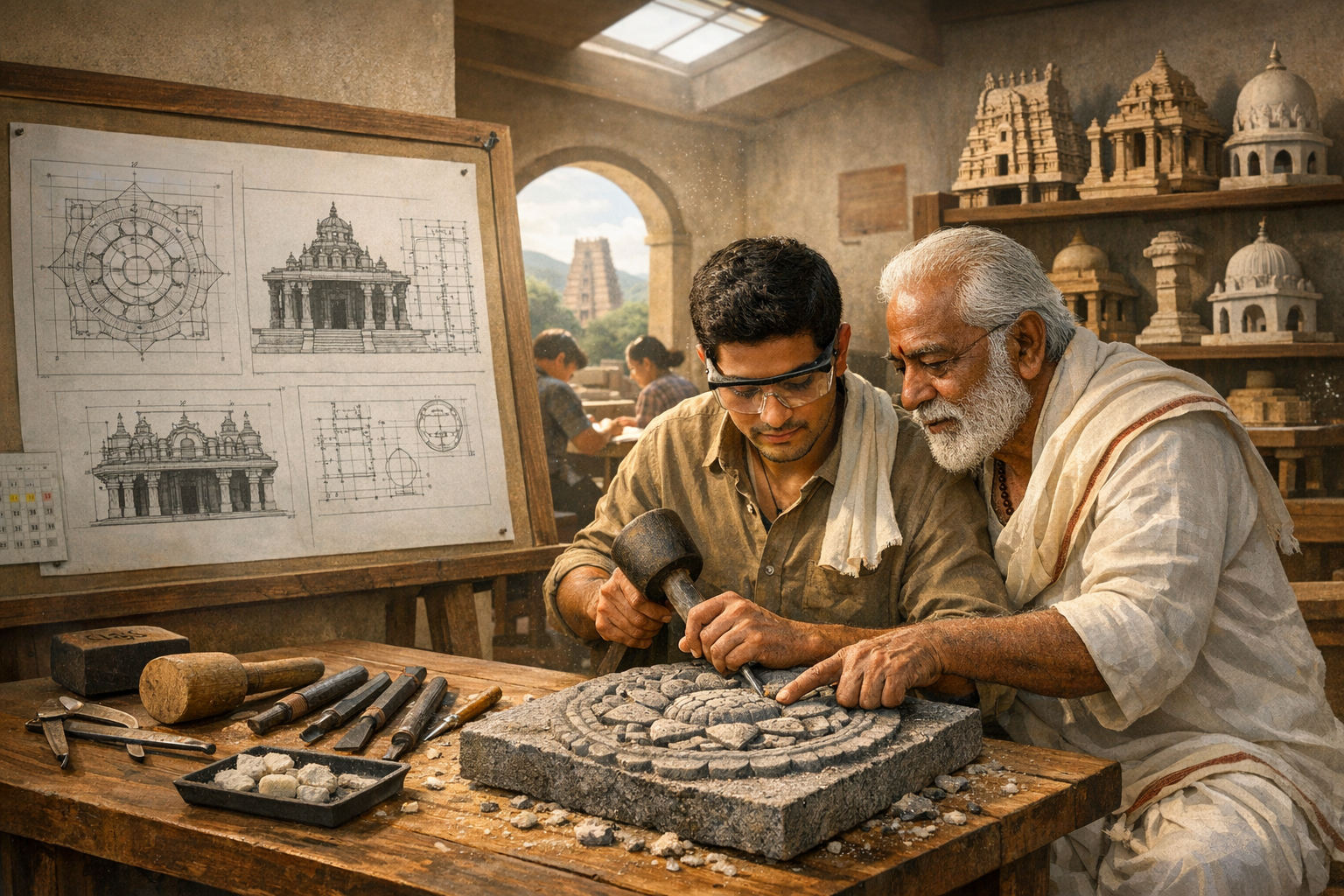
Pedagogy is apprenticeship-led. The workshop becomes a living classroom where design intent, tool control, and material response are learned together. Many cohorts recount that the first successful lotus medallion or yali relief carved under a master’s guidance transforms one’s sense of patience, listening, and humility. Days typically balance drawing, studio carving, and supervised field observation, complemented by readings that reference canonical sources such as the Mayamata, Manasara, and Shilparatna. This rhythm strengthens cognitive, visual, and tactile learningessential for excellence in Temple Construction and heritage restoration.
Eligibility is straightforwardClass 10 (SSC) passyet serious interest and aptitude in drawing, geometry, and hand skills are advantageous. Given the physical demands of stone and wood work, applicants should be comfortable with workshop safety norms and sustained studio practice. Selection and admission procedures follow TTD regulations and may include scrutiny of academic records and aptitude-oriented interaction. Applicants should consult the official TTD notification for the precise process, required documents, and any reservation provisions applicable under current norms.
Key dates for this cycle are unambiguous: applications open on May 04 and close on June 20 for the 2026–2027 intake. Prospective candidates should prepare scanned or attested copies of essential credentials (e.g., SSC certificate, identity proofs, and any category documentation if applicable) and follow the submission instructions specified in the official announcement. Early submission is recommended to allow time for rectifying any documentation queries that can arise during verification.
Student support reflects TTD’s public-service mandate. Selected students are offered free accommodation, easing financial barriers to long-cycle craft education. Access to tools, workshops, and reference collections aligns with the college’s objective of producing practitioners who are work-ready and grounded in textual authority and studio discipline. Medium of instruction typically accommodates regional language usage alongside technical vocabulary from Sanskrit and English, enabling faithful transmission of Shilpa Shastra terminology.
Graduates pursue diverse roles: junior sthapati or sculptor in temple workshops; site artisan within endowment boards; conservation technician with heritage practices; modeler and draughtsperson for architects; or independent craft entrepreneur catering to temple trusts and communities in India and abroad. Because the skillset is fundamentally about stone, wood, lime, and sacred geometry, it translates to conservation tasks across dharmic institutionsnot only in Hindu temples but also in Jain basadis, Buddhist viharas and stupas, and, where appropriate, elements of Sikh gurdwara precinctssupporting the blog’s broader objective of unity and stewardship across shared civilizational traditions.
Applicants can strengthen their candidacy by assembling a simple portfolio: freehand sketches of temple profiles and motifs, measured drawings of brackets or pillars observed at local shrines, and photographs of any prior craft experiments (clay, soapstone, wood). Reviewing fundamentals of Euclidean geometry and proportion, practicing line quality and shading, and visiting nearby heritage sites with a sketchbook sharpen the observational acuity indispensable to Ancient Architecture and architectural history. A respectful familiarity with ritual and liturgical contexts also helps learners understand why certain forms and materials are specified by tradition.
Sustaining temple heritage requires more than sentiment; it demands methodical training, ethical practice, and intergenerational transmission of knowledge. By opening admissions from May 04 to June 20 for its Diploma (4 years) and Certificate (2 years), TTD’s Sri Venkateswara Traditional Temple Architecture & Sculpture College affirms that calling. For candidates seeking a craft-centered education that contributes tangibly to Heritage preservation, this is a timely and meaningful pathway. Prospective students should review the official TTD notification in detail and submit applications within the stated timeline.
Inspired by this post on Hindu Pad.