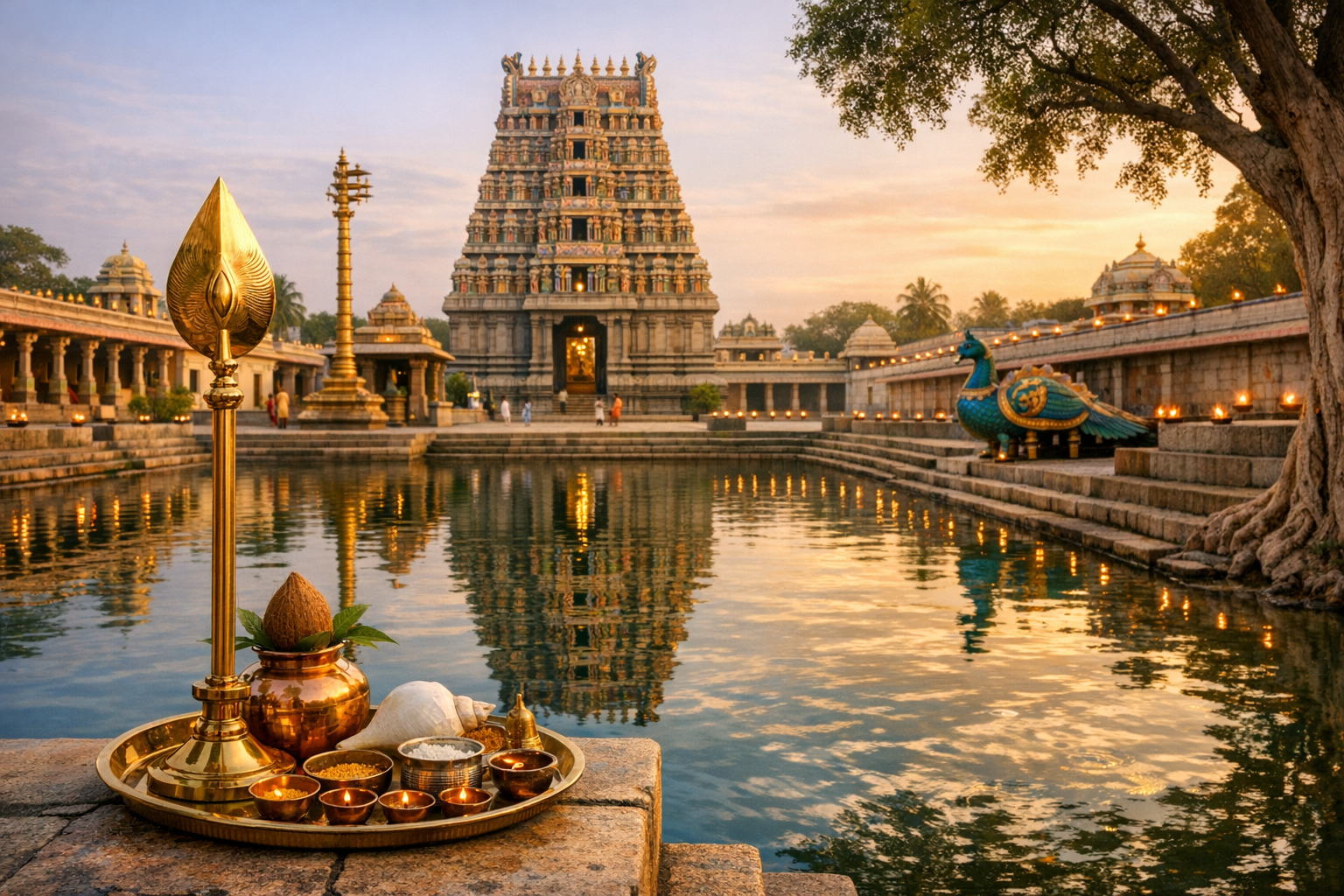
Thiruporur Kandaswamy temple, also known as Thiruporur Murugan Temple, stands as a prominent Dravidian shrine dedicated to Lord Murugan (Skanda, Subrahmanya) in Thiruporur, a panchayat town in Chengalpattu district of Tamil Nadu. As a living center of worship and cultural memory along the Chennai–Mamallapuram corridor, the temple blends deep textual traditions, austere ritual practice, and vibrant public festivals that continue to draw devotees from across India and the wider Tamil diaspora.
Located along Rajiv Gandhi Salai (Old Mahabalipuram Road, OMR), the temple is accessible from Chennai by road and public transport, and it lies within an easy day’s circuit that also includes the UNESCO World Heritage site of Mamallapuram. The temple maintains regular darshan hours from 6:30 am to 12:30 pm and 3:30 pm to 8:00 pm, enabling both morning and evening worship. Footfall peaks on Krithigai nakshatra days, monthly Sashti tithis, and during major Murugan festivals, when devotees plan visits in the early morning for a serene, unhurried experience.
The toponym “Thiruporur” is widely interpreted as the “sacred battlefield,” with local tradition linking the site to episodes in the Skanda Purana that narrate Murugan’s campaign against forces of adharma. This martial-spiritual symbolism is not about violence but about inner conquestvalor in the service of dharma and the disciplined overcoming of ignorancean interpretation that resonates across dharmic philosophies.
Historical memory and stylistic cues suggest a long continuum of worship at the site, with the present complex shaped significantly during a 17th-century revival attributed in local accounts to Chidambara Swamigal. Periodic kumbhabhishekams (consecration renewals) and careful conservation practices have sustained the temple’s ritual integrity and architectural profile, ensuring continuity between textual tradition, community devotion, and physical space.
Iconographically, the moolavar (presiding image) represents Kandaswamy with Valli and Deivayanai, the two divine consorts who embody complementary paths of devotion and wisdom. Murugan’s emblematic Vel symbolizes lucid discernmentthe keen, compassionate intelligence that severs bondage. The peacock vahana, often encountered in processional contexts, signifies the sublimation of pride and the dynamism of spiritual ascent. Together, these motifs form a coherent theological grammar intelligible within Saiva Siddhanta and broader South Indian devotional practice.
Architecturally, the temple exemplifies Dravidian temple architecture: an east-facing sanctum (garbhagriha) linked through an antarala and ardhamandapa to a spacious mahamandapa, and fronted by a multi-tiered rajagopuram that announces sacred presence in the landscape. Granite prakara walls, a dhvajasthambha (flagstaff), and a bali peetha articulate the axial order. A temple tank (theertham) and a venerated sthala-vriksha (sacred tree) anchor the shrine in a sacral ecology where water, stone, and flora participate in the life of worship.
The ritual life of Thiruporur Kandaswamy temple is governed by Agamic norms within the Saiva Siddhanta tradition. Daily worship follows a canonical sequence of purification, abhishekam (ritual bathing), alangaram (adornment), naivedyam (food offering), and deepa aradhana (waving of lamps). The cadence of prayer, bell, and mantra sustains a contemplative atmosphere that is at once intimate and communal, connecting individual supplication to a shared liturgical rhythm.
Four daily pujas punctuate the schedulekalasanthi in the morning, uchikalam at midday, sayaraksha in the evening, and arthajamam at nightproviding multiple windows for darshan and archana. Devotees commonly request special abhishekams with panchamrita (milk, curd, ghee, honey, and sugar), tender coconut water, sandal paste, and sacred ash (vibhuti), each medium articulating layers of symbolic purification and auspiciousness.
In addition to the daily cycle, observances tied to the lunar and stellar calendar infuse the month with spiritual highs. The monthly Sashti (sixth tithi) is particularly significant to Murugan devotees, as are Krithigai nakshatra days. These dates, together with pradosha-linked practices and Saturday evening congregations, create a devotional topography that rewards both planned pilgrimages and spontaneous visits.
The festival calendar is a principal marker of the temple’s cultural vitality. Vaikasi Visakam celebrates the birth-star of Murugan and draws large congregations for special abhishekams and processions. Aadi Krithigai in the monsoon season amplifies the luminous energy of the Krithigai star with lamps, music, and community service.
Skanda Sashti in Aippasi remains the most dramatic public rite, culminating in the Soorasamharam pageant that allegorically reenacts Murugan’s victory over the asura Surapadman. The spectacle is devotional theater in the highest sensean enactment of victory over inner impedimentsfollowed by Thirukalyanam (the celestial wedding), which sacralizes harmony and auspicious union.
Thai Poosam celebrates vow-fulfillment and steadfast devotion. Kavadi-bearing, paal kudam (milk-pot) offerings, and collective chanting of Tiruppugazh hymns create an affective tapestry of bhakti that is deeply personal yet unmistakably communal. Panguni Uthiram, associated with the divine marriage, underscores vows, fidelity, and the ethical foundations of family life, while Karthigai Deepam illuminates the temple and townscape with lamps that signify self-luminous awareness.
Devotional practices at Thiruporur Kandaswamy temple invite a participatory spirituality. The kavadi vow integrates austerity, mindfulness, and service (seva), while archana and pradakshina orient attention toward the sanctum as the axis of meaning. Many families mark life milestones herenaming ceremonies, first offerings after exams or career beginningsbraiding personal narratives into the temple’s longer civilizational story.
Hymnody is central to the experience. The Tiruppugazh corpus of Arunagirinathar, along with compositions such as Kandar Anubhuti, remain touchstones for congregational singing and private recitation. In these verses, Murugan is both commander and compassionate guide, a teacher of inner clarity whose grace is invoked in mellifluous Tamil that bridges classical poetics and contemporary devotion.
As a node in the sacred geography of Murugan worship, Thiruporur complements the more famous Arupadai Veedu circuit while retaining its own distinctive blend of ritual precision and local warmth. Pilgrims often combine their visit with exploration of Mamallapuram’s Pallava-era monuments, experiencing a continuum from sculpted stone narratives to living liturgyan encounter with Indian Cultural Heritage in both museum-quality reliefs and the immediacy of worship.
Seen through a broader dharmic lens, the temple’s ethos of courage, compassion, and discipline resonates across Hinduism, Buddhism, Jainism, and Sikhism. Murugan’s figure is venerated in multiple cultural settingsnotably as Kataragama deviyo in Sri Lankaillustrating how shared values such as ahimsa, tapas (austerity), dana (generosity), and seva (service) nurture unity in diversity. This plural, non-coercive spirituality affirms the freedom to pursue individual paths while honoring a common civilizational commitment to truth and ethical living.
Practical guidance supports a meaningful visit. Modest attire is recommended; photography policies should be confirmed on-site, especially near the sanctum. Those seeking specific pujas or abhishekams may inquire at the temple counters for timings and tickets. Early mornings typically offer calmer queues, while festival days reward advance planning, hydration, and patience as acts of mindful pilgrimage rather than mere logistics.
For many visitors, the temple’s atmosphere communicates a tangible stillness punctuated by the rhythm of bells and lamps. The experience is frequently described as clarifying: prayers offered for courage in adversity, steady insight in decision-making, and well-being for family and community. In this way, Thiruporur Kandaswamy temple remains not only a monument of Temple Architecture but also a compassionate institution of moral and spiritual education in the heart of Tamil Nadu.
In summary, Thiruporur Kandaswamy temple offers a comprehensive encounter with Murugan bhaktirooted in scripture such as the Skanda Purana, enacted through Abhishekam and daily pujas, and made luminous in festivals from Vaikasi Visakam to Karthigai Deepam. The darshan timings (6:30 am–12:30 pm; 3:30 pm–8:00 pm), the four-fold daily ritual cycle, and a calendar of sacred observances provide a clear framework for planning. More profoundly, the temple exemplifies how India’s Cultural Heritage sustains inner resilience and communal harmonyvalues vital to the unity of dharmic traditions.
Inspired by this post on Hindu Pad.