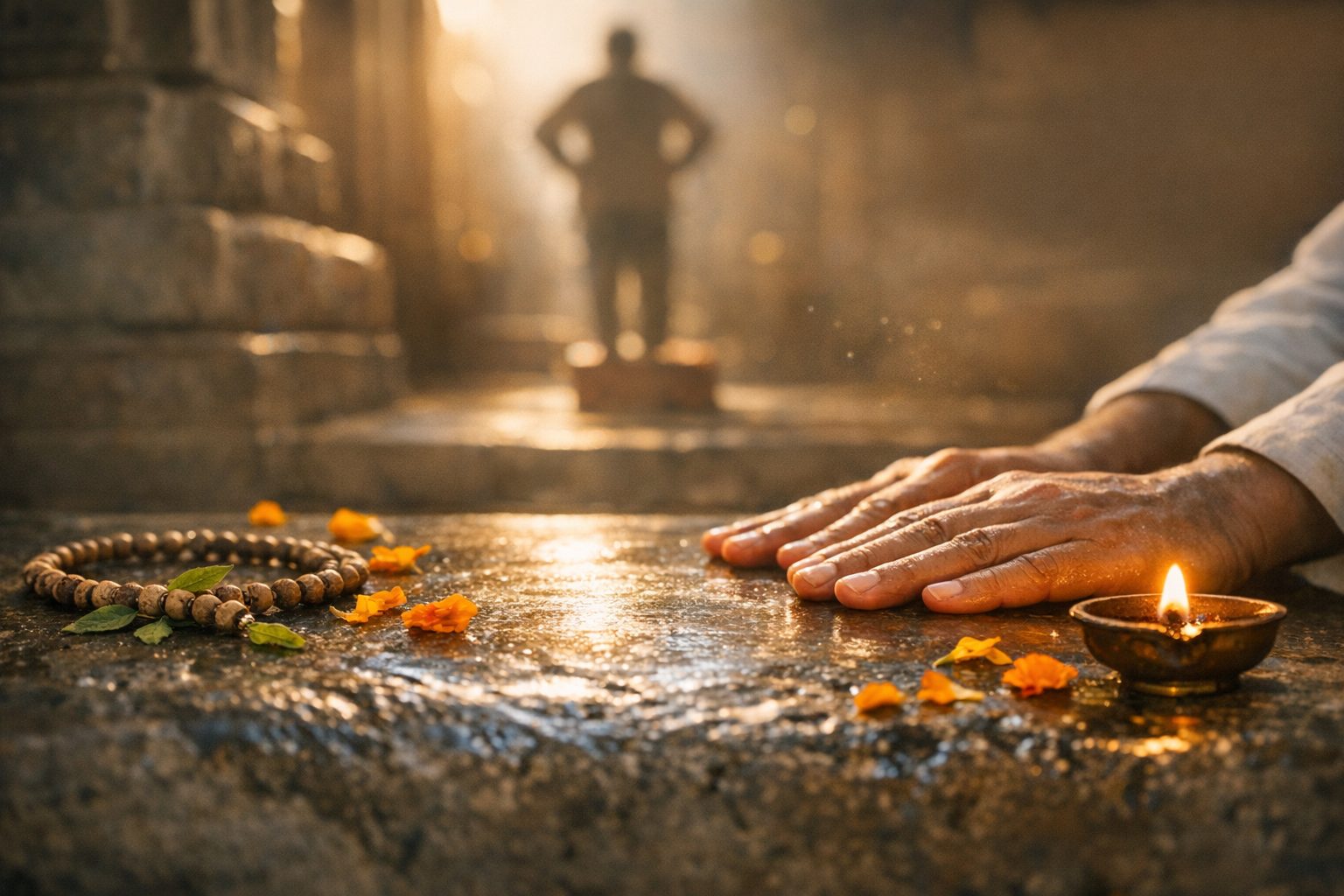
On the crescent bend of the Chandrabhaga (Bhima) River in Maharashtra stands the Vitthal-Rukmini Mandir of Pandharpur, a preeminent center of the Bhakti movement and the spiritual heartland of the Warkari Sampradaya. For millions of pilgrims who undertake the annual journeys on Ashadhi Ekadashi and Kartiki Ekadashi, one stone feature embodies the union of devotion and grace more vividly than any other: Namdev Chi Payari, the blessed first step on the approach to darshan of Lord Vitthal (Vithoba), an incarnation of Lord Vishnu.
Namdev Chi Payari is not merely a structural riser in the temple’s stairway; it is a living symbol in stone that condenses a vast spiritual tradition into a single, conscious act by the pilgrim. As devotees bow to touch the step before ascending toward the garbhagriha, they ritually acknowledge an ancestral teaching: profound humility and steadfast bhakti can soften the boundaries between the human and the divine. In the Warkari ethos, the first touch of this payari is a prelude to darshan, a mindful crossing from the worldly to the sacred.
Hagiographies within the Warkari tradition recount that Sant Namdev’s devotion was so absolute that divine agency reoriented space to honor it, forever sacralizing this threshold. Variants of the oral narrative emphasize different elementssome speak of social rebuff and divine redress; others highlight the Lord’s intimate responsiveness to song (abhang) and surrender. While the exact historical particulars remain in the realm of sacred memory rather than archival record, the shared core of these accounts is consistent: Namdev Chi Payari marks the place where unwavering bhakti met an answering grace from Vitthal, and the temple’s living practice has preserved that moment in perpetuity.
Linguistically and ritually, a payari functions as a limen, a threshold. In Hindu temple architecture, the journey through mandapa, antarala, and into the garbhagriha is choreographed to cue inner transformation. The first step, in this case identified with Sant Namdev, carries the additional valence of moral and spiritual instruction: approach with namrata (humility), offer the mind at the threshold, and let the name of the LordHari-namalead. The step’s worn and polished surface, bearing the trace of countless hands and foreheads, is itself a material archive of collective devotion.
Sant Namdev (often dated to the late 13th–early 14th century) emerged from Maharashtra’s fertile devotional milieu alongside figures such as Dnyaneshwar. A prolific composer of abhang in Marathi, Namdev traveled widely across Bhāratavarsha, carrying the idiom of intimate, personal devotion to the Divine. His spiritual legacy extends beyond regional boundaries: compositions attributed to Namdev appear in the Guru Granth Sahib, the central scripture of Sikhism, affirming a pan-dharmic resonance for core values of humility, remembrance of the Divine Name, and service.
This intertextual presence of Namdev in Sikh scripture is especially significant for understanding Namdev Chi Payari in a broader Dharmic framework. The Warkari discipline of naam-smaran (continuous remembrance of the Divine) finds clear parallels with Sikh simran; both cultivate an interiorization of devotion that dignifies the daily life of lay householders. While doctrinal nuances differ across Hindu, Sikh, Buddhist, and Jain traditions, the shared ethical horizonahimsa, humility, truthfulness, and compassionate serviceunderscores why this step in Pandharpur is remembered not only as an architectural feature but also as a pedagogical one.
The Warkari Sampradaya, centered on Vitthal of Pandharpur, is characterized by disciplined simplicity, communal singing of abhang, collective journeys (dindi) during the palkhi processions, and a strong ethical emphasis on equality and mutual care. The annual palkhis carry the padukas of Sant Dnyaneshwar from Alandi and Sant Tukaram from Dehu to Pandharpur, drawing lakhs of pilgrims across Maharashtra’s roads and fields. In this austere yet joyous culture of song and service, Namdev Chi Payari functions as a shared mnemonic: devotion, not social stratification, is what sanctifies human life.
Pandharpur’s ritual calendar intensifies during Ashadhi Ekadashi (June–July) and Kartiki Ekadashi (Oct–Nov), when the multi-week palkhi yatras culminate in a convergence before Vitthal. The darshan sequence often begins with veneration at Namdev Chi Payari, where pilgrims pause, recite an abhang, and collect their minds before entering deeper into the sanctum’s presence. For many, this practice frames the entire pilgrimage as an inward journey, with the payari as the first conscious step in transforming intention into experience.
Technically, the Vitthal murti within the garbhagriha is iconic: Vithoba stands upright, hands on hips, traditionally upon a brick, with a steady, compassionate gaze toward devotees. The Rukmini shrine, dedicated to the consort of Vitthal, forms part of the temple complex. Architecturally, Pandharpur integrates vernacular elements with classical Hindu temple planning: processional paths (pradakshina), mandapas for congregational kirtan, and thresholds that mark shifts in sacral density. Within this choreography, Namdev Chi Payari is liminal and didactic, inviting a turn from outward busyness to inner quietude.
The story world around the payari also encodes a social argument advanced by the Warkari movement: the primacy of bhakti relativizes rigid hierarchies of status. In community memory, the threshold honors the principle that no external status can outweigh inner sincerity. The practice of touching the step with reverence reiterates, in everyday ritual, a vision of society in which dignity and devotion are accessible to all.
From a philosophical perspective, Namdev Chi Payari dramatizes the dialogue between saguna bhakti (devotion to the Divine with form) and the intuition of the antaryami (the indwelling Divine). The temple offers a visible, relational focusVithoba’s formwhile the step recalls Namdev’s insight that the Lord who receives offerings in the sanctum also listens to the heart’s song at the threshold. Thus, the payari serves as a pedagogical pivot, turning attention from symbol to source, from stone to the living current of remembrance that the symbol activates.
Placed within the wider Dharmic universe, the values embodied here are consonant with Buddhist and Jain emphases on inner purification, ethical restraint, and mindfulness, even as the Warkari path remains distinctly devotional and theistic. The result is not doctrinal homogenization but a family resemblance: diverse traditions recognizing humility, self-discipline, and compassion as indispensable means to spiritual maturation. Namdev Chi Payari, therefore, becomes an emblem of unity-in-diversity within the Dharmic civilizational space.
For contemporary seekers, the enduring lesson is practical. The payari counsels a method: pause at the threshold of every important action, recollect the purpose, and bow inwardly before proceeding. In that brief intersticebetween touch and ascentpilgrims organize their attention, align conduct with conscience, and step forward with clarity. As a micro-ritual of intentionality, the gesture exemplifies how Bhakti seamlessly integrates into daily rhythms without demanding withdrawal from worldly responsibilities.
From the standpoint of heritage conservation, Namdev Chi Payari illustrates how intangible values and tangible artifacts co-produce meaning. The stone has been shaped not only by tools but by centuries of embodied practicekirtan vibrations, devotional touch, tears of gratitude, and the silent weight of prayerful pauses. Protecting such a site entails safeguarding both the material substrate and the living traditionsabhang singing, communal service, and the egalitarian normsthat infuse it with significance.
Pilgrims frequently testify that bowing at the payari softens inner resistance and heightens the quality of darshan. Emotionally, the step has become a place of honest accounting: many bring burdens of guilt, grief, or confusion to this exact stone and experience, in response, a renewed steadiness to continue walking the path. The experience is not presented as spectacle or miracle-seeking but as a disciplined receptivity to grace, consonant with the Warkari ethic of sobriety, seva, and song.
When viewed against the long arc of the Bhakti movementfrom the Marathi abhang tradition to the inclusion of Sant Namdev within the Guru Granth SahibNamdev Chi Payari can be seen as a concise syllabus of Devotion 101. It teaches that the first step is both literal and figurative: touch humility, then rise; remember the Name, then act; regard every threshold as an invitation to inwardness, then proceed into the world with compassion. In that sense, the blessed step at Pandharpur has never been simply about entering a single sanctum; it is about re-entering life transformed.
Pandharpur’s riverine geography, the rhythmic cycles of Ashadhi and Kartiki Ekadashi, the tireless Warkari foot journeys, and the collective recitation of abhang together sustain the step’s meaning across centuries. The continued veneration of Namdev Chi Payari thus represents more than reverence for a saint; it marks the ongoing capacity of Dharmic traditions to cultivate unity without erasing difference, to honor lineage while welcoming all, and to translate timeless values into living, accessible practice.
Today, as seekers from Hindu, Sikh, Jain, and Buddhist backgrounds stand side by side before Vitthal, the step remains what it has always been: a quietly radical threshold where devotion meets dignity, where memory becomes method, and where a simple, conscious touch initiates the ascent toward the presence that the Warkaris lovingly name Vithoba.
Inspired by this post on Hindu Blog.