The widespread belief that genuine Hindu bronze sculptures must be mirror-smooth, perfectly symmetrical, and free of visible marks is historically and technically inaccurate. In the living traditions of Hindu art and culture, as well as in closely allied Buddhist and Jain bronze practices, sacred images forged by lost-wax casting in panchaloha rarely emerge without minor surface variations. These subtleties are not defects; they are faithful records of process, devotion, and time—signatures of authenticity embedded in cultural heritage.
At the core of this truth lies the lost-wax (cire perdue) method. A unique wax model is hand-sculpted over a clay or organic core, fitted with channels (sprues and vents), and carefully invested in successive clay layers. When the mold is heated, the wax drains away, and molten metal—often a panchaloha alloy—is poured into the resulting cavity. Once the mold is broken, the bronze that emerges is singular; there is no second casting from the same wax. Authentic Hindu sculptures, especially those from the Chola Dynasty and later lineages, therefore carry subtle asymmetries and traces of their making.
The lost-wax pathway naturally produces characteristic surface phenomena. Sprues and risers leave faint scars where they were cut and cold-worked. Gas porosity may yield minute pinholes. Metal flow can create thin undulations or a soft orange-peel texture. Chasing, filing, and scraping to refine features after casting introduce fine tool marks—often visible on the reverse, beneath jewelry, or inside recesses. These quiet inscriptions of technique are the grammar of bronze workmanship, not indicators of negligence.
Material science further explains why idealized flawlessness is rare. Panchaloha, revered in Hindu sculptures, is not a single fixed recipe but a family of copper-based alloys historically including varying proportions of tin, zinc, and lead, with occasional traces of noble metals such as gold or silver depending on region and period. Ashtadhatu compositions also vary in textual and workshop traditions. These compositional differences influence casting fluidity, shrinkage behavior, and patination. Even within a single workshop, micro-variations in alloy batches and melt temperatures can produce subtle surface diversity—hallmarks that specialists recognize in ancient artifacts.
What are often labeled imperfections are, on close reading, expected outcomes of a complex transformation from wax to metal. Shrinkage cavities may occur in thicker zones without adequate risering. Cold shuts can present as faint, sinuous lines where metal fronts met but did not fully fuse. Small voids from gas entrapment manifest as pinpricks. In traditionally made bronzes, these occurrences fall within normal bounds and are typically stabilized or visually integrated during post-cast finishing.
Evidence of chasing and finishing, essential to the sculptural idiom, is another authenticity marker. Cross-hatching from small chisels, parallel striations from files, or subtle abrasion from abrasives often persist in sheltered areas, especially behind the halo of a Shiva Nataraja, under the arms, or beneath necklaces and girdles. Historical bronzes do not bear high-speed rotary buffing traces typical of many modern reproductions; nor do they exhibit the mechanically uniform symmetry that machine-assisted processes imprint.
Slight asymmetry is not merely tolerable; it is intrinsic to hand-modeled wax iconography. The tribhanga stance, the swing of an anklet, or the tilt of a crown narrate movement and rasa. In the canonical Somaskanda group, for example, the tender relational choreography between Uma, Skanda, and Shiva emerges from nuanced, non-mirror gestures. Such vitality would be diminished by over-insistence on geometric exactitude at the expense of bhava.
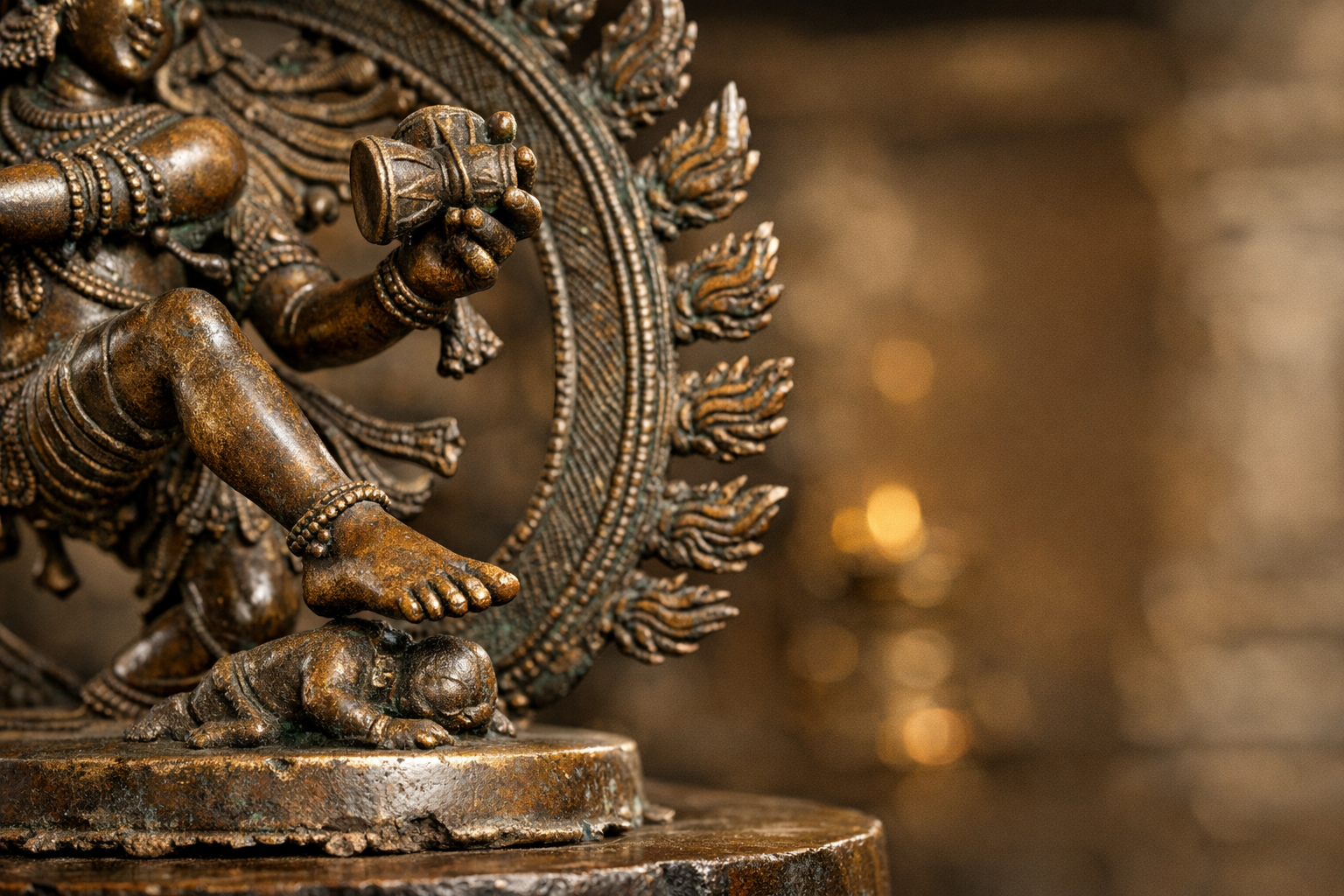
Attachments also reveal careful, time-honored practice. Ornaments, weapons, and attributes—such as the damaru or the flame of a Nataraja—were frequently cast separately and mechanically joined by rivets, tenons, or solder. The resulting junctions can leave inconspicuous seams or tiny peened areas. These are constructive details, not disqualifiers.
Larger images were often hollow-cast. Core supports (chaplets) used to stabilize the internal core can leave minute circular marks or internal traces accessible through the base. Flakes of core material sometimes persist within inaccessible cavities. On the underside of pedestals, vestiges of gating and finishing are common; their absence, coupled with an overly pristine base, can sometimes signal later over-restoration or reproduction.
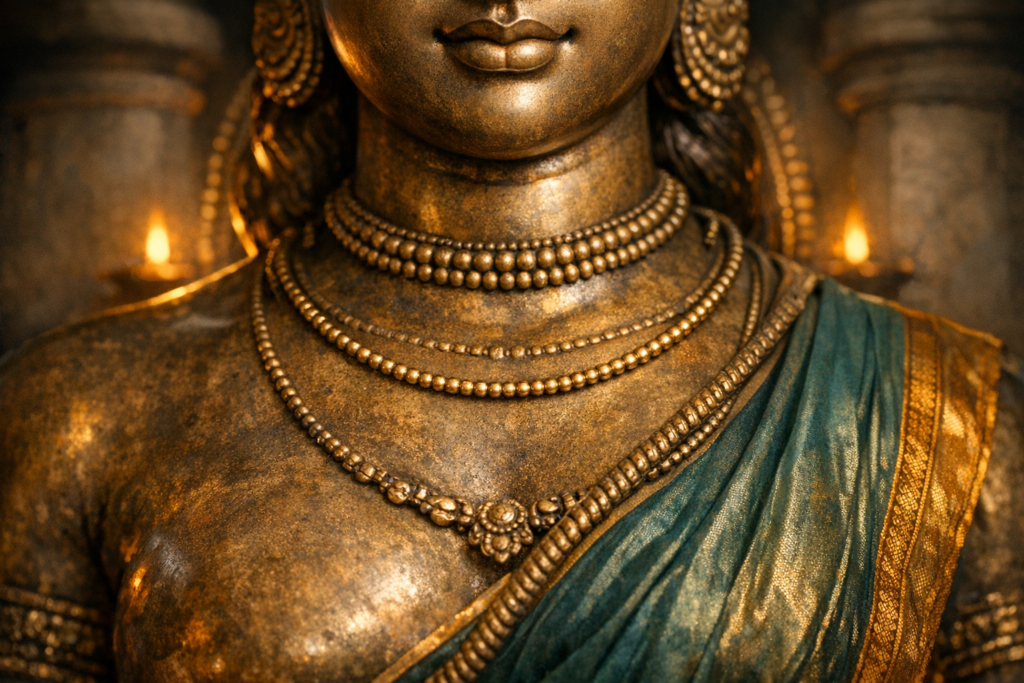
Patina development is another chapter in the sculpture’s biography. In temple contexts, oils, ghee, sandalwood paste, kumkum, and abhishekam waters chemically and physically modify the surface. Honest ritual wear appears as softness and sheen on protruding high points like the toes or fingertips—areas frequently touched during darshana. Soot from lamps and incense can accumulate in recesses. Green or brown-black patinas, variegated rather than uniform, typically reflect long devotional life rather than neglect.
Utsava murtis—processional images—lead especially active liturgical lives. Processions, seasonal festivals, and frequent adornment can leave microscopic abrasions, tiny dents, or ring-shaped marks from jewelry. Textiles and garlands polish some surfaces and protect others, creating differential luster. None of this diminishes sanctity; it documents the sculpture’s service to the community, its role in shared spiritual experience across generations.
Iconometric rigor remains fundamental, and the Shilpa Shastra literature maintains tala-based proportional canons transmitted across schools. Yet these treatises also emphasize expressiveness and auspiciousness, not sterile regularity. The goal is alignment of form with principle—lakshana with bhava—where prana-pratishtha imbues the icon with presence. In that light, small variations within the canons are not violations but humane adaptations.
From an aesthetic-philosophical vantage, darshana and rasa encourage a receptive gaze. The sculpture’s slight irregularities foster intimacy and immediacy, qualities aligned with the living nature of Hindu sculptures. Such qualities unite dharmic visual cultures: Buddhist and Jain bronzes from Kashmir, Pala-Sena Bengal, Odisha, and the Newar ateliers of the Kathmandu Valley bear comparable lost-wax traces, patination histories, and toolwork. Even where Sikh practice maintains a distinct relationship to images, reverence for sacred metalwork, emblems, and arms sustains a shared value: integrity of craft and memory.
Common market misconceptions call for careful correction. Excessively smooth, mirror-like surfaces across all planes, including deep recesses, often indicate modern machine polishing. Perfect bilateral symmetry, uniform pore distributions, or identical repeated details can point to industrial molds or CNC-derived patterns. Artificial patination may appear as flat, monotone color without the nuanced gradients produced by decades of ritual handling and environmental exposure. Visible two-part mold seams that run straight and uninterrupted over complex topology are further warning signs of mass reproduction.
Scientific tools can assist, but they do not replace connoisseurship. Non-destructive techniques such as X-ray fluorescence (XRF) often reveal panchaloha variability, including the presence of lead and tin consistent with historical practice, while also detecting anachronistic elements introduced by modern alloys. Radiography can image internal cores, chaplets, and gating geometries. These data should be interpreted in tandem with stylistic analysis, iconometric study, and contextual provenance.
Conservation ethics favor minimal intervention. Over-cleaning removes ritually accrued patinas and historically meaningful residues. Abrasive polishing to achieve commercial shine erases tool marks and micro-topography that carry essential evidence for dating and workshop attribution. Museums and temples increasingly adopt reversible, gentle methods that stabilize the metal while preserving the sculpture’s devotional biography.
Temple architecture considerations also appear on the underside and base. Tang holes, mortise remnants, or witness marks from vahana fittings provide clues to an icon’s original architectural or processional setting. These pragmatic traces, consistent with the practices of temple construction and ritual logistics, strengthen the case for authenticity and illuminate how the sculpture interacted with its sacred environment.
Those who have stood before a venerable Shiva Nataraja notice the soft burnish on the dancing foot, the fine chisel bites beneath the prabhamandala, and the faintly repaired cut where a sprue once rose. Rather than diminishing the image, these details draw viewers closer to a tangible lineage—the long arc from wax model to molten pour, from workshop to sanctum, from festival night to quiet dawn arati.
For collectors, curators, and devotees seeking to recognize true workmanship: look for signs of lost-wax individuality; harmonious but not rigid symmetry; nuanced, non-uniform patina; discreet tool marks in sheltered zones; credible sprue or join scars; wear at naturally handled high points; and contextually plausible iconometry. Treat perfect uniformity with suspicion, and be wary of surfaces that appear recently abraded or chemically standardized.
Across Hinduism, Buddhism, and Jainism—and with respect for Sikh heritage’s own sacred metalwork—the shared values of sincerity in craft, lived ritual, and ethical preservation converge. Imperfection is not the opposite of excellence; it is the visible record of human skill serving transcendence. In that convergence lies a unifying dharmic insight: sacred art is alive, and its vitality is written in textures that time and devotion alone can author.
Authentic Hindu bronze sculptures are never flawlessly uniform because they are not industrial products; they are consecrated presences shaped by hand, alloy, fire, and faith. Their subtle irregularities invite deeper seeing, informed care, and solidarity across dharmic traditions in safeguarding South Asia’s invaluable cultural heritage.
Inspired by this post on Hindu Blog.