
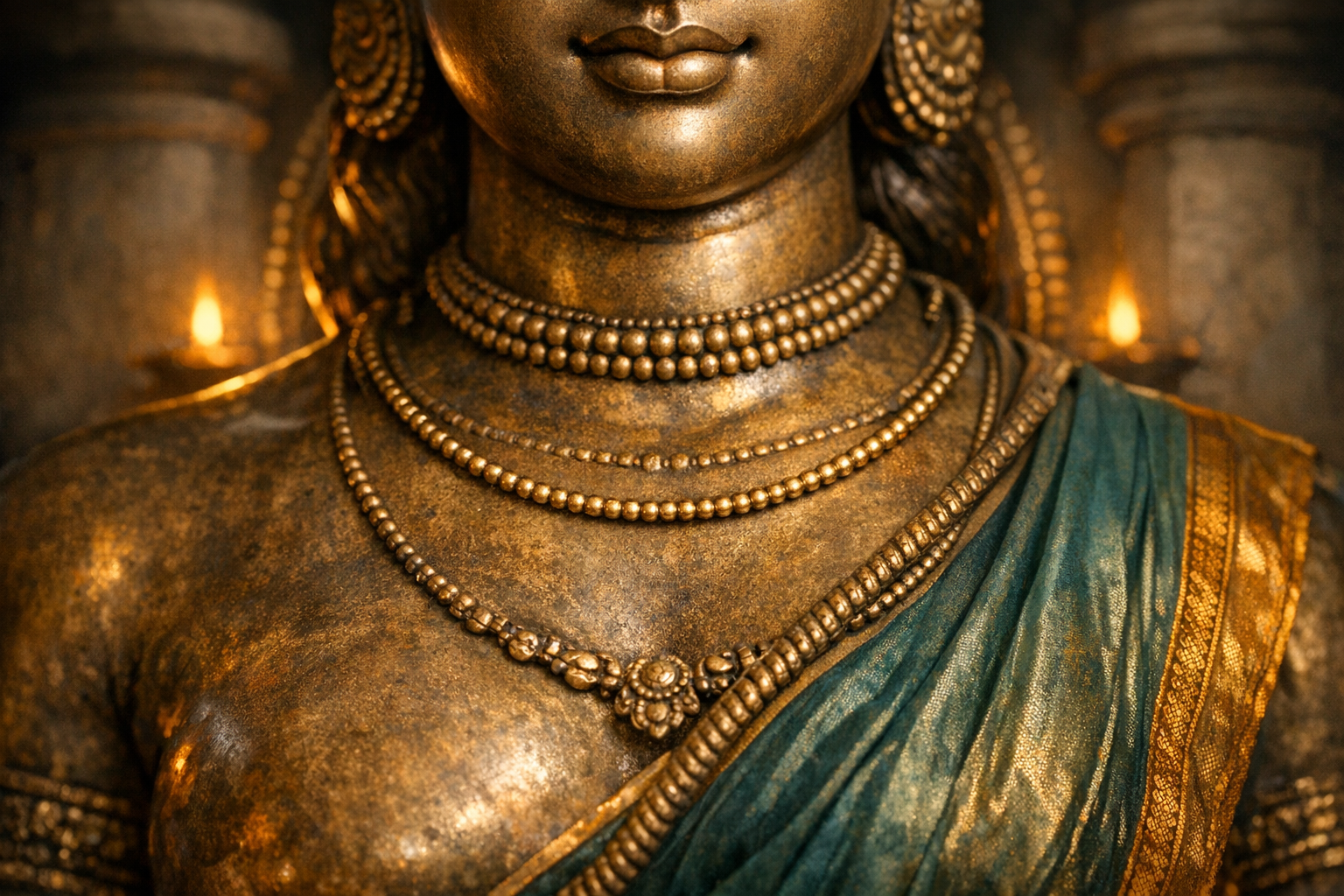
Across the sanctums of Hindu temples, in luminous Chola bronzes and chiselled stone reliefs alike, one ornament appears with quiet consistency and profound effect: the Ekavali. Literally meaning a “single strand,” Ekavali denotes an unbroken necklace worn close to the throat, without layering or interruption. In the visual grammar of Hindu iconography, this minimal form does more than decorate; it establishes an axial line of serenity at the neck, anchoring the figure’s presence and directing attention to the seat of speech and mantra.
Etymologically derived from Sanskrit (eka, one + āvali/āvalī, row or string), Ekavali is referenced in classical lexica and elaborated by the wider śilpa (artisanal) tradition that informs Agama-based temple practice. Textual canons dealing with image-making and consecrationoften summarized under Shilpa Shastras and the ritual chapters of the Agamasclassify necklaces by count, length, and function: kaṇṭhī (short choker), hāra (longer chain), muktā-mālā (string of pearls), vana-mālā (flower garland), and among these, the Ekavali as the elemental, single-row necklace. Its simplicity forms the baseline from which other layers rise.
Formally, an Ekavali rests high on the chest, often spanning the clavicles and skimming the suprasternal notch. In sculpture, it appears as a continuous, fine bandsometimes beaded, sometimes smoothrarely carrying a pendant and never branching into multiple loops. On bronze icons, the strand may be modelled as a gently raised rib, its continuity emphasized by surface polish; on stone, it is cut in low relief with regular beading or a clean, ribbon-like contour. Metal Ekavalis in ritual alankara (adornment) typically employ gold or silver wire, seed pearls, coral, or rudrākṣa seeds; in some regions, navaratna (nine-gem) single rows occur as ceremonial variants.
Within the structured layering of Hindu image adornment, Ekavali occupies a precise locus. The short kaṇṭhī hugs the neck; the Ekavali sets a quiet perimeter just below; longer hāras descend over the sternum; and garlands such as the vana-mālā extend further to the navel. The yajnopavita (sacred thread) crosses diagonally and is categorically distinct. This stratified schemeshort-to-long, inner-to-outercreates legible bands of meaning and rhythm on the divine body, with the Ekavali functioning as a visual hinge between the intimate throat zone and the more public, performative drape of longer necklaces and garlands.
Deity-specific conventions clarify this role. Vishnuic icons, for example, pair the characteristic vana-mālā with one or two short strands at the neck, of which the Ekavali is the most restrained; Shaiva images, including Shiva Nataraja, often juxtapose the ascetic texture of rudrākṣa with a smooth single strand to signify the reconciliation of austerity and auspiciousness; Śākta depictions employ Ekavali to sharpen the line of the collarbone beneath the more elaborate hāras and keyūra (armlets). In Somaskanda bronzes of the Chola period, the Ekavali’s unbroken arc visually stabilizes the trio’s compositional center. The strand’s economy of form thus becomes integral to the overall balance of the icon.
Regionally and historically, the Ekavali is both stable and stylistically adaptive. Gupta–Sarnath sculptures (5th–6th century) tend toward a sleek, almost abstract single band that complements the era’s idealized anatomy; Mathura productions show a slightly more tactile beading. In Pāla–Sena Bengal and Bihar (8th–12th century), the single strand often thickens and alternates bead sizes, echoing regional taste for luscious surface pattern. South Indian developments under the Pallavas and, later, the Cholas elevate the Ekavali within a sophisticated system of layered ornaments, pairing it with the long, delicately modelled hāras characteristic of Tamil bronzes. Subsequent Hoysala, Kakatiya, and Vijayanagara idioms multiply surface detail without discarding the foundational single-strand line.
The Chola bronze corpus (11th–12th century), renowned for masterful cire perdue (lost-wax) casting, offers textbook clarity. Shiva Nataraja exemplars typically carry a short kaṇṭhī, an Ekavali defining the throat-chest threshold, and one or more hāras; none interferes with the oscillating geometry of limbs and aureole. The Ekavali’s contour echoes the curving line of the lower jaw and collarbones, subtly amplifying the dynamic s-curve that animates the form. On high-tin bronze alloys, the polished strand catches light decisively, creating a luminous band at the level of vāṇī (speech) and mantraan intentional optical emphasis in ritual lamplight.
Ritual use confirms the strand’s primacy. In Agamic alankara, priests dress the murti in a graded sequence: bathing and unction (abhisheka), vesting (vastra), then ornaments (ābharaṇa). The first necklace at the throat is commonly a single strand, establishing the sanctified boundary at the viśuddha (throat) center before additional layers are added for daily, weekly, or festival-specific adornments. The Ekavali’s placement is therefore not incidental; it is a liturgical marker that frames the locus of mantra-recitation and the icon’s communicative power.
Symbolically, the Ekavali condenses three interrelated ideas. First, ekatva (oneness): a single, unbroken line that intimates the indivisibility of ātman and Brahman. Second, akhaṇḍatā (integrity): continuity without interruption, suggesting the vow-like circle of dharma and ethical speech. Third, śabda–mantra (sacral sound): the encirclement of the neckthe seat of voiceby a pure, minimal form connotes disciplined utterance. These resonances are neither sect-specific nor time-bound; they recur wherever the ritual imagination converges on the power of a contained, continuous form.
Pan-dharmic visual culture reinforces this unity. Buddhist bodhisattva imagery at Ajanta and later Pāla sites often includes a single, high strand among layered necklaces, using the same formal logic of near–far ornament bands. Jain visuality, while reserving austere non-ornamentation for Tirthankaras, assigns rich but ordered jewelry to Yakṣa–Yakṣi attendants, where a single row at the throat commonly anchors more elaborate hāras. In Sikh practice, the remembrance string (mālā) in simran similarly embodies continuity and focus, even though Sikh tradition does not employ murti-pūjā. Across Hinduism, Buddhism, Jainism, and Sikhism, the unbroken strand thus emerges as a shared metaphor of attention, truthfulness, and inward cohesion.
Materials and techniques broaden the Ekavali’s reach from stone and bronze to living ritual jewelry. Goldsmiths fashion single rows in hammered sheet, twisted wire, granulated beads, or strung pearls; South Asian ateliers also produce kundan–polki Ekavalis with singular, bezel-set diamonds placed rhythmically along the line. Regional preferences range from muktā (pearl) and pravāla (coral) in coastal zones to rudrākṣa or tulasī beads in Vaishnava milieus, all honoring the same single-line principle. The durability of the type lies in its structural clarity: a stable base layer that never visually competes with, yet always completes, the ensemble.
For curators, conservators, and students of iconography, correct identification of the Ekavali avoids common misreadings. It should not be conflated with the yajnopavita (a diagonal sacred thread), the naga-hāra (serpentine motifs with head terminals), or the vana-mālā (floral garland). On weathered stone, an Ekavali may survive only as a faint ridge above the sternum; in bronzes, repeated ritual cleaning can soften beading into a smooth band. Three practical cues assist field recognition: proximity to the throat (never mid-chest), complete and even continuity (no pendant break), and consistent gauge (minimal taper from side to center).
Chronological nuance further refines reading. Gupta–Sarnath Ekavalis privilege linear elegance; Pāla–Sena versions relish tactile bead rhythm; Chola bronzes seek luminous optical presence within dance-inflected compositions; Hoysala stone favors micro-carved granulation that retains the single-strand logic despite overall intricacy. Odisha’s medieval sculpture often sets the Ekavali as a crisp band that mediates between the prominent grīva (neck mouldings) and the cascade of longer hāras characteristic of Kalinga ateliers.
Contemporary practice preserves and adapts the type. The Ekavali remains a staple in South Asian jewelrya single-row pearl choker, a line of polki diamonds, or a tulasī kaṇṭhī for daily wearchosen precisely for its clarity and restraint. In temple alankara, the first necklace placed after abhisheka is often a plain single strand, to which festival-specific jewels are then added. Designers consciously cite Chola and Vijayanagara aesthetics by combining an Ekavali with a mid-length hāra, echoing canonical temple sculpture while meeting modern tastes for minimalism.
At the level of sacred aesthetics, the Ekavali’s deepest achievement is to consecrate simplicity. A single, continuous form quiets visual noise, frames the field of mantra, and discloses the theological poise central to Hindu sacred art. Its recurrence across regions and periodsshared in principle with allied strands in Buddhist, Jain, and Sikh traditionsaffirms a civilizational preference for clarity at the source of speech and remembrance. In the stillness of that unbroken line, the multiplicity of ornament finds its calm center.
Inspired by this post on Hindu Blog.
