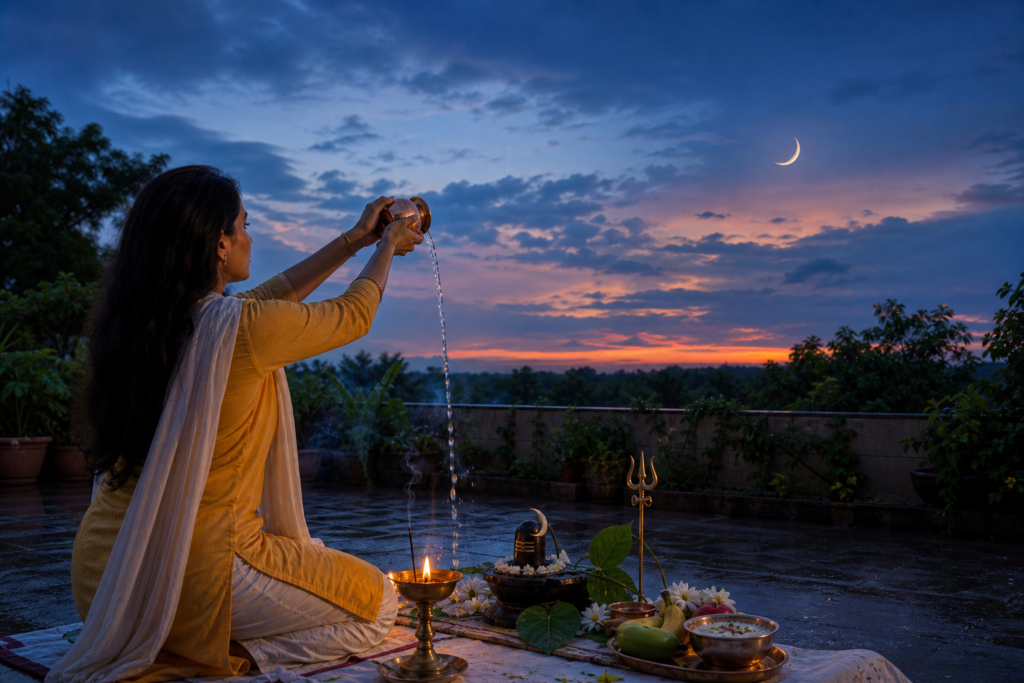
Mannarasala Sree Nagaraja Temple in Haripad, Alappuzha (Kerala) stands at the intersection of puranic memory, sacred ecology, and living ritual. Revered as one of India’s foremost centers of serpent worship, the grove-like temple complex preserves an unusually intimate covenant between humans, land, and the Naga deities. Local tradition links its spiritual genesis to the Khandava forest burning (Khandava-daha) narrated in the Mahabharata, framing Mannarasala as a place where destruction in epic time is ritually answered by care, regeneration, and balance in historical time.
The site is distinguished by a dense canopy, winding pathways, and tens of thousands of stone serpent icons that transform the precinct into a living sarpa kavu (sacred serpent grove). Two presiding deitiesNagaraja and Sarpayakshianchor the temple’s spiritual life. A distinctive feature of Mannarasala is the hereditary leadership of a senior priestess known widely as Mannarasala Amma, whose presence symbolizes a nurturing, protective stewardship aligned with the ethos of the grove.
The name Mannarasala is often parsed locally through a Malayalam–Sanskrit lens: mannan (Malayalam, “king”) and śāla/shala (Sanskrit, “hall,” “abode,” or by extension “grove”). In this reading, Mannarasala can be glossed as “the king’s grove,” understood in its sthala-purana as the abode of the Serpent King (Nagaraja). Alternative folk etymologiessome drawing on mannu (soil/earth) or regional toponymsalso circulate, underscoring the way place-names in Kerala encode both language history and ritual function. While philological certainty remains elusive, the recurrent association with “king” coheres strongly with the temple’s identity as the grove of the Naga-rāja.
Kerala’s broader tradition of sarpa kavu contextualizes the temple’s living ecology. Across homesteads and village margins, families historically maintained small woodland patches for the Nagas, performing periodic rites such as noorum palum (a rice-flour and milk offering) to safeguard fertility, water, soil, and health. Mannarasala represents this model at sacred scale, where the grove is both shrine and biodiverse sanctuary, integrating land care with worship.
According to local narratives, the origins of Mannarasala are entwined with the trauma and aftermath of the Khandava-daha. After the burning of the Khandava forest, displaced serpentsrepresentatives of a larger ecological disruptionare remembered as seeking refuge in the cool, humid littoral of the southwest coast. In this memory-map, Kerala emerges as a hospitable zone of reconciliation, where a renewed pact between humans and Nagas restores the principles of harmony, fertility, and protection.
The Mahabharata’s Adi Parva situates the Khandava-daha within a complex web of cosmic and social motives. Agni, seeking to regain strength, must consume the Khandava forest; Indra, allied with Takshaka (the Naga king), resists; Krishna and Arjuna enable Agni’s consumption of the forest despite repeated divine interventions. Some creatures escapemost famously Asvasena, the son of Takshakacreating a lingering thread that later surfaces in the Kurukshetra War. For many readers, the episode functions as an allegory of civilizational expansion and its ecological costs, a theme that later ritual traditions recast into practices of atonement and ecological guardianship.
Mannarasala’s memory work makes that rebalancing tangible. The grove becomes a spatial response to epic firewhere serpents are no longer adversaries but guardians; where the human community assumes covenantal obligations of care, and where the Nagas are honored as protectors of water, soil, lineage, and life. In this interpretive arc, the epic’s moral complexity is not dismissed but integrated, guiding the community toward reciprocity with nature.
A parallel origin legend cherished at Mannarasala tells of a pious, childless Brahmin couple whose austerities to the serpent deities culminate in a miraculous birth: a radiant, five-hooded serpent child. At the child’s behest, a consecration is performed in the grove; the serpent son withdraws to a subterranean chamber (nilavara), promising to protect the household and the land. From this narrative springs the unique office of the temple’s priestessthe Mannarasala Ammawhose maternal guardianship extends to all who seek the grove’s healing and blessings.
The presiding Nagaraja at Mannarasala is venerated as a syncretic presence embodying aspects of Ananta (Sesha), Vasuki, and related Naga forms honored across Sanskritic and regional traditions. Sarpayakshi complements this kingship with a fierce and benevolent maternal dimension. Together they reflect a theological grammar wherein serpent deities mediate between under-soil waters and surface fertility, between ancestral memory and present wellbeing.
Ritual life at Mannarasala is rich and precise. Noorum palum offerings sustain a rhythm of propitiation aligned with the agricultural and monsoonal cycles. Aayilyamthe day marked by the star Ayilyam (Aslesha)is observed with great fervor, with processions through the grove and specialized serpent rites. Votive practices such as uruli kamazhthalplacing an inverted bronze vessel (uruli) in the precincts as a fertility vow and righting it upon fulfillmentare intimately tied to household hopes for progeny, health, and prosperity.
Liturgical observances also draw from Kerala’s tantra and from domestic sarpa rituals such as sarpa bali and sarpam thullal in the wider region, bringing together community participation, priestly liturgy, and the sensory power of the grove itself. The authority of the Mannarasala Amma, supported by ritual specialists for specific tantric components, illustrates a gendered guardianship consonant with Kerala’s long-standing recognition of women as custodians of household shrines and lineal well-being.
Ecologically, the grove is a biocultural refuge. Its multi-strata canopy, leaf litter, and seasonal moisture regimes create niches for herpetofauna, birds, pollinators, and medicinal flora. The very offeringsmilk, rice pastes, turmericinteract with soil microbiomes and insect cycles, embedding devotion within nutrient and water dynamics. In this way, serpent worship and biodiversity conservation are not parallel endeavors but mutually reinforcing expressions of a single sacred geography.
The architecture of Mannarasala mirrors Kerala’s wooden and laterite idioms: a sree-kovil (sanctum) enfolded by shaded paths; shrinelets studded with serpent icons; and the ancestral illam where the Mannarasala Amma presides. The famed nilavara, associated with the serpent child of the legend, remains a potent symbol of unseen, protective depthof waters under earth, of ancestry under history.
Reliable epigraphic anchors for an early historical date are sparse, a common condition for grove-temples across the subcontinent. Stylistic features, textual allusions, and oral history indicate a medieval maturation over an older cultic substrate. In this, Mannarasala exemplifies how local sthala-puranas translate pan-Indic mythsespecially from the Mahabharata and the Puranasinto place-bound ritual ecosystems.
Serpent symbolism resonates across Dharmic traditions, underscoring a shared civilizational vocabulary. In Buddhism, the Naga Mucalinda shelters the meditating Buddha, while Nagas serve as guardians of sacred teachings in later narratives about transmission (e.g., traditions attributing the Prajnaparamita’s custodianship to the Nagas). In Jainism, Dharanendra protects the Tirthankara Parshvanatha beneath a many-hooded canopy, embodying compassion and refuge. Within Hinduism, Nagas bridge the cosmic (Ananta as Vishnu’s couch) and terrestrial (Vasuki encircling Mandara) orders. Read together, these motifs invite a unifying view: serpents as dharma’s allies, guardians of water, memory, and balance.
Semantically and ritually, the serpent is a liminal figureboth subterranean and surface-dwelling, feared yet protective, venomous yet medicinal. Kerala’s sacred groves activate this liminality as a resource for healing: appeased Nagas confer fertility, stabilize boundaries of homestead and field, and signal ethical reciprocity with the land. Mannarasala’s thousands of icons are not mere multiples; they externalize a worldview in which life is interdependent and sacred relations must be renewed through rite and restraint.
The presence of the Mannarasala Amma exemplifies a distinctive Kerala sensibility: sacred authority framed as care. Beyond office or ritual sequence, the Amma’s role is remembered as watchfulness on behalf of families, travelers, farmers, and the grove itself. Pilgrims often describe an atmosphere of maternal solicitude and grounded hopean affective ecology that is as integral to Mannarasala’s power as its liturgy.
For countless visitors, vows at Mannarasala are entwined with intensely personal aspirationschildren after long years of waiting, healing after illness, clarity after indecision. The grove receives these hopes not as transactions but as commitments to live in alignment with the dharmic ethic of reciprocity. Offerings are therefore complemented by everyday disciplines: gratitude, moderation, and reverence for all living beings.
Returning to the name, the mannan + śāla reading (“the king’s grove”) not only coheres with the presence of Nagaraja but also aligns with the layered meaning of śāla in South Asian sacred toponymy, where halls, hermitages, and groves are spaces of learning, initiation, and protection. Whether derived through this pathway or through allied folk etymologies, Mannarasala consistently indexes kingship-as-carethe serpent king’s sovereignty expressed as shelter, not domination.
Read ecologically, the Khandava-daha is a profound parable about the costs of unchecked transformation. Mannarasala’s ritual ecology answers that parable with a pedagogy of restraint: dignifying forests, safeguarding water, and honoring nonhuman guardians. In this response, the epic’s fire is neither denied nor repeated; it is ritually transmuted into practices that sustain life.
As a living Hindu temple and a beacon of Kerala’s sacred geography, Mannarasala also speaks to the shared dharmic inheritance of Hinduism, Buddhism, Jainism, and Sikhism: a reverence for creation, a commitment to compassion, and a vision of community anchored in truth and service. The grove thus becomes more than a site; it is a civilizational lessonwhere myth guides ethics, and where devotion restores the delicate balance between humanity and the more-than-human world.
Inspired by this post on Hindu Blog.