Kuravi Veerabhadra Swamy Temple, situated in the serene landscapes of Kuravi mandal in Mahabubabad district, Telangana, is a living Shaivite sanctuary where devotional practice, regional memory, and vernacular temple craft converge. For pilgrims across Telangana and beyond, it offers an experience of both fierce grace and protective compassion, centered on Lord Veerabhadra Swamy.
Dedicated to Lord Veerabhadra Swamy – a formidable manifestation of Shiva traditionally described with three eyes and ten arms – the shrine embodies the theological principle that righteous force is ultimately in service of dharma. The deity here is venerated as a guardian who subdues chaos and safeguards devotees, a theme that resonates widely in South Indian Shaiva traditions.
The temple’s narrative backdrop is the Daksha Yajna episode, where Veerabhadra emerges from Shiva’s matted locks to restore cosmic order after an affront to sacred norms. In the Kuravi context, this puranic account is understood less as a tale of wrath and more as a meditation on ethical boundaries, responsibility, and the reestablishment of balance. The lesson it imparts is deeply aligned with the dharmic ethos: strength must be tempered by compassion, and discipline must be rooted in wisdom.
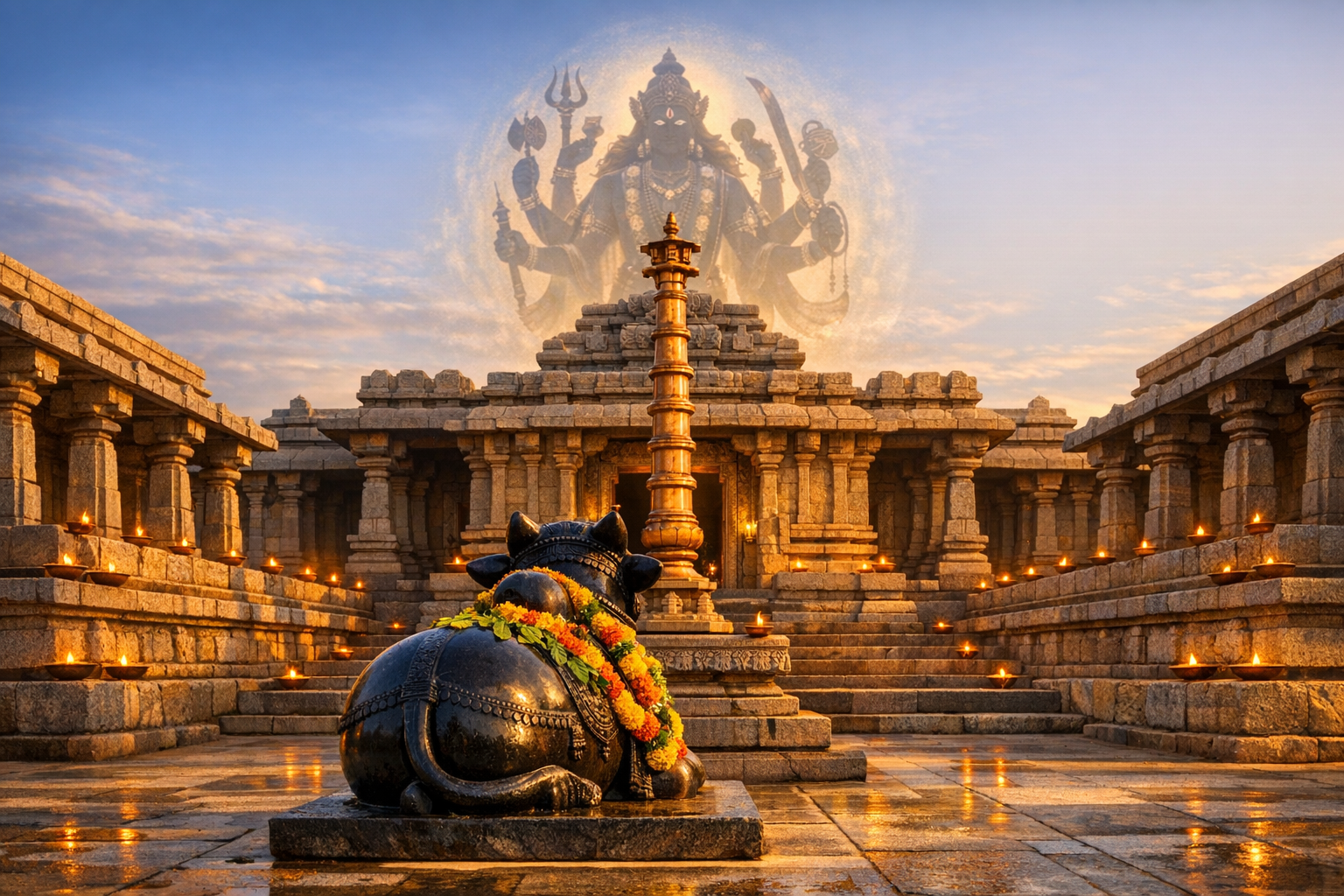
Iconographically, Veerabhadra Swamy at Kuravi is associated with the tri-netra (three eyes) signifying omniscience and the dasha-bhuja (ten arms) denoting manifold capacities to defend and protect. Weapons and attributes often linked to Veerabhadra include the trident, sword, bow and arrow, drum, and noose, alongside protective gestures. Nandi’s axial alignment with the sanctum reinforces the Shaiva identity of the site, while auxiliary shrines in Shaivite temples of the region commonly honor Ganapati, Subrahmanya, Bhadrakali Ammavaru, and the Navagrahas.
Historically, oral traditions in the Warangal–Mahabubabad cultural zone place the temple’s origins in the early to late medieval period, a time when Shaiva worship in Telangana flourished. While the precise foundation date of the Kuravi shrine remains a subject of local memory rather than an established epigraphic fact, the broader region saw strong patronage to Shaivism under successive regional polities. The continuity of worship at Kuravi stands as the most compelling historical testimony: rituals, festivals, and community practices have persisted and adapted through centuries.
Architecturally, Kuravi Veerabhadra Swamy Temple presents the familiar Shaivite plan of sanctum (garbhagriha), vestibule (antarala), and pillared hall (mandapa), typically preceded by a Nandi mandapa aligned to the main axis. A dhwaja-stambha (flag mast) and bali-peetham (offering altar) commonly mark the forecourt, while enclosed prakaras (circumambulatory enclosures) organize movement and ritual space. Local granite and sandstone, known for their durability and sculptural clarity, contribute to the temple’s resilient material character. Even where ornamentation is modest, the interplay of light, shadow, and carved profiles evokes the signature grace of Telangana’s sacred architecture.
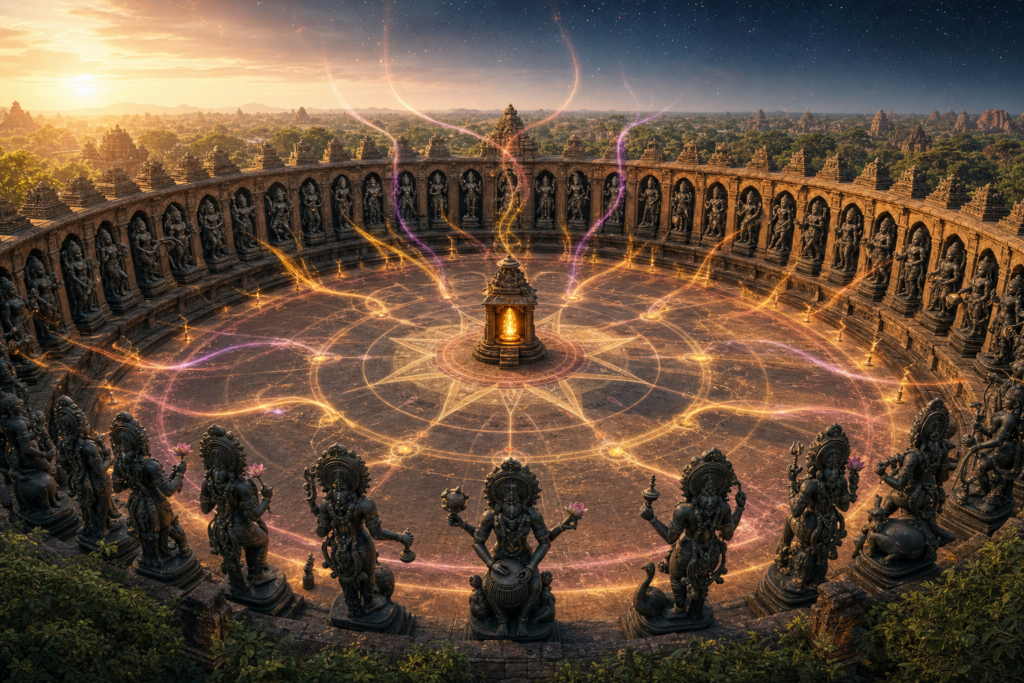
Sculptural programs in such sanctuaries often favor yaksha-ganas, Shaiva iconographies, and regional motifs that speak to agricultural rhythms and protective deities. While Kuravi’s current presentation may be conservative rather than heavily ornate, the site’s spiritual charge rests in its axial clarity, the intimate scale of the sanctum, and the palpable presence of Nandi facing the deity – a visual and philosophical alignment of devotion and grace.
The liturgical life of the temple centers on daily puja sequences, with morning and evening rites guiding the flow of darshan. Abhishekam, a hallmark of Shaiva worship, is performed with water, panchamrita, vibhuti, and fragrant substances, accompanied by the recitation of Sri Rudram and related hymns. Devotees commonly offer bilva leaves, rudraksha, and simple floral garlands, seeking blessings for courage, health, and clarity.
Festival observances anchor the temple’s annual rhythm. Maha Shivaratri draws the largest congregations, with night-long vigil, special abhishekam, and collective singing of Shaiva hymns. Karthika masam is especially auspicious in Telangana, marked by deepotsavam, extended pradakshina, and enhanced evening lamps that bathe the precinct in warm light. Pradosham, particularly when it falls on a Monday, brings steady streams of devotees who observe vrata, perform archana, and partake of prasadam with quiet reverence.
The pilgrim experience at Kuravi is contemplative and rooted in familial devotion. Many visitors describe the palpable shift in tone as one moves from the bustle of the approach road to the calm of the mandapa: the soft footfall on stone, the steady flame of ghee lamps, and the resonant cadence of mantras turning attention inward. Darshan from the Nandi axis provides a moment of alignment that is both visual and meditative.
At an ethical and philosophical level, the temple’s core message balances raudra and karuna – righteous intensity and compassion. This balance mirrors a shared dharmic vocabulary across Hinduism, Buddhism, Jainism, and Sikhism: self-discipline, service to the community, truthfulness, and non-harm. In this way, the site functions not only as a Shaivite tirtha but also as a cultural space that echoes the larger Indic commitment to unity in spiritual diversity.
Community activities around such temples typically emphasize seva and collective participation. On festival days, volunteers help regulate queues and distribute prasadam, while families often undertake small vrata observances together. The result is an inclusive devotional culture where personal vows intersect naturally with shared ritual life.
For practical planning, pilgrims generally find mornings and early evenings most conducive for darshan. As with many shrines, timings and ritual schedules can vary on festival days or seasonally, so it is prudent to confirm local announcements before travel. Mondays and major tithis can witness heavier footfall; arriving early secures a more unhurried experience.
Reaching Kuravi is straightforward via rail and road. Dornakal Junction and Mahabubabad are the nearest major railway nodes, well connected to the Kazipet–Vijayawada corridor. State-run and private buses serve the mandal from regional hubs, and taxis or autos typically cover the last-mile approach. For air travelers, Hyderabad’s Rajiv Gandhi International Airport is the principal gateway, with onward rail or road connections to Mahabubabad district.
Accommodation is more abundant in nearby towns and cities. Pilgrims often choose stays in Mahabubabad or Warangal for better hotel availability and onward access to other heritage sites. Vegetarian food options are widespread, and prasadam distribution at the temple offers a simple, nourishing complement to local fare.
The best visiting window spans roughly October to February, when the Deccan climate is temperate and outdoor movement is comfortable. The monsoon months infuse the surroundings with verdure but can bring intermittent showers; summer afternoons may be warm, making early or late visits preferable.
Cultural etiquette aligns with standard norms for South Indian temples: modest attire, removal of footwear before entering sacred zones, and attentive silence inside the mandapa and near the sanctum. Photography policies vary; when signage is present or staff advise restraint, it is considered respectful to comply fully.
Accessibility considerations are relevant for elders and young children. Steps and stone floors can be uneven or warm underfoot depending on time of day, so supportive footwear for outer areas and adequate hydration are advisable. As with most active temples, occasional midday closures may occur, and festival-day logistics can involve extended standing or longer queues.
Kuravi integrates well with a broader heritage circuit in Telangana. Warangal Fort and the Thousand Pillar Temple at Hanamkonda situate the traveler within the region’s medieval continuum, while a visit to the Ramappa Temple at Palampet – celebrated for its sculptural finesse – offers a complementary architectural lens. Together, these sites frame Kuravi’s living ritual within a rich cultural landscape.
Textual resonances for the temple’s theology span major puranas that narrate the Veerabhadra episode, most notably sections of the Shiva Purana and Skanda Purana. Ritual handbooks and Shaiva hymns used during abhishekam, together with the lived memory of the local community, ensure that practice remains grounded in scriptural ethos while staying dynamically responsive to present-day devotees.
As a living sacred environment, Kuravi Veerabhadra Swamy Temple invites responsible pilgrimage. Avoiding single-use plastics, honoring queues, maintaining silence near the sanctum, and supporting local crafts respectfully help sustain the site’s spiritual and cultural integrity. Such mindful visitation preserves not only stone and sanctuary but also the intangible rhythms of prayer that give this temple its enduring life.
In sum, Kuravi Veerabhadra Swamy Temple stands as a testament to the enduring vitality of Shaivism in Telangana. Its icon of Veerabhadra communicates a timeless balance between strength and compassion, while its rituals and festivals knit together families and communities. For travelers and devotees alike, Kuravi offers a contemplative passage into the heart of dharma – a place where heritage is not merely observed but lived.
Inspired by this post on Hindu Pad.