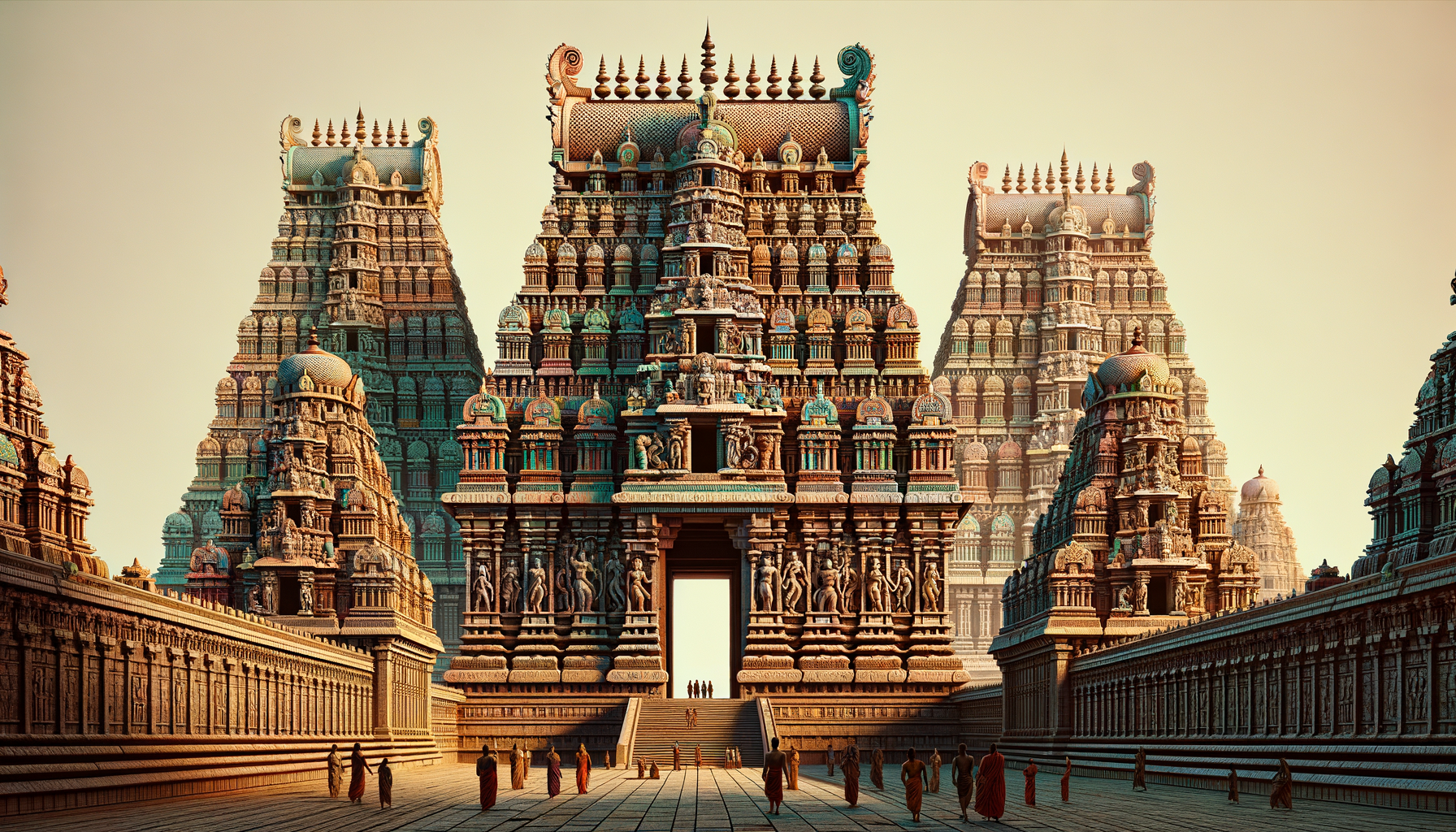
Hindu temple architecture is renowned for its visual grandeur and layered symbolism, and the gopuram—also written gopura—stands among its most evocative features. Predominantly associated with South Indian temples within the Dravida tradition, these monumental gateways announce the transition from the everyday world to the sacred precincts. Across the dharmic spectrum, gateways and thresholds carry shared meanings: as with Buddhist toranas and the gateway fronts of many Jain temples in Tamil Nadu and Karnataka, the gopuram invites reverence, contemplation, and a sense of collective belonging.
Art historians commonly describe three principal gopuram types by position and scale within the temple’s concentric enclosures (prakaras): the inner gopuram, the intermediate gopuram, and the raja gopuram at the outermost boundary. Together, they guide movement, frame processions, and structure a devotee’s experience—subtly teaching that one advances toward the sanctum by crossing meaningful thresholds, each marked by heightened artistry and spiritual intent.
The inner gopuram typically addresses the precinct nearest the sanctum. Modest in height and sparing in tiers (talas), it emphasizes clarity and intimacy over spectacle. Granite courses often define the base, while brick-and-stucco superstructures carry restrained iconographic programs—dvarapalas, lotus bands, and makara-toranas—foregrounding order, protection, and auspicious entry. For many visitors, this gateway feels like a quiet invitation to refocus the mind before deeper entry.
The intermediate gopuram announces a shift from quiet approach to communal rhythm. Taller and more elaborately tiered, it frequently supports festive circulation, accommodating processional routes and ritual pauses. Here, narrative panels and sculptural registers multiply—mythic scenes, ganas, celestial motifs—producing a didactic frieze that is both historical memory and living pedagogy. The experience becomes participatory: the architecture choreographs gathering, chanting, and movement.
The raja gopuram, the outermost and tallest gateway, functions as a civic landmark and spiritual beacon. Its commanding silhouette—stepped talas punctuated by kuta and sala motifs and crowned by kalasa finials—anchors the skyline and signals the temple’s presence to the wider community. Exemplars at Srirangam, Madurai, Chidambaram, and Srivilliputhur demonstrate how the raja gopuram integrates urban life with sacred geography: marketplaces and streets align to its axis, while festivals radiate outward from its threshold, reinforcing shared cultural ties and devotion.
Historical evolution underscores these types. Early Chola gateways tended toward structural clarity and disciplined profiles, as seen around Thanjavur and in ensembles such as the Brihadeeshwara Temple and Gangaikondacholeesvarar Temple. Pandya, Vijayanagara, and Nayaka periods amplified scale and surface narrative, culminating in the colossal raja gopurams whose brick-and-stucco superstructures bloom with sculptural abundance. This progression reveals not only changing aesthetics, but also an expanding social role: as temples became hubs of education, art, and service, their gateways mirrored the breadth of community life within.
While distinctly rooted in Hindu practice, gopurams share a wider dharmic vocabulary of sacred entry. Jain temples in South India often adopt comparable gateway fronts, and Buddhist toranas—though formally different—parallel the gopuram’s threshold symbolism: to pass beneath is to accept guidance, cultivate mindfulness, and affirm shared ethical values. Such resonances highlight a civilizational unity that honors diverse paths within a common quest for truth and wellbeing.
Architecturally, each type distills a pedagogical function. The inner gateway orients attention inward; the intermediate gateway fosters collective rhythm; the raja gopuram proclaims the temple’s moral and cultural presence in the world. Ornament and structure are never merely decorative: pilasters, kapotas, bhadras, and panjaras articulate stability; narrative panels teach; guardians protect; the rising tala sequence suggests ascent from the gross to the subtle. In this way, the gopuram becomes both a work of art and a guide, transforming movement into meaning.
Taken together, the three types of gopurams form a graded journey—from approach to gathering to proclamation—binding personal devotion to communal celebration. They preserve historical memory, foster social cohesion, and reflect the shared architectural language of India’s dharmic traditions. The result is an experience that is at once scholarly and deeply human: crossing the gateway, one finds both a city’s heartbeat and a sanctuary’s stillness.
Inspired by this post on Hindu Blog.