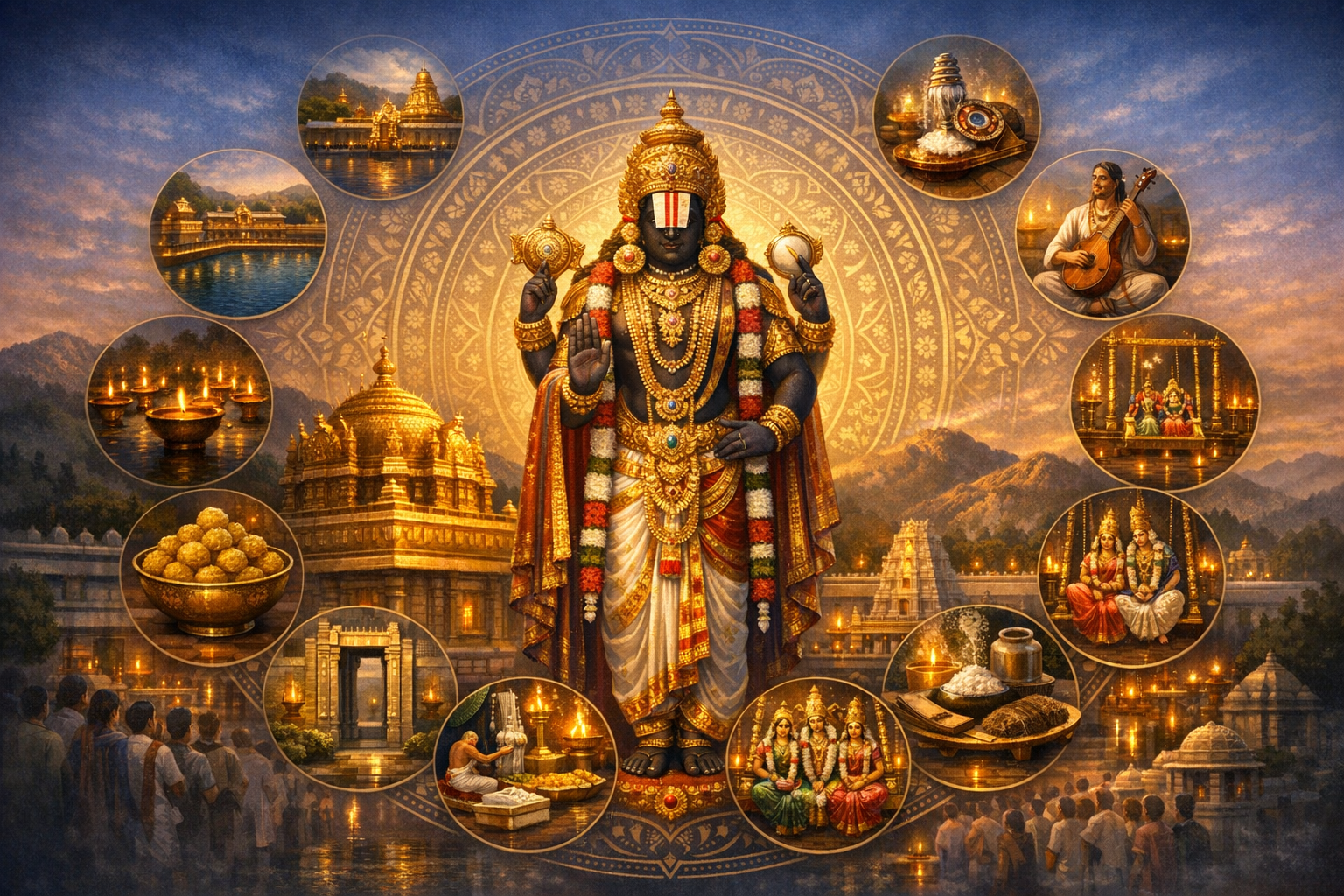
Sri Venkateshwararevered as Srinivasa, Balaji, Venkatachalapati, and Govindais venerated as a compassionate, accessible manifestation of Lord Vishnu. Enshrined on the Seshachalam range at the Tirumala Tirupati Temple in Andhra Pradesh, the deity draws lakhs of devotees daily who seek darshan, participate in sevas, and experience the unifying ethos of Sanatana Dharma.
Presented below are twenty-nine concise, research-grounded facts about Venkateshwara Swamy and the Tirumala tradition, synthesized from Agamic practice, sthalapurana narratives, epigraphic references, festival manuals, and the living ritual maintained by Tirumala Tirupati Devasthanam (TTD). Each point highlights a dimension of theology, temple architecture, ritual liturgy, or community practice that continues to inspire devotion across dharmic communities.
Fact 1: Theologically, Venkateshwara Swamy is honored as the Kaliyuga Pratyaksha Daivama form of Vishnu whose grace is readily accessible in the current age. Puranic narratives portray this presence as uniquely efficacious for relieving collective and individual suffering.
Fact 2: Tirumala is one of the seven sacred hills of the Seshachalam range, traditionally named Seshadri, Neeladri, Garudadri, Anjanadri, Vrishabhadri, Narayanadri, and Venkatadri. The ascent through these hills is understood as a symbolic pilgrimage from the mundane to the divine.
Fact 3: The main icon, called the Dhruva Beram, is a self-revealed (swayambhu) stone image of Vishnu in standing posture. The upper hands bear the chakra and shankha, the lower right hand is in varada mudra (boon-bestowing gesture), and the lower left rests on the hip (katyavalambita), communicating protection, stability, and grace.
Fact 4: Tirumala follows the Vaikhanasa Agama for nitya (daily) and naimittika (occasional) worship. This Vaishnava ritual system emphasizes precise procedures for consecration, abhishekam, alankaram, naivedyam, and archana to maintain an unbroken continuum of worship.
Fact 5: The day begins with the Venkatesa Suprabhatam, a set of invocatory verses composed in the 15th century by Prativadi Bhayankara Annan. This awakening liturgyrecited before dawnframes darshan as a participatory encounter with sacred sound.
Fact 6: The congregational chant “Govinda, Govinda” is an integral, community-affirming feature of Tirumala darshan. The nama-japa harmonizes pilgrims’ intention, steadies queues, and embodies shared devotion to Srinivasa.
Fact 7: For processions, the utsava murti Malayappa Swamy is taken around the prakara in lieu of the earlier Ugra Srinivasa. Traditional accounts note that Malayappa Swamy’s discovery in the hills in medieval times restored auspiciousness to the temple processional tradition.
Fact 8: The world-famous Tirupati Laddu is prasadam with a Geographical Indication (GI) tag, obtained in 2009. As naivedyam that is ritually offered and then shared, it carries the sanctity of the sanctum into the hands of each devotee.
Fact 9: Annadanamfree, sattvic meals offered to pilgrimsembodies the principle that feeding devotees is a direct service to the deity. Through the Sri Venkateswara Anna Prasadam initiatives, tens of thousands are nourished daily, reflecting the inclusive dharmic ethic of care.
Fact 10: Tonsuring (mokku), performed at Kalyanakatta and other designated areas, is a well-known votive act. A living legend connects this practice to Neela Devi, who is said to have offered her hair to Venkateshwara to cover a wound, sanctifying the gift of hair as an expression of gratitude and surrender.
Fact 11: The Srivari Brahmotsavam is a nine-day festival traditionally believed to have been initiated by Brahma. Key processionsincluding Garuda Sevadramatize Venkateshwara’s cosmic kingship and draw pilgrims from across India and the global diaspora.
Fact 12: On Vaikuntha Ekadashi, the Uttara Dwaram (northern gate) is ceremonially opened for darshan, symbolizing passage through the “Vaikuntha Dwaram.” This is among the most spiritually potent days in the temple calendar and attracts massive footfall.
Fact 13: Swami Pushkarini, the sacred temple tank, is revered as having been brought from Vaikuntha by Garuda. Pilgrims often bathe or ritually purify themselves here before darshan, reinforcing the theological unity of waters, worship, and inner cleansing.
Fact 14: The Ananda Nilaya Vimanamthe gold-plated sanctum towerenshrines the image of Vimana Venkateswara. Circumambulation beneath this vimanam is held to confer special merit, underscoring the architectural-sacramental fusion of shrine and theology.
Fact 15: Friday Abhishekam to the Dhruva Beram is a weekly highlight in which the icon is ritually bathed and adorned. Nijapada Darshanamdarshan of the Lord’s lotus feet without certain coveringsoccurs on designated occasions and is deeply cherished by devotees.
Fact 16: Kalyanotsavam, the ceremonial wedding of the Lord with Sridevi and Bhudevi, is performed daily as an arjitha seva. The rite sacralizes the bond between cosmic sustenance (Bhudevi), prosperity (Sridevi), and the Lord’s benevolence toward householders.
Fact 17: Sahasra Deepalankara Seva fills the mandapam with the radiance of a thousand lamps. This daily evening service, often followed by Unjal Seva, intertwines light, music, and movement to express the rhythmic grace of Venkateshwara’s presence.
Fact 18: Tallapaka Annamacharya (15th century), often called the Pada-kavita Pitamaha, composed thousands of sankeertanas in praise of Venkateshwara. His corpus remains a living liturgical resource; the songs continue to be sung in the temple and in homes worldwide.
Fact 19: The temple is widely regarded as one of the wealthiest in terms of offerings and endowments. Rather than opulence for its own sake, Tirumala’s wealth is traditionally understood as dharma-sampatresources held in trust for ritual continuity and community benefit.
Fact 20: Tirumala’s darshan system integrates free, special-entry, and seva-linked pathways to accommodate very high daily footfall with fairness and safety. Queue management, time-slotting, and volunteer guidance are designed to preserve the sanctity and accessibility of darshan.
Fact 21: Architecturally, the garbhagriha faces east in alignment with classical temple canons. The innermost precincts employ measured spatial transitionsfrom maha-mandapam to antarala to sanctumto gradually shift devotees from sensory stimulus to contemplative stillness.
Fact 22: The Lord’s eyes are traditionally covered with the Vaishnava nama (tirunamam), which devotees interpret as a compassionate veil that moderates the intensity of the Lord’s gaze. The red streak within the white nama is associated with Sri (Lakshmi), indicating eternal inseparability.
Fact 23: The belief that the Lord’s hair is eternally lustrous and free of tangles is closely tied to Tirumala’s hair-offering ethos. While this is held in the domain of sacred tradition, it reinforces the intimate, living bond devotees experience with Srinivasa.
Fact 24: The temple’s naivedyam repertoiresuch as pongal, daddojanam (curd rice), pulihora, and laddusillustrates the Vaikhanasa emphasis on sattvic offerings. Food sanctified in the sanctum becomes prasadam, a conduit of grace that unites pilgrims beyond social differences.
Fact 25: The Tirumala narrative is intrinsically linked with Sri Vaishnava acharyas. Ramanujacharya’s influence on ritual organization and theological orientation is revered in tradition, and the Jeeyar mutts continue to serve as guardians of doctrine and practice.
Fact 26: Annual festivals beyond Brahmotsavamsuch as Vasanthotsavam, Pavitrotsavam, Pushpayagam, and Teppotsavamprovide cyclical opportunities for communal renewal. Each rite ritually “resets” temple space, reaffirming purity, continuity, and shared responsibility.
Fact 27: Swami Pushkarini’s chakra snanam, the sacred bath of the Sudarshana Chakra during Brahmotsavam, is both dramatic and didactic. It enacts divine protection over the community and environment, integrating theology with ecological reverence.
Fact 28: The wider Tirupati kshetra includes Vaishnava and Shaiva shrines such as the Govindaraja Swamy Temple and Kapileswara Temple, expressing the integrative fabric of Hindu practice. This local harmony resonates with the dharmic ideal Vasudhaiva Kutumbakam“the world is one family.”
Fact 29: Devotees address Venkateshwara Swamy as Akhilanda Koti Brahmanda Nayaka, “Lord of countless universes.” This honorific encapsulates the Tirumala experience: intimate devotion to a personal deity who simultaneously embodies cosmic sovereignty.
Many pilgrims recount that Tirumala feels like an encounter with both history and eternitywhere Agamic precision, living music, luminous lamps, and the unbroken chanting of “Govinda, Govinda” transform waiting into worship. Families often describe tonsuring, annadanam, and darshan as milestones not just of travel but of values passed from one generation to the next.
In a plural dharmic landscape that includes Hinduism, Buddhism, Jainism, and Sikhism, the Tirumala tradition demonstrates how reverence, service, and shared ethical commitments cultivate unity without erasing diversity. By engaging with these factsrooted in scripture, ritual, and community memorydevotees and learners alike can deepen darshan and carry the spirit of Srinivasa into everyday life.
Inspired by this post on Hindu Pad.