
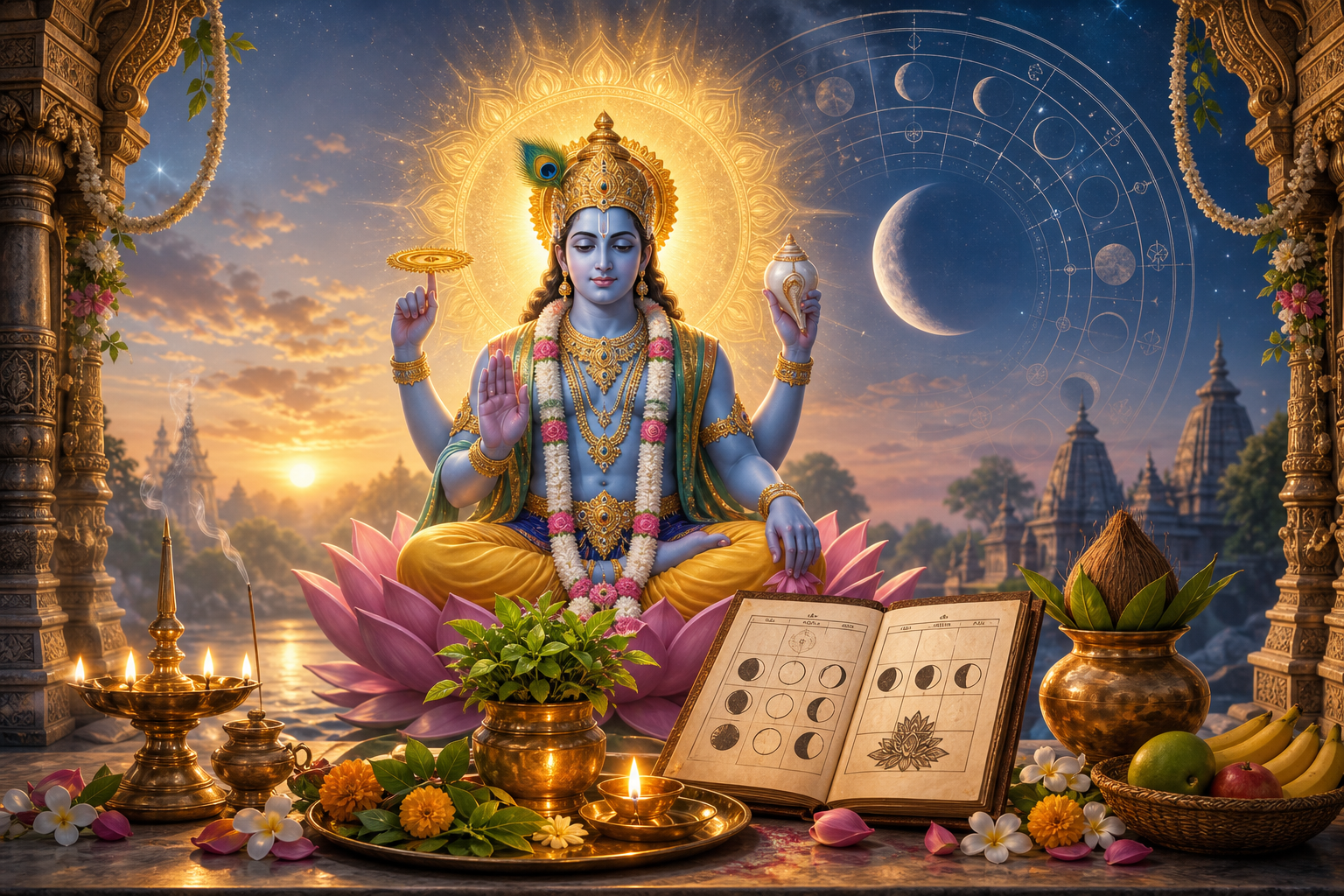
Parama Ekadashi 2026 falls on June 11, 2026, and occupies a distinctive place in the Hindu calendar because it occurs during Krishna Paksha of Adhik Jyeshta Maas. This makes the observance especially meaningful for devotees who follow Ekadashi Vrat as a discipline of devotion, self-restraint, purification, and remembrance of Lord Vishnu. In both Amavasyant and Purnimant Panchanga traditions, the day is associated with the sacred rhythm of an Adhika Masa, the additional lunar month inserted to harmonize the lunar and solar calendars.
The importance of Parama Ekadashi lies not only in the act of fasting but also in the wider spiritual psychology behind the vrata. Ekadashi is traditionally understood as a day meant to lighten the body, steady the mind, discipline the senses, and redirect attention toward the divine. In the case of Parama Ekadashi, the devotional emphasis becomes even stronger because Adhika Masa, also known in many Vaishnava traditions as Purushottam Maas, is regarded as a period especially dedicated to Lord Vishnu.
According to the traditional Hindu calendar, the Ekadashi that occurs in Krishna Paksha of an Adhika Masa is known as Parama Ekadashi or Parama Ekadasi. The word “Parama” suggests the idea of the highest, the supreme, or the most elevated. In this context, the observance points toward a spiritual aspiration: to move beyond ordinary concerns and cultivate a more disciplined, ethical, and devotional way of life. For households that mark Ekadashi regularly, this day often feels like a deeper pause within an already sacred cycle.
Parama Ekadashi Vrat is primarily dedicated to Lord Vishnu, who is revered as the preserver and sustainer within the Hindu sacred imagination. The observance is shaped by faith in Vishnu’s grace, but it also carries a practical dimension. Fasting, prayer, mantra recitation, charity, and self-reflection become tools for reordering daily life. In a world often driven by urgency, consumption, and constant distraction, the vrata offers a structured way to return to simplicity and inward steadiness.
The calendrical setting of Parama Ekadashi 2026 deserves careful attention. June 11, 2026 corresponds to Krishna Paksha Ekadashi in Adhik Jyeshta Month. Krishna Paksha refers to the waning phase of the moon, the fortnight after Purnima and before Amavasya. Ekadashi is the eleventh lunar tithi, and in Hindu ritual practice this tithi is especially associated with fasting and Vishnu worship. Because tithi calculations depend on the lunar day rather than the civil date alone, devotees commonly consult a local Panchang for exact fasting and parana timings.
Adhik Jyeshta Maas gives the 2026 observance its special character. Adhika Masa is not an ordinary month in the ritual calendar. It arises because the lunar year is shorter than the solar year, and the Hindu lunisolar system periodically inserts an additional month to maintain seasonal alignment. Rather than treating this extra month as merely technical, Hindu tradition transforms it into an opportunity for intensified spiritual practice. This is one of the remarkable features of the Hindu calendar: astronomy, ritual, ethics, and devotion are woven together into a living cultural system.
The Parama Ekadashi Vrat Vidhi generally begins with a clear sankalpa, or sacred intention. Devotees may wake early, bathe, clean the puja space, and worship Lord Vishnu with flowers, incense, lamp, water, fruits, tulasi leaves where appropriate, and sincere prayer. Many observe a full fast, while others follow a partial fast depending on health, age, family tradition, and personal capacity. The spirit of the vrata is not competitive austerity but disciplined devotion performed with humility and steadiness.
Recitation plays a central role in the observance. Vishnu Sahasranamam, Vishnu stotras, the names of Lord Narayana, and simple japa of divine names are commonly recommended on Ekadashi. The traditional view is that sacred sound refines awareness and redirects the mind away from restlessness. Even when a devotee cannot perform elaborate ritual, sincere remembrance of Lord Vishnu, disciplined speech, and a sattvic routine are considered meaningful expressions of Ekadashi observance.
Food discipline is one of the most visible features of Ekadashi, but its deeper meaning is often misunderstood. The vrata is not merely a dietary restriction. It is a conscious reshaping of desire. Many devotees avoid grains, beans, and heavy foods, while some take fruits, milk, nuts, or other vrata-friendly preparations. Others may observe nirjala fasting if their tradition and health permit it. The appropriate practice should be guided by family custom, temple instruction, health realities, and a mature understanding of dharma.
The significance of Parama Ekadashi is traditionally described in strong devotional language. It is believed to relieve poverty, hardship, and accumulated sins, and to bring the devotee closer to Lord Vishnu’s grace. Such statements should be understood within the broader dharmic worldview, where material difficulty, moral conduct, inner purification, and divine remembrance are deeply interconnected. The promise of prosperity is not merely an invitation to seek wealth; it also points to the wealth of clarity, discipline, gratitude, and spiritual orientation.
In many families, Ekadashi becomes a shared cultural memory. Elders may recall observing the day with simple meals, evening lamps, Vishnu Sahasranamam, and stories from the Puranas. Children may first encounter the vrata as a household rhythm before later understanding its philosophical depth. This continuity matters. It preserves Hindu traditions not as abstract doctrine but as lived practice: a calendar remembered through food, sound, silence, restraint, temple visits, and family devotion.
Parama Ekadashi also has social significance. A vrata is personal, but it is rarely isolated. It encourages charity, kindness, control of speech, reduction of waste, and attention to those in need. When the fast is understood properly, it softens the ego rather than hardening identity. The day becomes a reminder that devotion to Lord Vishnu should be reflected in conduct: compassion, honesty, restraint, and respect for all sincere spiritual paths within the wider dharmic family.
This inclusive understanding is especially important in contemporary religious life. Hinduism contains many sampradayas, regional customs, temple traditions, and household practices. Some devotees may emphasize Vaishnava worship, others may connect Ekadashi with broader practices of meditation, mantra, dana, or scriptural reading. The unity of dharmic traditions is strengthened when such diversity is approached with reverence rather than rivalry. Parama Ekadashi can therefore be seen as a day of devotional depth and cultural harmony.
For those asking how to do Parama Ekadashi Vrat in 2026, the essential framework is simple. One may prepare the previous evening by eating lightly, avoiding excess, and setting a devotional intention. On June 11, 2026, the devotee may wake early, perform puja to Lord Vishnu, observe fasting according to capacity, recite Vishnu Sahasranamam or other Vishnu mantras, avoid anger and gossip, engage in charity, and spend the day in mindful conduct. The fast is traditionally concluded with parana on the following day, at the appropriate time indicated by the local Panchang.
Technical accuracy is important because Ekadashi observance depends on tithi. The civil date of June 11, 2026 gives the broad date for Parama Ekadashi, but local sunrise, tithi start and end times, and Dwadashi parana windows can vary by location. Devotees in India, North America, Europe, or elsewhere should therefore consult a reliable regional Panchang or temple calendar. This preserves the integrity of the vrata and avoids confusion created by time-zone differences.
At its heart, Parama Ekadashi 2026 is a call to refinement. It asks the devotee to simplify consumption, remember Lord Vishnu, honor the sacred calendar, and cultivate a disciplined inner life. Its traditional promises of relief from hardship and purification from past wrongs are best approached with sincerity, not superstition. The vrata becomes powerful when fasting is joined with humility, ethical action, sacred recitation, and a genuine desire to live more consciously.
For modern devotees, the day offers a practical bridge between ancient wisdom and contemporary life. A person may be surrounded by work deadlines, digital noise, financial pressure, and emotional fatigue, yet still pause for a sacred tithi. That pause is the gift of Ekadashi. Parama Ekadashi, especially in Adhik Jyeshta Maas, deepens that pause into a disciplined remembrance of the supreme, a renewal of faith, and a quiet return to dharma.
Inspired by this post on Hindu Pad.




Leave a Reply
You must be logged in to post a comment.