
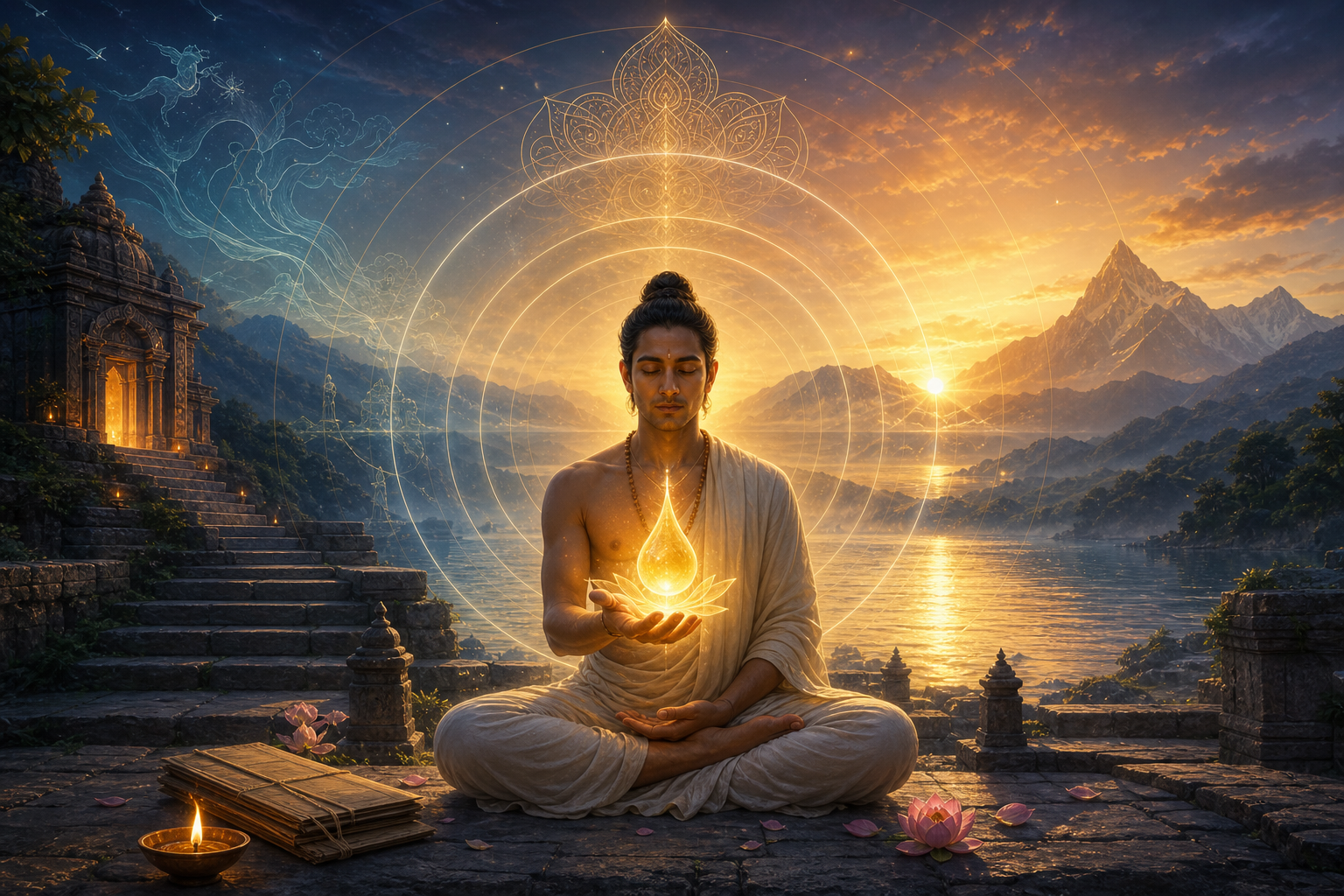
Amritatva in Hinduism is one of the most profound ways of describing the human longing to move beyond sorrow, limitation, fear, and death. The term points toward a state of immortality and bliss, not merely as endless biological survival, but as freedom from the cycle of ignorance, attachment, and suffering. In the Upanishadic vision, the deepest human aspiration is not satisfied by temporary pleasure, social success, or intellectual certainty alone; it seeks the discovery of an unconditioned reality that is deathless, self-luminous, and whole.
The Sanskrit word ‘amritatva’ is connected with ‘amrita,’ meaning deathlessness, nectar, or immortality. In a philosophical context, it refers to the state in which the seeker realizes the imperishable nature of the Self, or atman, and is no longer bound by the fear of decay and death. This does not imply that the physical body becomes permanent. Rather, Hindu philosophy distinguishes between the perishable body-mind complex and the deeper consciousness that remains untouched by bodily change. Amritatva, therefore, is a spiritual realization rather than a material condition.
The Upanishads repeatedly return to this theme because they examine the central questions of existence: What is the Self? What survives death? What is the source of lasting happiness? What is real when all changing forms pass away? The answer offered in many Upanishadic passages is that liberation comes through the realization of the identity, relationship, or profound intimacy between the individual self and ultimate reality, described in different traditions as Brahman, Paramatman, Bhagavan, Shiva, Vishnu, Devi, or the Supreme Truth. The language differs across Hindu darshanas, yet the concern remains the same: freedom from bondage and the attainment of the highest good.
Amritatva is closely associated with moksha, mukti, nirvana, and kaivalya. These terms are not always identical in every philosophical school, but they share a common concern with release from suffering and spiritual bondage. Moksha and mukti generally refer to liberation from samsara, the cycle of birth and death. Nirvana, especially in Buddhist traditions, refers to the extinguishing of craving and ignorance. Kaivalya, prominent in Yoga and Jain philosophical contexts, indicates a state of pure freedom or absolute aloneness of consciousness from material entanglement. The presence of these related terms across Hinduism, Buddhism, Jainism, and Sikh thought demonstrates the broad Dharmic concern with liberation, ethical purification, and direct insight into truth.
In Hinduism, the quest for amritatva begins with a simple but universal observation: all living beings seek happiness and avoid suffering. This is not merely a psychological habit; it is treated as a sign of the soul’s deeper orientation toward fullness. Ordinary pleasures provide relief, beauty, and meaning, but they remain limited by time. Health can decline, possessions can be lost, relationships can change, and the mind itself can become restless even in favorable circumstances. The Hindu spiritual tradition does not deny worldly joys; instead, it asks whether there is a joy that is not dependent on unstable conditions.
The Upanishadic response is that the highest happiness is rooted in the realization of the Self. The Taittiriya Upanishad presents a layered understanding of the human being through the pancha kosha model: annamaya, pranamaya, manomaya, vijnanamaya, and anandamaya. These sheaths represent the physical, vital, mental, intellectual, and blissful dimensions of embodied existence. The teaching suggests that human identity is usually mistaken for one or more of these layers, while the true Self is subtler than all of them. Amritatva becomes possible when this misidentification is overcome through disciplined inquiry and realization.
The Brihadaranyaka Upanishad gives one of the most memorable spiritual movements toward immortality in the prayer: asato ma sad gamaya, tamaso ma jyotir gamaya, mrityor ma amritam gamaya. The passage moves from unreality to reality, from darkness to light, and from death to immortality. Its force lies in its universality. It does not speak to one sect, caste, region, or historical period alone. It expresses the inner cry of the human being who recognizes that surface-level existence is incomplete without truth, illumination, and freedom from mortality’s deepest terror.
The Katha Upanishad develops this quest through the dialogue between Nachiketa and Yama, the lord of death. Nachiketa refuses temporary rewards and asks what happens after death. This story is central to Hindu philosophy because it contrasts preyas, the pleasant, with shreyas, the truly beneficial. The pleasant is not condemned, but it is shown to be insufficient when it distracts from the highest knowledge. The seeker of amritatva must learn to distinguish between immediate gratification and lasting wisdom. This distinction remains deeply relevant in modern life, where constant stimulation often imitates happiness while leaving the deeper mind unsettled.
Amritatva also requires a mature understanding of death. Hindu scriptures do not treat death only as an event at the end of life. Death is present in every moment of change: childhood gives way to youth, youth to age, certainty to doubt, possession to loss, and identity to transformation. The Bhagavad Gita teaches that the embodied self passes through changing conditions, while the deeper Self is unborn, eternal, and not destroyed when the body is destroyed. This teaching is not meant to produce indifference, but clarity. Grief remains human, yet it can be held within a larger awareness of continuity and spiritual purpose.
Different Hindu schools interpret amritatva through their own philosophical frameworks. Advaita Vedanta emphasizes the realization that atman is Brahman and that bondage arises from avidya, or ignorance. Vishishtadvaita Vedanta understands liberation as the soul’s eternal communion with Narayana, preserving both divine unity and meaningful distinction. Dvaita Vedanta stresses the eternal difference between the individual soul and Bhagavan, with liberation understood as loving proximity and service to the Supreme. Shaiva, Shakta, Vaishnava, Yoga, and Tantra traditions each offer distinctive pathways, but all affirm that ordinary bondage can be overcome through knowledge, devotion, discipline, grace, and ethical life.
This diversity is not a weakness in Hinduism; it is one of its philosophical strengths. The tradition recognizes that human beings differ in temperament, capacity, culture, and spiritual inclination. Some are drawn to jnana, the path of knowledge. Some are moved by bhakti, the path of devotion. Some find transformation through karma yoga, the disciplined offering of action. Others pursue raja yoga, meditation, mantra, ritual, temple worship, pilgrimage, seva, or contemplative study of sacred texts. Amritatva is therefore not reduced to a single technique. It is approached through many valid disciplines that refine the mind and orient life toward truth.
The Bhagavad Gita makes this pluralism practical by integrating action, devotion, knowledge, and meditation. It does not ask the human being to abandon responsibility in order to seek liberation. Instead, it teaches that action performed without egoistic attachment can become a means of freedom. This is important because amritatva is sometimes misunderstood as withdrawal from life. In the Gita’s vision, liberation matures through participation in dharma. Family life, social duties, governance, scholarship, service, and even difficult moral decisions can become part of spiritual growth when performed with discernment and surrender.
The ethical dimension of amritatva is essential. A restless, exploitative, or violent mind cannot easily recognize the deathless Self. Hindu traditions therefore place great emphasis on yama and niyama, including ahimsa, satya, asteya, brahmacharya, aparigraha, saucha, santosha, tapas, svadhyaya, and Ishvara pranidhana. These disciplines are not merely moral rules imposed from outside. They are technologies of inner purification. Truthfulness reduces fragmentation, non-violence softens aggression, restraint conserves energy, study deepens insight, and surrender loosens the ego’s claim to absolute control.
Amritatva also has a psychological meaning. Much human suffering arises from identification with temporary roles: success, failure, praise, blame, status, injury, memory, and expectation. Hindu spirituality does not dismiss these experiences, but it asks the seeker to observe them rather than become imprisoned by them. Meditation, japa, pranayama, puja, and scriptural reflection gradually create distance between awareness and mental turbulence. This distance is not emotional numbness. It is a refined form of presence in which the person can act with compassion without being consumed by fear or craving.
The pursuit of immortality in Hinduism should not be confused with the pursuit of power. Mythological narratives about amrita, such as the Samudra Manthan, show devas and asuras seeking the nectar of immortality. At a symbolic level, the churning of the ocean represents the churning of consciousness itself. Poison emerges before nectar, reminding the seeker that spiritual life often brings hidden impurities to the surface before clarity appears. Shiva’s act of holding the poison reflects the need for containment, courage, and grace in the process of transformation. Amritatva, in this sense, is not obtained by greed; it is approached through purification.
The relationship between amritatva and bliss is equally important. Hindu philosophy often distinguishes between pleasure and ananda. Pleasure depends on contact between senses and objects; ananda arises from proximity to the Self, devotion to the Divine, and freedom from inner division. Aesthetic joy, sacred music, temple worship, satsang, pilgrimage, and meditation can all provide glimpses of this deeper bliss. Yet the tradition cautions that even refined experiences are not the final goal if they come and go. Amritatva points toward that which remains when experience itself is understood in the light of consciousness.
In Dharmic traditions, liberation is never merely private escape. Hinduism, Buddhism, Jainism, and Sikhism all connect spiritual freedom with ethical responsibility. Compassion, self-discipline, truthfulness, non-possessiveness, humility, and service appear in different vocabularies across these traditions. The Jain emphasis on ahimsa, the Buddhist analysis of suffering and craving, the Sikh commitment to seva and remembrance of the Divine, and the Hindu pursuit of moksha all reveal a shared civilizational concern: the human being must be transformed, not merely informed. Amritatva is therefore best understood within a wider Dharmic commitment to inner freedom and outer responsibility.
This unity does not erase differences. Hindu moksha, Buddhist nirvana, Jain kaivalya, and Sikh mukti are shaped by distinct metaphysical and theological understandings. However, their ethical and contemplative convergences are significant. Each tradition recognizes that ordinary consciousness is clouded by ignorance, attachment, egoism, or karmic bondage. Each offers disciplines for purification. Each values direct realization over mere opinion. In an age often marked by shallow polemics, this shared Dharmic vocabulary offers a basis for mutual respect and serious dialogue.
Amritatva also has contemporary relevance because modern societies often promise immortality through memory, achievement, genetic legacy, technology, or digital permanence. These may have limited value, but they do not answer the existential problem addressed by the Upanishads. A preserved image, a social reputation, or a technological extension of life cannot by itself resolve fear, ignorance, craving, or grief. Hindu philosophy asks a more radical question: What is the nature of the one who seeks permanence? Without this inquiry, the pursuit of immortality can become an endless extension of insecurity.
The disciplined pursuit of amritatva therefore begins with viveka, discrimination between the eternal and the non-eternal. It develops through vairagya, a mature detachment from compulsive dependence on transient objects. It is supported by shatsampatti, the cultivation of inner qualities such as calmness, self-control, endurance, faith, and concentration. It matures through mumukshutva, the deep longing for liberation. These classical Vedantic qualifications are not abstract ideals; they describe a gradual reorientation of the entire personality toward freedom.
Devotion offers another powerful route to amritatva. In bhakti traditions, immortality is not understood only as impersonal realization, but as participation in divine love. The devotee seeks freedom from ego not by analysis alone, but through surrender, remembrance, chanting, worship, and loving service. The names of Rama, Krishna, Shiva, Devi, Narayana, and other revered forms become vehicles of transformation. For many practitioners, bhakti makes the abstract idea of immortality emotionally accessible. The heart learns to trust the Divine reality that the intellect seeks to understand.
Temple worship also embodies the search for amritatva. The temple is not only a cultural monument or ritual site; it is a sacred architecture of ascent. The movement from outer space to garbha-griha mirrors the movement from dispersed attention to concentrated awareness. Darshan, mantra, pradakshina, arati, prasada, and silence create a ritual environment in which the ordinary mind is gently re-educated. The devotee enters with burdens and leaves, at least for a moment, with a wider sense of belonging to a reality larger than personal anxiety.
Yoga provides a technical map of this transformation. Patanjali’s Yoga Sutras define yoga as the stilling of the fluctuations of the mind. When these fluctuations quiet down, the seer rests in its own nature. This resting in one’s own nature is closely related to amritatva because bondage is sustained by misidentification with mental modifications. Asana stabilizes the body, pranayama refines vital energy, pratyahara withdraws the senses, dharana develops concentration, dhyana deepens meditation, and samadhi opens the possibility of direct realization. The path is systematic, experiential, and demanding.
Knowledge, devotion, meditation, and action converge in the recognition that immortality is not produced; it is uncovered. Hindu philosophy generally does not claim that spiritual practice manufactures the Self. The Self is already present, but obscured by ignorance and habitual conditioning. Practice removes obstruction, much like cleaning a mirror reveals the face already reflected in it. This distinction is crucial. Amritatva is not an achievement of the ego; it is the transcendence of the ego’s false centrality.
Such a teaching can feel both inspiring and demanding. It is inspiring because it affirms that the deepest reality of the human being is not helplessness. It is demanding because it requires the seeker to examine attachment, pride, fear, anger, envy, and delusion with honesty. The path toward amritatva is therefore not sentimental spirituality. It is a rigorous discipline of consciousness, supported by scripture, guru, community, ethical conduct, and contemplative practice.
The role of the guru has traditionally been central in this journey. The Upanishadic model is dialogical: the student approaches with humility, inquiry, and readiness to learn. The guru does not merely provide information but points the seeker toward direct recognition. In the absence of living guidance, sacred texts, commentarial traditions, and sincere satsang can still serve as supports. Yet Hinduism repeatedly emphasizes that liberation requires more than intellectual familiarity. It demands assimilation, contemplation, and transformation of life.
Karma is another key concept in understanding why amritatva matters. Actions leave impressions, and these impressions shape tendencies, choices, and future experiences. Samsara continues because desire-driven action binds the individual to results. Liberation does not mean irresponsibility toward karma; it means freedom from the ignorance that makes one cling to action and result as the basis of identity. Karma yoga is thus a profound preparation for amritatva, because it teaches disciplined action without bondage to egoistic reward.
From a social perspective, the doctrine of amritatva can cultivate dignity. If the same sacred reality is present in all beings, then human worth cannot be reduced to wealth, birth, profession, gender, or social approval. This insight has ethical consequences. Compassion, restraint, service, and respect for different spiritual paths become natural extensions of metaphysical understanding. The quest for immortality, rightly understood, does not pull the seeker away from society; it deepens responsibility toward all life.
At the same time, Hindu texts avoid simplistic optimism. The path is difficult because the mind is attached to habit. The Katha Upanishad compares the Self to a subtle reality not easily grasped by the untrained intellect. The Bhagavad Gita acknowledges that the mind is restless and difficult to control, while also affirming that practice and detachment can discipline it. This realistic psychology makes Hindu spirituality enduringly relevant. It recognizes struggle without making struggle the final truth.
Amritatva is therefore both a metaphysical goal and a lived orientation. It shapes how one understands death, pleasure, duty, knowledge, devotion, and community. It asks the human being to move from compulsive seeking to wise seeking, from fear to inquiry, from ego-centered living to dharma-centered living, and from fragmented identity to spiritual wholeness. It is not a rejection of the world, but a transformation of the way the world is seen and inhabited.
In the broad landscape of Hindu spirituality, amritatva remains a powerful word because it names what ordinary language often fails to capture: the longing for a happiness that does not collapse, a truth that does not decay, and a freedom that is not dependent on circumstance. Whether approached through Vedanta, Yoga, Bhakti, Tantra, temple worship, scriptural study, or selfless action, the search for amritatva continues to invite seekers into the deepest promise of Sanatana Dharma: the realization that the essence of life is not death-bound, but rooted in immortal consciousness and bliss.
Inspired by this post on Hindu Blog.
