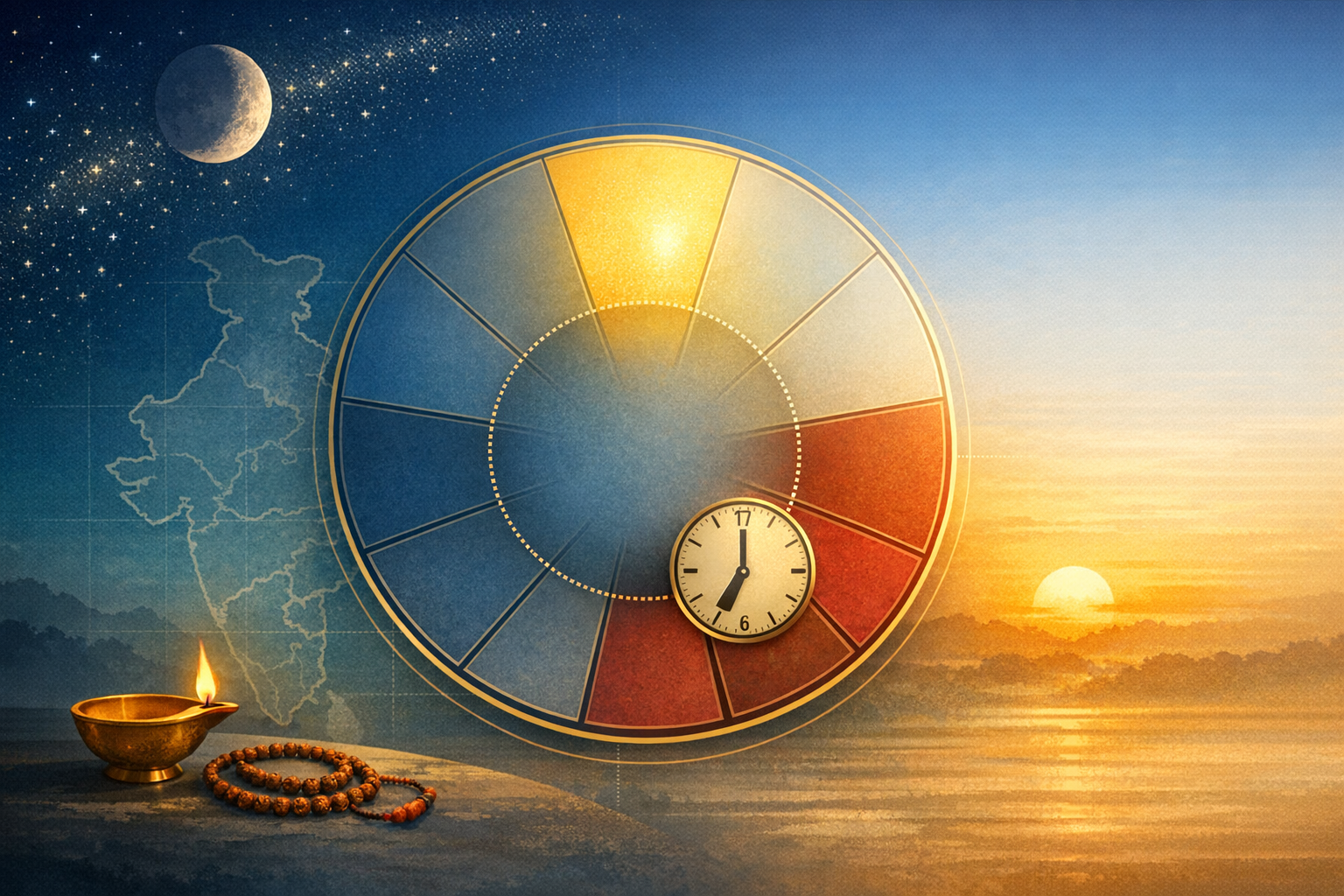
March 15, 2026 (Sunday) in the Hindu Panchang falls on Krishna Paksha Ekadashithe eleventh tithi of the waning lunar fortnightin most regions. The Ekadashi tithi continues till 6:58 AM on March 15. From that moment onward, Krishna Paksha Dwadashi (the twelfth tithi) prevails for the remainder of the day. This analytical note situates the day within the broader Hindu calendar, explains Panchang elements that matter for practice (Tithi, Nakshatra, Rashi, Shubh Muhurat), and offers method-based guidance for accurate, location-specific use.
Tithi is a fundamental unit of the lunar calendar, defined by the relative angular separation between the Moon and the Sun. Each tithi spans a 12-degree elongation, yielding thirty tithis per synodic lunar month. Because the Moon’s apparent motion is not uniform, actual tithi lengths vary; a tithi may begin or end at any time of day or night, which is why calendar entries specify precise transitions. The Panchang therefore tracks tithi transitions against local time to guide daily religious observances, muhurta selection, and festival fasts.
On March 15, 2026, Krishna Paksha Ekadashi holds until 6:58 AM, after which Dwadashi begins. In practice, many communities determine fast observance (vrata) by whether Ekadashi prevails at local sunrise. When Ekadashi is present at sunrise, the fast is typically observed that day, with parana (fast breaking) on Dwadashi as per local tradition. Given the tithi change at 6:58 AM in most regions, Ekadashi is likely to be present at sunrise across many Indian locations; nevertheless, sunrise varies by latitude, longitude, and season, so practitioners should confirm with a reliable local Panchang before fixing parana windows.
Ekadashi carries a long-standing place in Hindu dharmic life, particularly in Vaishnava traditions where it is associated with upavasa (fasting), japa, and satvika conduct. Its discipline emphasizes clarity, restraint, and devotionqualities widely honored across the dharmic family. Comparable rhythms of lunar observance appear in Uposatha (Buddhism) and Paushadha/Posadha (Jainism), while Sikh communities historically referenced Bikrami lunar dates for certain commemorations before adopting the Nanakshahi calendar. A shared ethic of self-restraint, seva, and remembrance underscores unity across Hindu, Buddhist, Jain, and Sikh practices while respecting distinct identities.
Dwadashi, which follows Ekadashi, is significant for properly concluding the observance. Parana is generally done on Dwadashi within prescribed windows after sunrise, avoiding times that Smarta or Vaishnava guidelines consider inauspicious. Because parana rules can vary by sampradaya and localeand depend on whether Dwadashi extends past the next sunriseconfirmation from a region-specific Panchang is essential for accuracy.
Sunday (Ravi-vara) is governed by Surya (Aditya) in classical jyotisha. As a day marker, it traditionally emphasizes vitality, clarity, and steady leadership. Many households honor Surya with morning arghya (water offering) at sunrise, recitation of Aditya Hridayam, or quiet contemplation facing the early sun where feasible. When aligned with Ekadashi’s atmosphere of restraint and focus, Sunday can be especially conducive to disciplined sadhana and reflective study.
Beyond Tithi, practitioners often consider Shubh Muhuratauspicious windows selected through multiple Panchang factors. One widely used marker is Abhijit Muhurta, centered on local solar noon (not necessarily 12:00 clock time), spanning approximately 24 minutes before and after true noon. It is frequently treated as a generally favorable time for endeavors requiring clarity and decisiveness, though certain rites (such as marriage) follow more specialized muhurta rules and should be fixed by a competent astrologer or a detailed regional Panchang.
Rahu Kalam, Yamaganda, and Gulika are cautionary intervals traditionally avoided for initiating new undertakings. They are computed by dividing the local daylight interval (sunrise to sunset) into eight equal parts and then applying weekday-specific segment rules. For Sundays, Rahu Kalam occupies the eighth segment of daylight; Yamaganda occupies the fifth; and Gulika occupies the seventh. Because sunrise and sunset shift by place and season, these segments must be calculated with actual local daylight duration to obtain precise clock times. This method-first approach yields better reliability than any fixed-hour approximation.
Choghadiya offers another practical, time-tested framework for daily planning. Day and night are each divided into eight “ghadi” segments, rotating through qualities such as Amrit, Shubh, Labh (considered favorable) and Udveg, Rog, Kaal (considered challenging), among others. Many households align routine errands, correspondence, or travel with neutral-to-auspicious Choghadiya segments while avoiding the more adverse ones. As with Rahu Kalam, exact Choghadiya windows depend on local sunrise and sunset, so location-specific calculation is recommended.
Nakshatra denotes the Moon’s position among the twenty-seven stellar sectors (from Ashwini to Revati). Each Nakshatra carries attributes affecting undertakings, interpersonal tone, and spiritual practices. Since Nakshatra can change at any point in a civil day, working with a trustworthy Panchang or astronomical software is crucial to identify which Nakshatra prevails at a given hour on March 15, 2026. This information, combined with Tithi, provides a more nuanced view for sankalpa, study, or quiet observances aligned to the lunar current.
Rashi (Moon sign) indicates the Moon’s sign-based backdrop at the time under consideration. Daily Rashi lends a temperamental flavorhow communications unfold, what kind of tasks feel natural, and where patience or flexibility may be needed. Because the Moon moves quickly, the Rashi can differ even within a single calendar day; for accurate planning, consult a regional Panchang giving Moon Rashi timings for March 15, 2026 in the relevant time zone.
Yoga and Karana, two additional Panchang limbs, refine muhurta selection. Yoga is calculated from the sum of the longitudes of the Sun and Moon and is associated with qualities conducive to certain activities. Karanahalf a tithicycles through specific patterns (e.g., Bava, Balava, Kaulava, Taitila, Gara, Vanija, Vishti) that practitioners often weigh before starting travel, negotiations, or ritual work. Because both can change within the day, precise local timings matter for March 15, 2026.
To localize all of the above for March 15, 2026, a reliable method is advisable: first, obtain exact local sunrise and sunset; second, compute daylight duration and divide by eight for Rahu Kalam/Yamaganda/Gulika segments; third, verify Tithi, Nakshatra, Rashi, Yoga, and Karana from a regional Panchang set to the correct time zone and daylight-saving rules; fourth, confirm whether Ekadashi prevails at sunrise to determine the day of observance and the Dwadashi parana window. This sequence reduces error and aligns daily practice with astronomical reality.
Practically, the pre-6:58 AM span on March 15, 2026 remains within Krishna Paksha Ekadashi, which many devotees use for japa, dhyana, and scriptural study. After 6:58 AM, with Dwadashi in effect, households that observed Ekadashi fasting will plan parana per local guidance, maintaining the spirit of sattva and gratitude. When exact parana hours are constrained by local rules (e.g., avoiding Hari-vasara, or observing Vaishnava-smarta distinctions), deferring to a competent priestly or Panchang source is prudent.
Across dharmic traditions, the day’s cadence invites shared values. Buddhists may align meditation with Uposatha-inspired restraint; Jains may observe Paushadha or Samayik with enhanced vigilance toward ahimsa; Sikhs may deepen simran and seva in the spirit of collective uplift. Within Hindu practice, acts of dana, a satvika diet, and mindful speech embody Ekadashi’s essence. Such parallel commitmentsdistinct yet harmoniousadvance unity among Hinduism, Buddhism, Jainism, and Sikhism while preserving each path’s integrity.
In summary: Sunday, March 15, 2026, is Krishna Paksha Ekadashi until 6:58 AM in most regions, followed by Krishna Paksha Dwadashi. Auspicious timing for initiatives should consider Abhijit Muhurta near true noon, avoid Rahu Kalam/Yamaganda/Gulika per localized segment calculations, and incorporate Nakshatra, Rashi, Yoga, and Karana for precision. With careful reference to a regional Panchang, the day can be observed with accuracy, serenity, and a spirit of pan-dharmic goodwill.
Inspired by this post on Hindu Blog.