
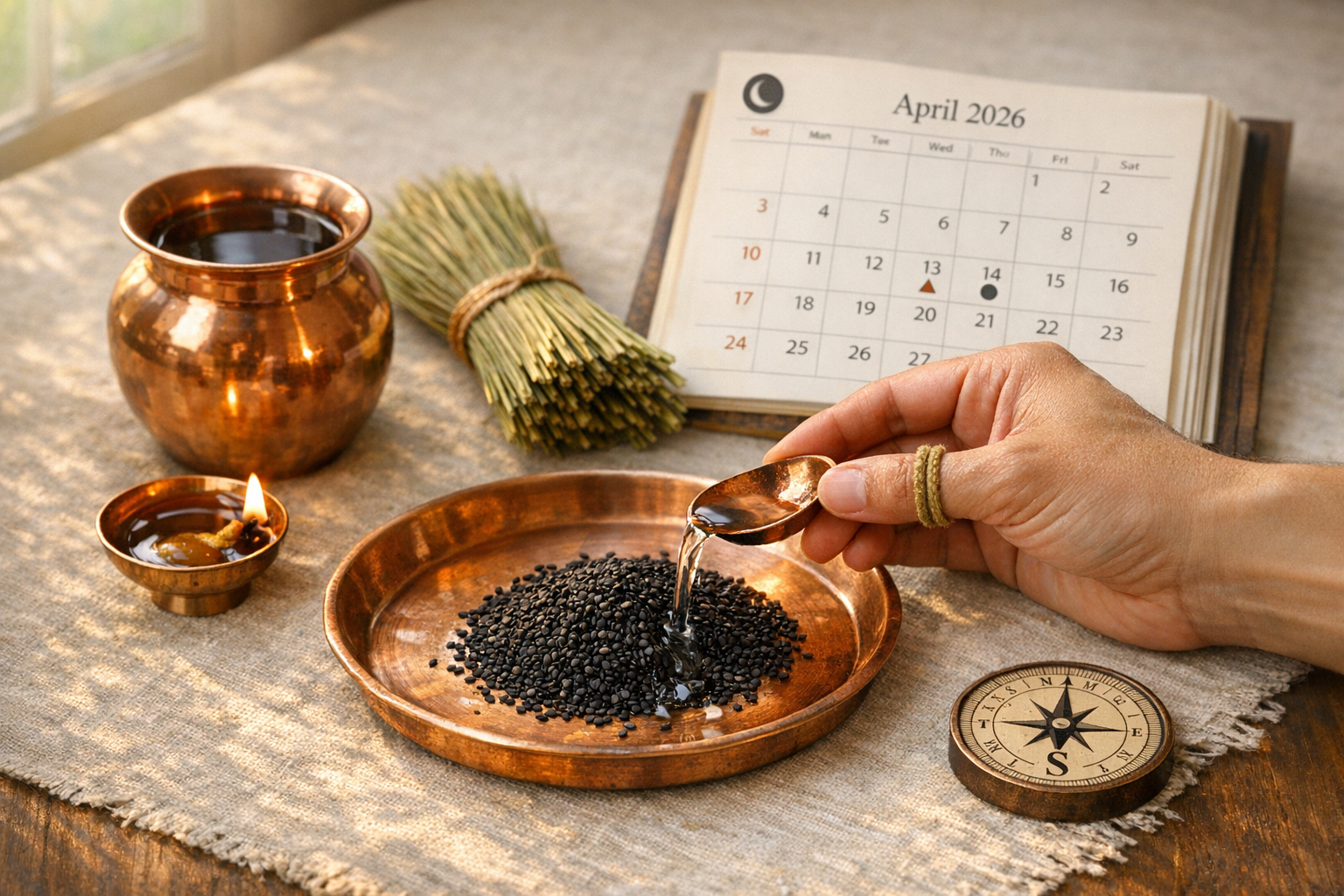
Amavasya Tharpanam Sankalpam Mantras April 2026 are observed across India on 16 April 2026 and 17 April 2026, with regional calendrical usage determining the specific day. The new-moon observance is known as Chithirai Amavasya in Tamil Nadu, Mesha Maasa Amavasya in Kerala, Chaitra Amavasya in the Telugu, Kannada, Marathi, and Gujarati calendars, and Vaishakh Amavasya in the North Indian purnimanta tradition. Because the Amavasya tithi spans both dates in April 2026, many almanacs (Panchang) list either or both days, depending on the tithi prevailing at local sunrise.
The two-date listing reflects an important rule in traditional Panchang computations: for household observances, the tithi that prevails at local sunrise typically determines the festival date, while certain vratas and shraddha-related rites can prioritize the presence of the tithi during the most suitable daytime segment. Accordingly, some communities will perform Amavasya Tharpanam on 16 April, while others may find 17 April more appropriate, based on their local Panchang and family tradition (sampradaya).
Amavasya Tharpanam is a compact, dignified Vedic practice of gratitude and remembrance offered to pitṛs (ancestral beings). It cultivates inner steadiness (sattva), a sense of continuity across generations, and a lived awareness of interdependence. Many practitioners report a steadying quietude when the oblations of water mixed with tila (black sesame) are offered with attention and care, aligning intention (sankalpa) with action. Across the broader dharmic family, remembrance of ancestors and teachers is upheld as a unifying ethic that nurtures humility and shared responsibility.
The calendrical names differ because distinct regional systems coexist in India. In Tamil Nadu (solar Chithirai) and Kerala (solar Mesha), month names are anchored to the Sun’s transit. In Andhra–Telangana, Karnataka, Maharashtra, and Gujarat (amanta lunar system), the month concludes on Amavasya; thus the April observance is Chaitra Amavasya. In large parts of North India (purnimanta lunar system), the month ends on Purnima; consequently, April’s new moon falls in Vaishakh Amavasya. The sacred intent of Tharpanam remains the same across these systems.
Timing is guided by two principles: (1) follow the local Panchang to ensure Amavasya is present on the chosen date, and (2) perform the Tharpanam during the appropriate daytime segment (often morning to midday, or aparahna as per family tradition). When an eclipse coincides with Amavasya, that special condition carries additional rules. In April 2026, those undertaking the rite should confirm the local tithi window and sunrise alignment to decide between 16 or 17 April.
Preparation typically includes clean water in a spoon (uddharani) or palms, black sesame (tila), darbha (kusha grass) formed into a pavitram ring, and a clean seat (asana), ideally kusa or a natural-fiber mat. Facing south is customary for pitṛ-related offerings. Observers may keep a serene space with minimal disturbance and mentally recollect lineagegotra and, where known, pravarawithout anxiety or embellishment. Adherence to one’s sampradaya (Apastamba, Bodhayana, etc.) ensures continuity.
A common sequence proceeds as purification (achamana) and quiet breath regulation (as per tradition), a clear sankalpa stating place, time, and intent, followed by tarpanam in the order of Deva–Rishi–Pitṛ (or Pitṛ-only on Amavasya, if that is the family custom). Each oblation is offered with a focused recitation, allowing the stream of water and tila to flow gently southward while maintaining inner composure and recollection.
The sankalpam declares the precise cosmic time-marker and the ritual intention. The variables include the saṁvatsara name, ayana (Uttarayana), ṛtu (Vasanta), month name (Chithirai/Mesha, Chaitra, or Vaishakh), paksha (Krishna), tithi (Amavasya), weekday, and optionally gotra–sūtra–pravara. In April 2026, the saṁvatsara in use is Viśvavasu (Vishwavasu). The following samples illustrate how to articulate the sankalpa for both dates and for the differing month names used across India.
Suggested sankalpam (Devanagari) for Chithirai Amavasya / Mesha Maasa Amavasya on 16 April 2026 (Thursday): अस्मिन् विश्ववसु नाम संवत्सरे, उत्तरायणे, वसन्त-ऋतौ, मेष-मासे, कृष्ण-पक्षे, अमावास्यायां, गुरुवासरे, [गोत्रः] [सूत्रः] [प्रवरः] सह, ममोपात्त-समस्त-दुरित-क्षयद्वारा श्री-परमेश्वर-प्रीत्यर्थं पितृ-तर्पणं करिष्ये।
IAST: Asmin Viśvavasu-nāma saṁvatsare, Uttarāyaṇe, Vasantṛtau, Meṣa-māse, Kṛṣṇa-pakṣe, Amāvāsyāyām, Guruvāsare, [gotra] [sūtra] [pravara] saha, māmopātta-samasta-durita-kṣaya-dvārā Śrī-Parameśvara-prītyarthaṁ pitṛ-tarpaṇaṁ kariṣye.
Suggested sankalpam (Devanagari) for Chithirai Amavasya / Mesha Maasa Amavasya on 17 April 2026 (Friday): अस्मिन् विश्ववसु नाम संवत्सरे, उत्तरायणे, वसन्त-ऋतौ, मेष-मासे, कृष्ण-पक्षे, अमावास्यायां, शुक्रवारसे, [गोत्रः] [सूत्रः] [प्रवरः] सह, ममोपात्त-समस्त-दुरित-क्षयद्वारा श्री-परमेश्वर-प्रीत्यर्थं पितृ-तर्पणं करिष्ये।
IAST: Asmin Viśvavasu-nāma saṁvatsare, Uttarāyaṇe, Vasantṛtau, Meṣa-māse, Kṛṣṇa-pakṣe, Amāvāsyāyām, Śukravāsare, [gotra] [sūtra] [pravara] saha, māmopātta-samasta-durita-kṣaya-dvārā Śrī-Parameśvara-prītyarthaṁ pitṛ-tarpaṇaṁ kariṣye.
Suggested sankalpam (Devanagari) for Chaitra Amavasya (Telugu, Kannada, Marathi, Gujarati calendars; use 16 or 17 April per local sunrise): अस्मिन् विश्ववसु नाम संवत्सरे, उत्तरायणे, वसन्त-ऋतौ, चैत्र-मासे, कृष्ण-पक्षे, अमावास्यायां, [वारसे], [गोत्रः] [सूत्रः] [प्रवरः] सह, ममोपात्त-समस्त-दुरित-क्षयद्वारा श्री-परमेश्वर-प्रीत्यर्थं पितृ-तर्पणं करिष्ये।
IAST: Asmin Viśvavasu-nāma saṁvatsare, Uttarāyaṇe, Vasantṛtau, Caitra-māse, Kṛṣṇa-pakṣe, Amāvāsyāyām, [vāsare], [gotra] [sūtra] [pravara] saha, māmopātta-samasta-durita-kṣaya-dvārā Śrī-Parameśvara-prītyarthaṁ pitṛ-tarpaṇaṁ kariṣye.
Suggested sankalpam (Devanagari) for Vaishakh Amavasya (North Indian purnimanta; use 16 or 17 April per local sunrise): अस्मिन् विश्ववसु नाम संवत्सरे, उत्तरायणे, वसन्त-ऋतौ, वैशाख-मासे, कृष्ण-पक्षे, अमावास्यायां, [वारसे], [गोत्रः] [सूत्रः] [प्रवरः] सह, ममोपात्त-समस्त-दुरित-क्षयद्वारा श्री-परमेश्वर-प्रीत्यर्थं पितृ-तर्पणं करिष्ये।
IAST: Asmin Viśvavasu-nāma saṁvatsare, Uttarāyaṇe, Vasantṛtau, Vaiśākha-māse, Kṛṣṇa-pakṣe, Amāvāsyāyām, [vāsare], [gotra] [sūtra] [pravara] saha, māmopātta-samasta-durita-kṣaya-dvārā Śrī-Parameśvara-prītyarthaṁ pitṛ-tarpaṇaṁ kariṣye.
Core Pitṛ Tarpanam mantras (Devanagari), to be offered with water and tila facing south, according to family method: ॐ पितृभ्यः स्वधा नमः। ॐ पितामहेभ्यः स्वधा नमः। ॐ प्रपितामहेभ्यः स्वधा नमः।
Maternal lineage (where observed, in the same manner): ॐ मातृभ्यः स्वधा नमः। ॐ मातामहेभ्यः स्वधा नमः। ॐ प्रमातामहेभ्यः स्वधा नमः। Conclude, if desired: ॐ सर्वेभ्यः पितृभ्यः स्वधा नमः।
Suggested closure: यथा शक्त्या कृतं पितृतर्पणं तत्र देवाः प्रीयन्तां, पितरः प्रीयन्ताम्। ॐ शान्तिः शान्तिः शान्तिः। Allow a moment of stillness, letting the intention settle into gratitude.
Observational notes support steadiness and clarity: the pavitram (darbha ring) and the use of tila should follow one’s sampradaya; those unable to access a riverbank can offer into a clean vessel and later return the water to soil or a plant bed respectfully. Precision of the rite rests more in attention, humility, and correct tithi than in elaboration, and any uncertainties (such as gotra, pravara, or exact procedural variants) may be gracefully acknowledged without strain.
Ethical conduct harmonizes with ecological care: avoid polluting water bodies, maintain cleanliness, and embody kindness through modest charity and food-sharing as per family practice. These small commitments align the ritual with ahimsa and stewardship, strengthening the virtue that Tharpanam seeks to awakencontinuity with all that supports life.
Within the dharmic tapestryHinduism, Buddhism, Jainism, and Sikhismremembrance, gratitude, and the honoring of forebears and teachers form a shared ethical thread. While forms and historical practices vary, the spirit of reverence for lineage, service to community, and aspiration toward wisdom is common. Approached in this light, Amavasya Tharpanam deepens unity across traditions by affirming values that all can recognize.
April 2026 at a glance: practitioners in Tamil Nadu (Chithirai Amavasya) and Kerala (Mesha Maasa Amavasya) may observe on 16 or 17 April, per tithi at sunrise; those following amanta calendars (Chaitra Amavasya in Telugu, Kannada, Marathi, Gujarati systems) and purnimanta calendars (Vaishakh Amavasya in North India) should likewise confirm the local Panchang and choose the date accordingly. In all cases, the sankalpam should clearly state Viśvavasu saṁvatsara, Uttarayana, Vasanta ṛtu, the correct month name for the tradition in use, Krishna Paksha, and Amavasya tithi.
Centered in gratitude and guided by the Panchang, Amavasya Tharpanam in April 2026 becomes a poised act of remembrance. With precise sankalpa, careful oblations, and a gentle closing prayer for peace, households participate in a time-tested discipline that strengthens familial bonds, honors shared ancestry, and nourishes a wider sense of unity across the dharmic family.
Inspired by this post on Hindu Pad.







