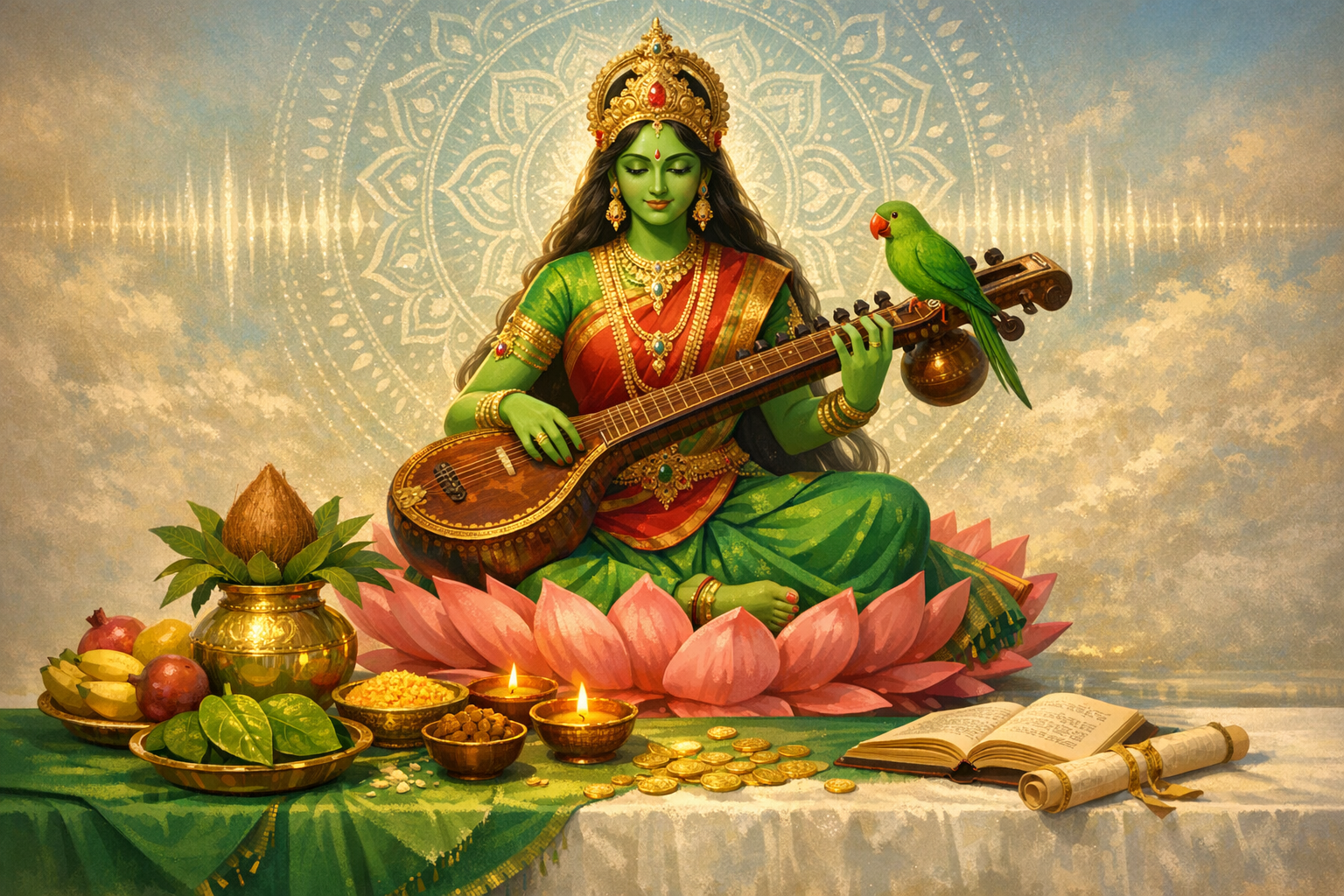
Matangi Jayanti commemorates the first appearance (avatara-utsava) of Goddess Matangi, revered as the ninth Mahavidya in the Dasha Mahavidya tradition. In 2026, Matangi Jayanti falls on April 19 and is observed on Vaishakh Shukla Tritiya, coinciding with Akshaya Tritiya (Akha Teej). This convergence amplifies the day’s auspiciousness in the Hindu calendar, drawing devotees who seek both spiritual refinement and enduring prosperity.
Known as the Tantrik Saraswati, Matangi presides over vāk (speech), sāhitya (letters), saṅgīta (music), and the creative arts. Her worship is traditionally associated with attaining vāk-siddhi (empowered, truthful, and graceful speech), lucid intellect, and cultured expression. Across classical and contemporary practice, Matangi’s śakti is invoked to harmonize knowledge, aesthetics, and ethical use of language.
Tantric narratives portray Matangi’s emergence from the ucchiṣṭa (sacred leavings) of Shiva and Pārvatī, a symbolism that challenges rigid binaries of pure and impure. The teaching is transformative: wisdom, when rightly approached, sublimates what is socially marginal or neglected into insight and compassion. In this reading, Matangi safeguards liminal thresholdsbetween sound and meaning, inner voice and public wordoffering refuge to all who seek integrity in thought, speech, and action.
Akshaya Tritiya is counted among the sāḍe-tīn muhūratself-auspicious windows requiring no additional muhurtaand thus carries the promise of akṣaya (ever-increasing) merit. When Akshaya Tritiya coincides with Matangi Jayanti, as it does in 2026, devotees perceive a twofold blessing: prosperity grounded in dharma and the refinement of eloquence under Tantrik Saraswati’s grace. Households often align the Matangi Jayanti vrata with customary Akshaya Tritiya observances for maximal spiritual benefit.
Calendar note for 2026: Vaishakh Shukla Tritiya prevails on April 19 in most Indian time zones; however, the exact start and end of the tithi vary regionally. For accurate observance, a local Panchang should be consulted to identify the period when Tritiya is operative during daylight, as household puja is customarily performed while the tithi is in effect. If Tritiya spans two civil dates, regional smriti and family traditions guide the preferred day for Matangi Jayanti worship.
At home, puja may be conducted with a sattvic, scripturally grounded sequence: śuddhi (purification of space and mind), saṅkalpa (statement of intent for Matangi Jayanti 2026), ghata or kalasha sthāpana, avahana (invocation), upacharas (offerings), and ārati. An image or yantra of Matangi may be placed on a clean altar adorned with green cloth or foliage, reflecting her iconographic hue and association with Mercury-like clarity. Devotees frequently include a veena image, parrot motifs, or items linked to learning and music.
Japa and meditation are central to Matangi sādhana. Practitioners commonly focus on the purity of speech and mental stillness before reciting mantras taught within their sampradāya, emphasizing the bija syllable associated with Saraswati’s current of knowledge (Aim) and the contemplative remembrance of Matangi as the purifier of inner voice. Meditative attention at the viśuddha (throat) centeraligned with truthful expressionsupports the day’s intention of vāk-siddhi.
Traditional offerings include coconut, fresh fruits, betel leaves (tāmbūlam), turmeric-scented akṣata, sugar or jaggery preparations, and sattvic cooked rice. Classical Tantric sources mention ucchiṣṭa-related ritual symbolism; householders, however, typically observe a fully sattvic mode of worship. Any advanced Tantric methods are to be undertaken only under qualified guru-guidance and within a responsible paramparā, preserving both safety and scriptural integrity.
Many undertake a vrata (fast) on Vaishakh Shukla Tritiya, observing upavāsa or phalāhāra until puja completion. Dāna (charity) on Akshaya Tritiya is considered especially meritorious; book donations, educational support to students, or offerings to music and arts institutions align beautifully with Matangi’s emphasis on learning and refined expression. Devotees often complement the puja with parayana of stotras that honor the Divine Feminine, following their family tradition.
Iconographically, Goddess Matangi is frequently depicted with an emerald-green hue, seated in regal poise, and playing the veena, with a parrot signifying articulate, living speech. A contemplative visualization on Matangi as the radiance of pure sound (nāda) aids those engaged in music, scholarship, pedagogy, law, or public communication. This inner focus integrates aesthetics with ethical clarity, ensuring that skill in words does not outpace responsibility in their use.
Astrologically informed practitioners associate Matangi with Budha (Mercury) and the refinement of the viśuddha chakra. Initiating studies, creative projects, or speech-related disciplines on Matangi Jayantiespecially during Akshaya Tritiya 2026accords with the day’s promise of sustained growth and durable merit. Many report that even a modest daily japa begun on this date yields noticeable improvements in articulation and confidence over time.
Across professions and vocations, Matangi Jayanti observance is linked with practical outcomes: articulate communication, removal of tongue-tied hesitation, creative breakthroughs, cultured manner of debate, and prosperity that flows from knowledge put to compassionate use. By anchoring prosperity in wisdom, the day counters the temptation to pursue gain without guiding values.
In keeping with the unity of dharmic traditions, the essence of Matangi Jayanti resonates beyond sectarian lines. Buddhism’s Right Speech (samyag-vāc), Jainism’s commitment to ahiṃsā in thought and word supported by Anekāntavāda (intellectual humility), and Sikh reverence for the śabad (divine Word) all converge on truthful, compassionate expression. Observing Matangi Jayanti with this shared ethos strengthens harmony among Hindu, Buddhist, Jain, and Sikh communities, reaffirming that refined speech is a sacred bridge across traditions.
Regional practice varies: some Śākta temples highlight special ālankāra and musical offerings, while educational and cultural institutions may hold sāhitya-sabhās or saṅgīta-sevā in honor of Tantrik Saraswati. Households often integrate children’s reading, music practice, or poetry recitation into the day, consecrating learning as an act of worship.
Practical guidance for 2026 emphasizes discernment: align puja vidhi with a trusted guru or family tradition; prefer sattvic offerings at home; and schedule rites when Shukla Tritiya is in effect locally. While gold purchases are common on Akshaya Tritiya, the heart of the observance remains dāna, japa, and the cultivation of learning. When approached with this intent, Matangi Jayanti 2026 becomes a sustained practice in ethical eloquence and prosperity grounded in dharma.
In summary, Matangi Jayanti 2026 on April 19coinciding with Akshaya Tritiyapresents a rare confluence for seekers to refine speech, elevate the arts, and anchor material well-being in wisdom. Whether through simple home puja, steady japa, or charitable support for education and music, the day’s observances mature into year-long habits that dignify public discourse and nurture inner clarity. With Panchang-guided timing and a commitment to unity among dharmic traditions, Matangi’s grace is understood not merely as eloquence, but as compassionate truth in action.
Inspired by this post on Hindu Pad.