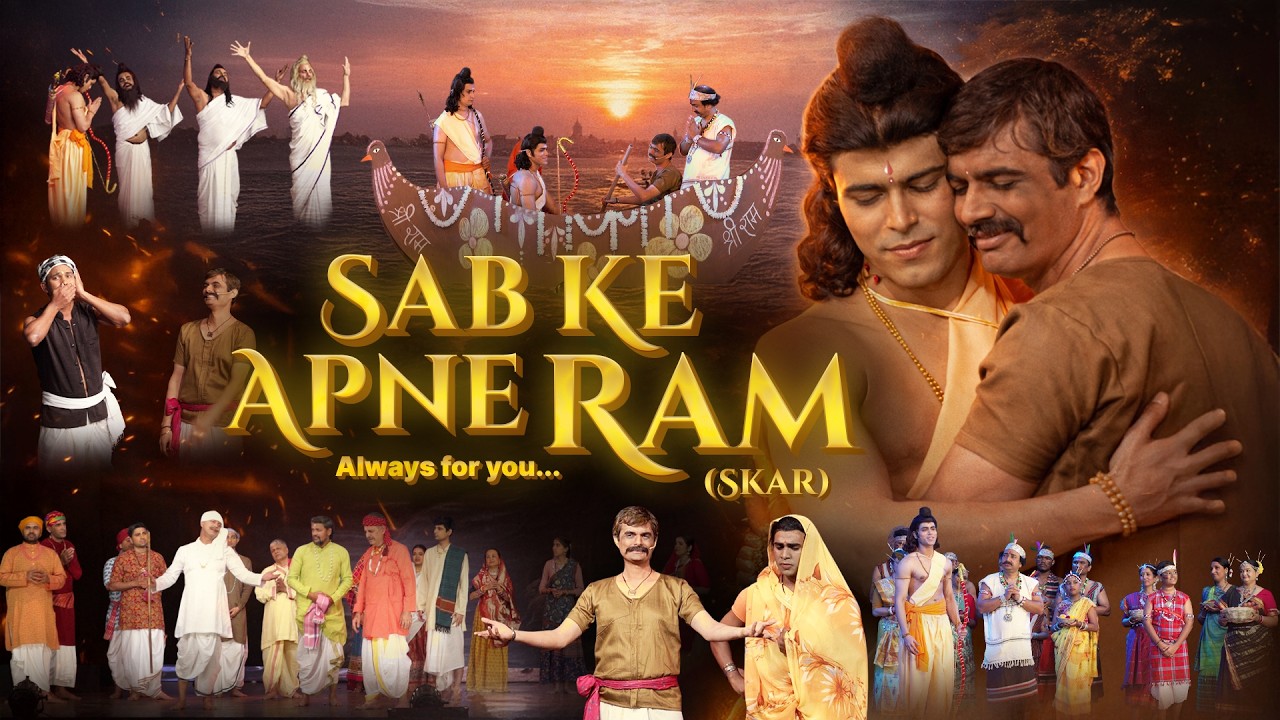
SAB KE APNE RAM (SKAR) presents a meticulously staged Ramayana drama at ISKCON Chowpatty, captured in 4K for exceptional visual clarity. The production curates a unified theological portrait of Ram as the Ideal King, the Loving Friend, the Goal of Sages, and the Beloved of Every Devotee. Set within a devotional yet academically resonant framework, the performance translates core tenets of Sanatana Dharma into accessible stagecraft that speaks to families, students, and seekers across Hinduism, Buddhism, Jainism, and Sikhism.
The availability of English subtitle autotranslation (Activate Autotranslation for the subtitles in English) significantly broadens access for global audiences. This accessibility aligns with the inclusive ethos of the Bhakti Tradition, ensuring that diaspora viewers, interfaith learners, and cultural historians can follow the narrative, appreciate the dramaturgical choices, and engage the ethical questions embedded in the storyline.
The production’s four-fold thematic scaffold is both classical and comprehensive. As Maryada Purushottama, Ram embodies rajadharmaethical governance, restraint, and justicelong celebrated in Indian political imagination as the template for public leadership. As the Loving Friend, Ram foregrounds the relational dimensions of dharmatrust, loyalty, and mutual care. As the Goal of Sages, Ram is approached as the inner telos of contemplation and liberation. As the Beloved of Every Devotee, Ram is the locus of universal devotion that transcends social location and personal history.
The segment “Ram the Ideal King” engages the grammar of rajadharma visible across the Ramayana corpus and subsequent political thought. The staging emphasizes procedural ethics (maryada) and service-oriented power (seva-centered leadership), mapping these ideas to the long-standing cultural aspiration of Ram Rajya as good governance. This is less nostalgia than normative governance theory: transparent justice, protection for the vulnerable, and accountability as the litmus of rulership in the Hindu way of life.
“Ram the Loving Friend” is rendered through the affective language of sakhya-bhakti. The proxemics of characters on stagemutual eye line, shared physical space, and protective gesturestranslate friendship from text to embodied performance. Dramaturgical choices underscore that righteous relationships are spiritually constitutive in Sanatana Dharma: friendship is not peripheral; it is a legitimate path of devotion integrated with ethical responsibility.
“Ram the Goal of Sages” situates devotion within contemplative disciplines, drawing implicitly on Upanishadic and Purana-inflected readings in which Rama-bhakti and inquiry converge. The mise-en-scène slows, lighting softens, and vocal delivery lowers to evoke śānta rasa (tranquility), suggesting that devotion culminates in inward clarity. Within this frame, jnana (insight) and bhakti (devotion) appear as complementary rather than competing routes to liberation.
“Ram the Beloved of Every Devotee” universalizes access to grace. Chorus responses and congregational moments direct attention to devotion (bhakti) as a socially leveling practice. The performance implies that in a dharmic society, love and tolerance are not slogans but practices realized in modest, repetitive acts of care, remembrance, and service.
The most touching episode, Kevat’s simplicity, selfless service, and pure devotion, receives a carefully layered treatment. In Valmiki’s Ramayana (Ayodhya Kāṇḍa), the crossing of the river with the Niṣāda community marks a liminal passage; in Tulsidas’s Ramcharitmanas, the Kevat expands into a luminous exemplar of devotion who insists on washing Rama’s feet before ferrying the party across. The staging draws on the latter tradition to heighten bhakti rasa while maintaining fidelity to the spirit of the earlier text.
Symbolically, the boat is samsara’s vessel, the river a bhava-sāgara of contingency, and the washing of feet a ritual of humility that inverts worldly hierarchies. Kevat’s refusal of material reward, preferring lifelong seva, is dramatized with restrained abhinaya rather than declamatory emphasis, allowing the ethical meaning to arise from action and silence. The result is an elegant demonstration of how devotion purifies intent, clarifies duty, and reorders social relationships around dignity and compassion.
Socially, the Kevat encounter foregrounds the dignity of labor and the sanctity of service. By centering a boatman’s agency and wisdom, the production affirms that spiritual excellence is uncoupled from status and learning is reciprocal. This interpretive choice exemplifies Unity in Diversity within Indian traditions and models how shared ethical commitmentsseva, ahiṁsā, truthfulnessare affirmed across Hinduism, Buddhism, Jainism, and Sikhism.
The aesthetic architecture of the show reflects Nāṭyaśāstra-informed choices. Angika (gesture), vācika (speech), āhārya (costume and set), and sāttvika (inner emotion) abhinaya are balanced to sustain rasa through scene transitions. Color palettessubdued earth for vanavāsa, riverine blue-green for the Ganga, warm golds for moments of graceserve as visual cues for emotional modulation without distracting from the textual gravitas.
Musically, the score employs a devotional idiom consistent with the Bhakti Tradition, alternating between lyrical bhajans and spare, contemplative textures to support narrative beats. Instrumentation favors timbres that carry well in live halls while remaining unintrusive on camera, ensuring vocal clarity for shlokas and dialogic passages. The musical design thus functions as a pedagogical aid: it signals affect, frames meaning, and supports recall.
Performance kinetics are deliberately economical. The actors avoid melodrama, opting for clean kinesics that keep ethical action front and center. This restraintespecially in the Kevat sequencecreates interpretive space for audiences to internalize rather than merely admire, nurturing reflective engagement consistent with a learning-centered approach to sacred drama.
The 4K capture enhances pedagogical and archival value. High dynamic range preserves chiaroscuro lighting and fine-grained expressions crucial for rasa transmission. Careful sound staging separates dialog, vocals, and ambient responses so that viewers relying on subtitles can synchronize auditory and visual cues. For educators, community organizers, and diaspora families, this technical polish makes the production a reliable resource for repeated, nuanced viewing.
Intertextuality is handled with discretion. The production signals awareness of textual variantsparticularly between Valmiki and Tulsidaswithout turning the stage into a scholastic debate. Instead, it stages a hermeneutic convergence in which narrative choices are justified by devotional intelligibility and ethical clarity, not mere sentimentality.
The show’s ethical core resonates across dharmic traditions. Kevat’s seva mirrors Sikh langar’s egalitarian service; the emphasis on ahiṁsā and non-appropriation aligns with Jain ethics; the enactment of karuṇā (compassion) speaks to Buddhist soteriology; and bhakti itself is framed as a universal discipline within Hinduism’s capacious spiritual tapestry. By foregrounding these shared values, the production embodies the principle of Unity in Diversity without erasing doctrinal distinctions.
Beyond devotion, the drama functions as civic pedagogy. The figure of Ram as Maryada Purushottama integrates rule of law, compassion, and restraint into a template of leadership relevant to contemporary governance discourse. In this light, Ram Rajya is not a theocratic ideal but a civilizational aspiration for ethical public lifetransparency, justice, and care for the vulnerable.
Audience responses typically track a rasa arc from karuṇā in exile motifs to vīra in resolve and finally to śānta in reconciliation and service. Families and youth engage the narrative emotionally, while educators leverage its layered symbolism to teach dharma as lived ethics rather than abstraction. This dual registeraffect and analysisexplains the production’s reach across generations and backgrounds.
As intangible cultural heritage, such performances revitalize scripture through living practice. The stage becomes a shared learning space where sacred text, community memory, and contemporary questions meet. ISKCON Chowpatty’s curation strengthens cultural continuity by using high-quality production methods to transmit classical narratives in a form accessible to modern attention patterns.
In sum, SAB KE APNE RAM (SKAR) at ISKCON Chowpatty offers a rigorous yet tender dramaturgy of devotion. By harmonizing textual fidelity, ethical clarity, and technical excellence, it presents Ram as king, friend, goal, and beloved in one coherent vision. The Kevat episode anchors the message: simplicity, selfless service, and pure devotion remain the surest vessels across the river of worldly uncertaintyan enduring lesson for a plural, dharmic society grounded in love and tolerance.
Inspired by this post on Dandavats.