
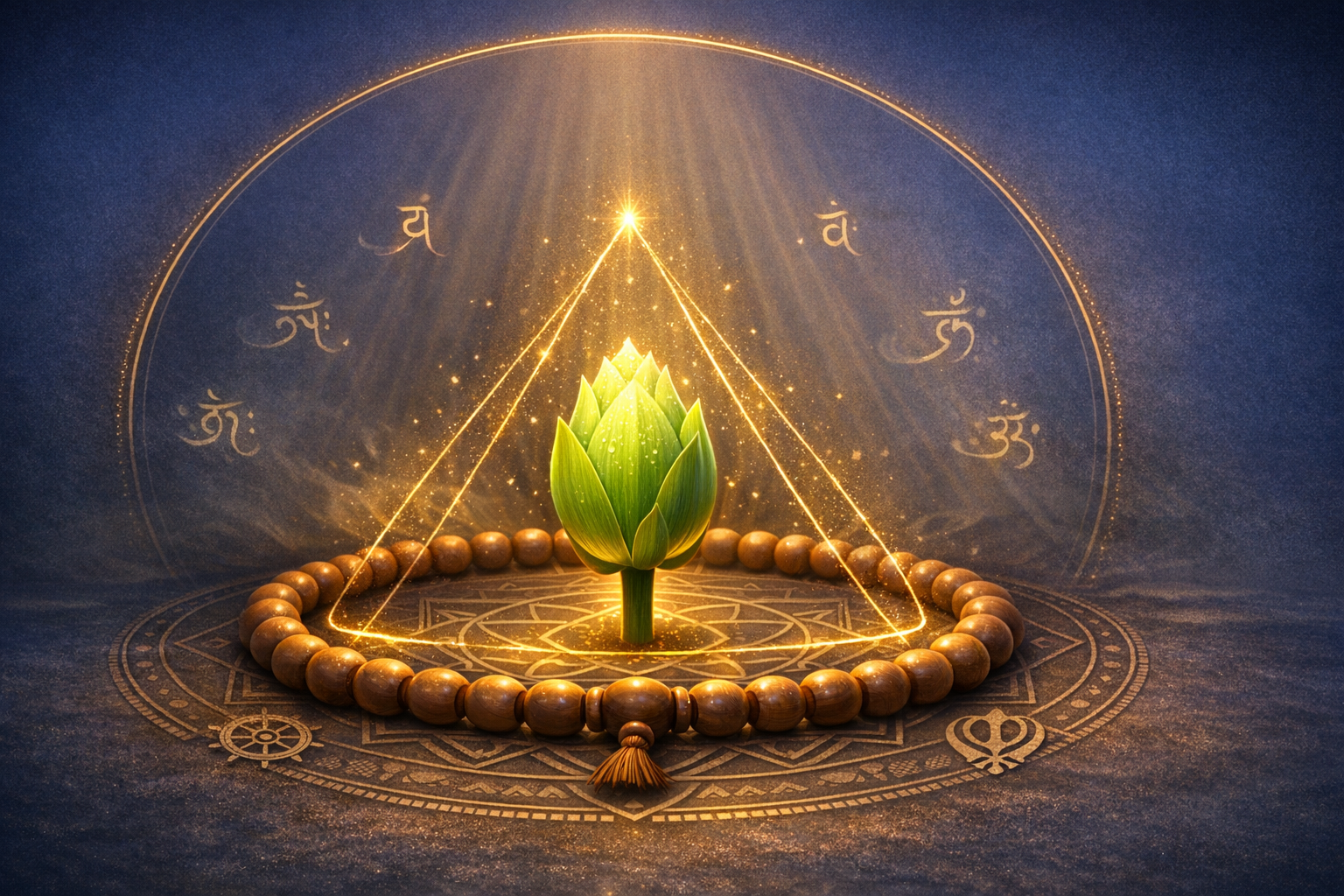
In the vast landscape of Tantric practice within Hinduism, mantras occupy a central and highly sensitive position. Within this intricate field of mantra-śāstra, the notion of the Pallava Mantra (often discussed as Pallav Prayogas) signifies a distinctive, name-infused application of sacred sound, one that brings into sharp focus three converging forces: naming (nāma), will (icchā-śakti), and the law of consequences (karma). This study examines the meaning, scope, and spiritual implications of pallava usage with an emphasis on ethical alignment, technical rigor, and inter-dharmic harmony.
Etymologically, ‘pallava’ in Sanskrit denotes a sprout or bud. In mantra practice, it points to a sprouting phrase or segment that is grafted onto a mūla-mantra (root mantra) to direct the mantra’s effect toward a specific locus. In common exposition, a Pallava Mantra is one in which the name of a specific person, place, object, or purpose is inserted into the mantra-body according to grammatical, phonetic, and ritual rules. The insertion personalizes the mantra’s vector without altering the deity at its core.
Framed in the technical language of mantra-śāstra, pallava belongs to the larger ecosystem of ancillary manipulations that include sampuṭīkaraṇa (encasement of mantras), nyāsa (installation of mantra-syllables on the body), and aṅga-mantras (limb-mantras). Its role is directive rather than constitutive: the deity, bīja-s, and mūla-structure remain intact while the sprout steers the mantra toward a named beneficiary or intention.
The metaphysics underpinning pallava is the classical nexus of śabda (sound), nāma (name), and rūpa (form). Traditional schools hold that śabda does not merely label phenomena; it participates in their emergence and modulation. To pronounce a name within a sanctified phonetic field is, therefore, to invite a lawful correspondence between inner will and outer manifestationalways bound by dharma and karma.
Technically, practitioners form the pallava with grammatical care. Names are declined into appropriate vibhakti-s (cases) so that the mantra remains metrically, phonetically, and semantically coherent. A common, non-injurious template places the dative case before or after the salutation particle: ‘amukāya namaḥ’ (salutations for the benefit of so-and-so), or aligns the genitive-dative cluster with the mantra’s beijaic matrix to create a precise semantic channel. The insertion point may be initial, medial, or terminal, depending on lineage instructions.
Phonetics (śikṣā), prosody (chandas), and orthophony (svara) matter. Teachers emphasize clear akṣara articulation, unbroken mātrā timing, and gentle, sustained airflow, especially when a proper name introduces phonemes not native to Sanskrit. Sandhi (euphonic conjunction) may be observed when the pallava touches bīja-s, though most lineages keep bīja phonotactics inviolable, letting the name rest adjacent rather than internal to the seed-syllable.
Behind the technique stands icchā-śaktidirected will stabilized by dhāraṇā (one-pointedness). Pallava practice does not substitute intention for form; it fuses right intention with right form. The mūla-mantra’s deity, the pallava’s name-vector, and the practitioner’s will cohere best when bounded by niyama (discipline) and guided by a competent guru.
Ritually, pallava is set within a standard pre- and post-japa frame: bhūta-śuddhi (subtle purification), kara-nyāsa and aṅga-nyāsa (installing syllables on hands and limbs), dhyāna (visualization of the deity), and dik-bandha (protective sealing). Post-practice, deities are respectfully bid farewell (visarjana), and merit is dedicated universally (śānti-praṇāma) to align personal benefit with collective well-being.
Pallav Prayogas, historically catalogued within prayoga-oriented manuals, are often grouped by intention: śānti (pacification), pauṣṭika (nourishing, prosperity, health), and abhicarika (coercive or injurious). Dharmic traditions consistently privilege śānti and pauṣṭika applications. The law of consequences (karma-siddhānta) and the doctrine of pratyavāya-doṣa (adverse rebound) are taken seriously; harm-oriented manipulations are held to bind both beneficiary and practitioner to unwholesome return effects.
From an ethical vantage, pallava highlights the triad of dharma, intention, and consent. Dharma circumscribes legitimate aims; intention must be compassionate and transparent; consent matters wherever an identifiable person is named. This triad brings the practice into consonance with ahimsa and the yamas of Yoga, and aligns it with a pan-dharmic conscience shared across Hinduism, Buddhism, Jainism, and Sikhism.
Buddhist Vajrayāna demonstrates conceptual kinship rather than identity. While its mantras, often ending in ‘svāhā’, are rarely modified by inserting a layperson’s name into seed formulae, liturgies routinely dedicate merit to named beings for healing and longevity. The ethical trajectory is the same: mantra is harnessed for śānti under the governance of bodhicitta (the resolve for the welfare of all).
Jain traditions, with their rigorous articulation of ahimsa, similarly cultivate directed benevolence without coercion. Maitrī-bhāvanā (the contemplation of friendship) often includes mentally naming individuals toward whom goodwill is extended, reinforcing the principle that sound and intention converge most fruitfully when they relieve suffering rather than control circumstances.
Sikh praxis emphasizes the universality of the Divine Name through Naam Simran and the communal power of Ardas. While classical Sikh liturgy does not fuse personal names into mantras, congregational prayer frequently remembers specific individuals by name. The shared ethic across dharmic streams is unambiguous: voice, name, and will serve the uplift of human dignity and the unity of life.
Practitioners often attest to the singular affective resonance created when a mantra is voiced with a person’s name in a consecrated mannera felt sense of ‘being seen’ within a compassionate field. Families have quietly used such śānti-aligned pallavas at hospital bedsides, during convalescence, or ahead of examinations, reporting increased calm and a renewed will to meet circumstances with clarity.
A practical, dharmic blueprint for Pallav Prayogas begins with saṅkalpa (formal resolve). The practitioner frames the purpose in plain languagehealth, peace, protectionexplicitly renouncing harm. The mūla-mantra is then selected according to lineage authorization, deity affinity, and ethical suitability for śānti or pauṣṭika aims.
Next comes the grammatical shaping of the pallava. If the beneficiary is ‘Asha’, a simple, non-invasive form places the dative ‘Aśāyai’ or nominative with a dative particle near ‘namaḥ’ or ‘svāhā’, avoiding any intrusion into the bīja. The name may also be introduced immediately after the deity’s epithet, preserving both prosody and semantic clarity. When in doubt, teachers recommend adjacency over insertion into tightly bound seed clusters.
Count (saṅkhyā) is chosen for steadiness rather than display: 108, 216, or 1008, aligned to capacity and guidance. Time is selected for psychological and ritual supportbrahma-muhūrta for clarity, sandhyā for equilibrium, or a specific nakṣatra and tithi if indicated by tradition. Offerings remain sattvic; diet, speech, and conduct are kept clean to stabilize prāṇa and attention.
Protective measures include brief bhūta-śuddhi, a simple dik-bandha, and the recitation of a kavaca or śānti-mantra before and after japa. Closing rites disperse intensified prāṇa safely: water libations, silent gratitude, and a universal dedication‘Sarve bhavantu sukhinaḥ’to ensure that the merit does not contract around a single personality but flows outwardly in keeping with dharma.
An important practical distinction separates pallava from sampuṭīkaraṇa. In sampuṭīkaraṇa, a mantra or verse wraps another mantra (or part thereof) like a casket to modulate its energy or secrecy. Pallava, by contrast, is a discrete addendum that points the mantra’s agency toward a name or intention. Both are advanced methods and are best learned with qualified instruction.
Philosophically, some object that the Divine requires no reminders or added names. Mantra-śāstra replies that pallava is not for the Divine but for the human instrument; it refines attention, stabilizes compassion, and concretizes the vow. The deity is unchanged; the practitioner becomes more attuned, and the named beneficiary is held within an acoustically sanctified field of goodwill.
Another concern is manipulation: could name-insertion coerce outcomes or override another’s autonomy? The law of karma, combined with the restraint of ahimsa, answers this decisively. Coercive or injurious aims accumulate pratyavāya-doṣa and are condemned by dharmic lineages. Pallava, when aligned with śānti and pauṣṭika, honors consent, supports agency, and respects the complexity of causes and conditions.
The psychology of name-hearing supports traditional intuitions. A person’s own name, when spoken gently and meaningfully, recruits attention networks and soothing affect. Within a sacred frame, that effect is deepened: breath cadence slows, vagal tone rises, and the beneficiary often reports a softening of anxiety. Pallava practice, then, is not mere metaphysics; it also engages known mechanisms of human receptivity.
On the linguistic plane, attention to akṣara integrity cannot be overstated. Where transliterations are necessary, practitioners prefer stable systems with diacritics (ā, ī, ū, ṛ, ṃ, ḥ) to preserve vowel length and articulation. Names drawn from non-Sanskritic languages are adapted with care, prioritizing faithful sound over orthographic exactitude, and always tested in quiet japa before formal use.
A minimal, lineage-consistent sequence might look like this: brief śuddhi and grounding, deity dhyāna, mūla-mantra japa to entrain the field, pallava-mantra japa for the named beneficiary, concluding mūla-mantra rounds to re-center in the deity, and a universal dedication. The symmetry keeps the practice devotional rather than merely instrumental.
Advanced variants occasionally place the pallava in dynamic positions: pre-bīja for invocation, post-bīja for dedication, or flanking placement for dual emphasis. Such methods change mantric stress and should be attempted only with specific instructions. Where no such instruction exists, conservative adjacency near ‘namaḥ’ or ‘svāhā’ is the safer norm.
Within household settings, pallava is often woven into simple pūjā rather than isolated japa: a lamp lit for the deity, a quiet resolve spoken for the beneficiary, and name-infused recitation that breathes kindness into the room. Observers frequently describe a palpable settlingthoughts slow, postures soften, and conversation resumes with greater mutual regard.
Alignment with broader dharmic unity is straightforward. Hindu traditions supply the formal grammar of mantra and pallava; Buddhist practice models dedication of merit and compassion as non-negotiables; Jain ethics contributes rigorous non-harm and mindfulness of consequences; Sikh devotion elevates collective prayer and service (seva). Together they illuminate a single principle: sound becomes sacred by the love and responsibility carried within it.
Claims of quick fixes or guaranteed outcomes do not belong to serious mantra-śāstra. Pallava does not annul karma; it refines inner capacities and supports wholesome conditions. Physical and mental healthcare remain indispensable where appropriate; spiritual practice complements, but does not replace, responsible care for the body and mind.
There is also jurisprudence internal to practice. If signs of agitation, aversion, or fixation arise, traditional counsel is to pause pallava usage, return to plain mūla-mantra or śānti-mantras, consult a teacher, and simplify. The measure of right practice is the emergence of clarity, humility, and benevolencenot occult preoccupation.
In pedagogical contexts, teachers often introduce pallava after foundational stability is evident: steady breath, consistent posture, lucid pronunciation, and a settled devotional attitude. Only then does the insertion of a name serve as skillful means rather than as a distraction or an outlet for anxiety.
A frequently asked question concerns the choice of deity. Śānti- and pauṣṭika-oriented deities and mantrassuch as those associated with Śrī Viṣṇu, Śiva in his auspicious forms, Devī as Śrī or Sarasvatī, or the neutral ‘Oṃ Namaḥ’ structuresare commonly chosen for name-directed goodwill. Fierce or boundary-protective forms may be invoked for inner clarity and courage, provided the saṅkalpa remains non-injurious.
The culmination of a well-formed pallava session is not a dramatic sign but a gentle shift: quieter breath, warmer regard for the beneficiary, and renewed commitment to ethical action. The mantra is then allowed to dissolve into silence, teaching that the deepest pallavathe true sproutis the bud of compassion ripening in awareness.
In summary, Pallava Mantra in Tantra is a precise, ethically bounded way of aligning sacred sound with a named intention. It rests on the metaphysics of śabda, the discipline of grammar and phonetics, the integrity of saṅkalpa, and the humility demanded by karma. When practiced as śānti and pauṣṭika prayoga, it affirms a shared dharmic vision: many paths, one compassion.
Pallav Prayogas, then, are not curiosities at the fringes of esotericism but living expressions of responsibility in mantra practice. They ask practitioners to speak carefully, feel deeply, and act noblyso that naming, will, and consequence harmonize in the service of life.
Inspired by this post on Hindu Blog.
