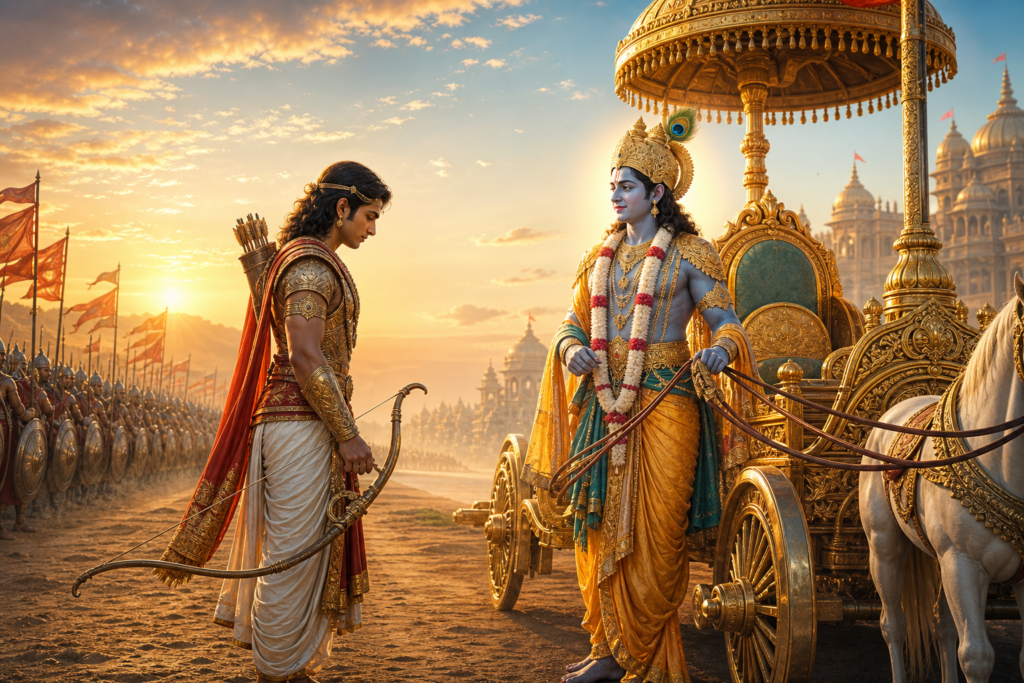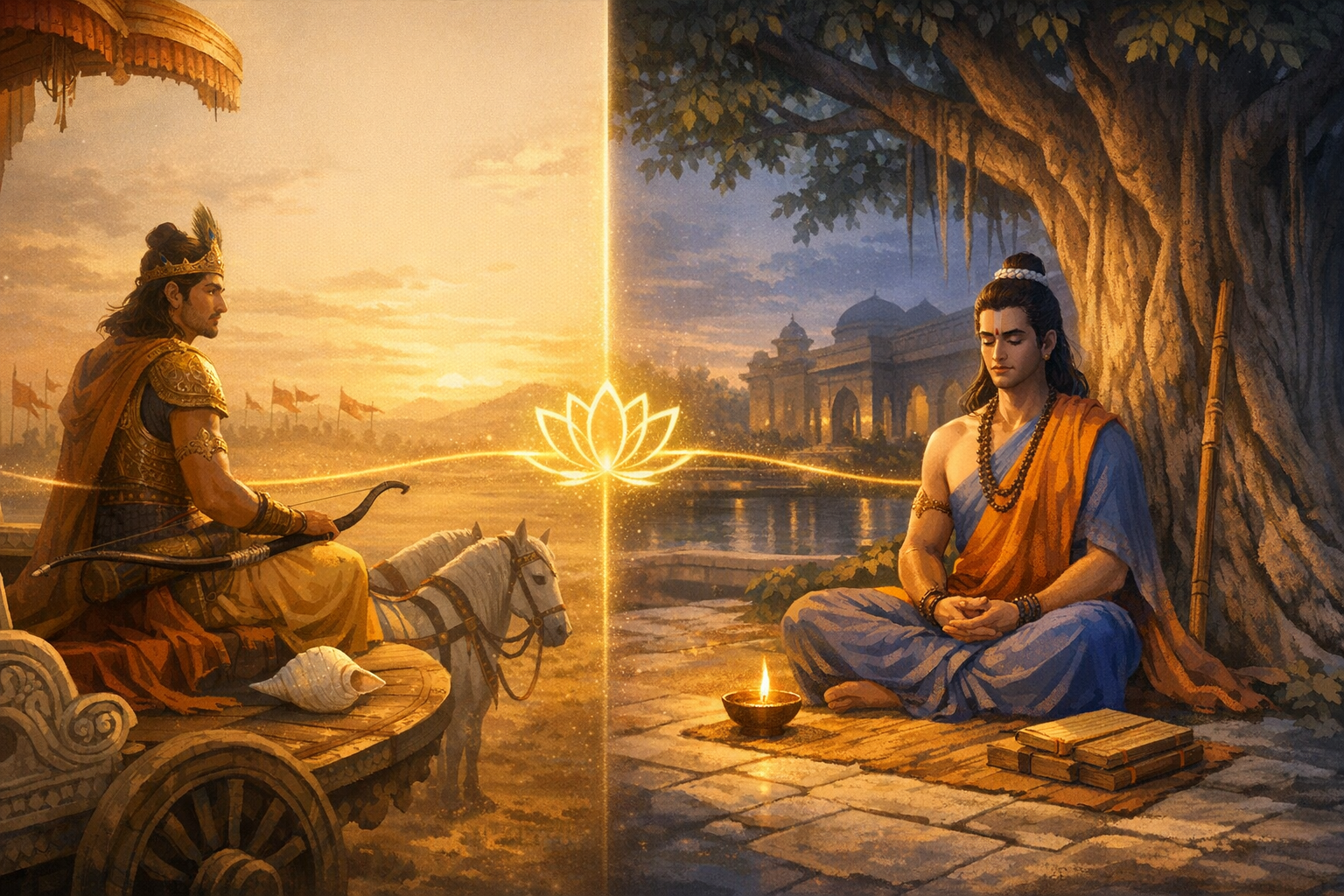
Two scenes of withdrawal anchor some of the most influential teachings in the Hindu philosophical canon: Arjuna’s refusal to fight at Kurukshetra in the Bhagavad Gita and Rama’s world-weary silence in the Yoga Vasishta. Outwardly both appear as renunciation, yet their inner sources diverge sharply. One is born of moha, a grief-clouded confusion that collapses moral judgment; the other rises as vairagya, a lucid and durable dispassion that ripens into inquiry. Understanding this difference clarifies why the Gita prescribes karma-yoga while the Yoga Vasishta unfolds jnana-centered vichara, and why both finally reaffirm dharma as compassionate participation in the world rather than withdrawal from it.
In the Gita, moha names a constricted cognitive-affective state in which memory, insight, and composure degrade under grief and attachment. In the Vasishta, vairagya names the cool clarity that follows deep discernment (viveka) regarding impermanence, causality, and the non-self-subsistence of experiences. Both are “turning points,” but only one is fit for decisive wisdom; the other must first be disentangled by reasoned guidance and disciplined action.
Arjuna’s crisis unfolds in the first chapter of the Bhagavad Gita. He surveys teachers, kinsmen, and friends facing each other on the battlefield and breaks down: the Gandiva slips from his hand, his skin burns, and he cannot stand firm. The ethical imagination floods with images of social collapse, adharma, and the sin of slaying elders; the will dissolves into “I will not fight.” The Gita names this opening movement as visada (despair), signaling not liberation but a diagnostic exposure of confusion.
Soon after, Arjuna articulates karpanya-doshathe defect of faint-hearted self-pityand confesses to dharma-sammudha-cetah, a mind bewildered about duty. He seeks instruction: “I am your disciple; teach me what is truly good for me.” This is a critical hinge. Having recognized the limits of his own judgment, he accepts the discipline of being taught, which sets the stage for a distinct resolution: not escape from action but purification of intention within action.
The Gita’s remedy is karma-yoga: action done without attachment to specific outcomes (nishkama) and consecrated to the highest principle. It rejects the fantasy that refraining from action suffices for freedom: “na karmanam anarambham naishkarmyam purusho ’shnute” (Gita 3.4). Instead, it installs buddhi-yogasteady, discerning intelligencein the heart of life’s work: “yoga-sthah kuru karmani” (2.48). The battlefield is not abandoned; it is re-understood as a field for disciplined offering, loka-sangraha (the welfare and cohesion of the world), and inner renunciation of anxiety and possessiveness.
To avoid confusing resignation with renunciation, the Gita differentiates sannyasa and tyaga and grades renunciation by the gunas (18.4–9). Renunciation in tamas (out of delusion or fear) is rejected; renunciation in rajas (for relief from discomfort) is unstable; only renunciation in sattvaduty performed while relinquishing craving for fruitsis praised. Arjuna’s initial retreat thus exemplifies a tamas-tinged withdrawal; the teaching elevates it to a sattvic, dharma-affirming participation.
The psychological outcome is a reconstitution of agency. The sthita-prajna (2.55–72) is not a passive figure; rather, a knower whose emotions are tranquil, whose senses are governed, and whose insight is stable. When Arjuna rises to act, it is not as an aggressor but as a steward of svadharma, integrated by inner equanimity. In this arc, moha dissolves into clarity, and renunciation is internal: the relinquishment of clinging, not of responsibility.
Rama’s withdrawal in the Yoga Vasishta begins from a profoundly different place. Having returned from pilgrimage and exposure to the full range of human experiences, he sits in a thoughtful silence that neither rebellion nor cowardice can explain. He describes the world’s flux, the unreliability of pleasures, and the mind’s endless projections. This is nirveda or vairagya: not depression but clear-sighted disenchantment, the ripeness that impels inquiry into what cannot be lost.
Vasishta meets this ripeness not with exhortations to fight or flee but with methodical vichara (philosophical inquiry) and contemplative training. The text’s architectureclassically enumerated as Vairagya, Mumukshu Vyavahara, Utpatti, Stithi, Upashama, and Nirvanamaps a curriculum from dispassion and aspiration through metaphysical clarity to the quieting of the mind and stabilized realization. Throughout, parables and thought experiments dissolve the mind’s reifications, inviting recognition that bondage and liberation are functions of understanding.
Where the Gita establishes purity of action by purifying intention, the Vasishta establishes purity of mind by purifying cognition. Vasishta does not trivialize action; rather, action is permitted or declined from the standpoint of knowledge, not compulsion. The culmination is jivanmukti: freedom while living, where one may rule, parent, teach, or retire with equal inner stillness. True vairagya neither resists nor clings; it simply refuses to confer ultimacy on the transient.
The contrast is therefore precise. Arjuna’s turning is crisis-induced and affect-laden; it requires the medicine of duty reinterpreted by insight, so that action itself becomes yoga. Rama’s turning is maturation-induced and insight-laden; it requires the medicine of inquiry, so that knowledge itself becomes the ground of effortless, appropriate action. Both reject escapism. Both return to the world healed: Arjuna to a dharma-yuddha rightly understood, Rama to Rama-rajya as just governance grounded in wisdom.
Ethically, the Gita treats the justice of action under unavoidable conflict, balancing compassion with responsibility to preserve order and protect the vulnerable. The Yoga Vasishta treats the justice of understanding, preventing metaphysical errors that fuel suffering regardless of one’s social position. Together, they outline a unity: responsibility without possessiveness, and contemplation without quietism.
Psychologically, the two states can be distinguished by energetic tone. Moha constricts, agitates, and fragments attention; it is allied with tamas and rajas and tends to indecision or rashness. Vairagya expands and clears attention; it resonates with sattva and tends to calm curiosity. A practical diagnostic emerges: if the mind pleads for escape while burning with anxiety, one is not yet renouncing but avoiding; if the mind stands quiet and lucid, one is prepared for inquiry or for action free of grasping.
Soteriologically, the Gita and Vasishta are complementary, not contradictory. The Gita emphasizes karma-yoga as a purifier that prepares the mind for deeper absorption, culminating in knowledge and devotion. The Vasishta emphasizes jnana-yogasravana, manana, nididhyasanaas the direct instrument of liberation, presupposing moral purity and attentional discipline. Both converge on inner relinquishment as the essence of tyaga, and both preserve compassion as the test of authentic realization.
This complementarity resonates with the broader dharmic family. Buddhism’s path integrates ethics (sila), concentration (samadhi), and wisdom (prajna), echoing the Gita’s call to disciplined action purified by insight and the Vasishta’s insistence on right view. Jainism’s vairagya, aparigraha, and samyak darshan similarly affirm renunciation as inner non-clinging, not social abdication. Sikhism’s seva and nirvair align with nishkama service and equipoise. Across these traditions, unity in spiritual diversity is not a slogan but a shared grammar of freedom and responsibility.
For contemporary practitioners, the two portraits offer a pragmatic sequence. When duty presses and the mind trembles, the Gita’s regimenclarify svadharma, consecrate action, relinquish fruits, and steady attentionprevents collapse into avoidance masquerading as spirituality. When maturity flowers as dispassion and the mind is calmly inquisitive, the Vasishta’s regimensustained vichara supported by meditationreveals the ground in which acting and not acting are equally transparent.
Common misunderstandings fall away under this lens. The Gita does not sacralize violence; it sacralizes responsibility clarified by wisdom under tragic necessity. The Vasishta does not endorse world-negation; it exposes the mind’s projections so that engagement is freed from compulsion. In both, authentic renunciation is measured by freedom from grasping, compassion for beings, and stability of mind, not by external posture alone.
Textual-historical notes also help situate the discussion. The Bhagavad Gita, embedded in the Mahabharata, synthesizes karma, bhakti, and jnana within an epic-ethical frame. The Yoga Vasishta, transmitted in several recensions and often associated with Advaita Vedanta, elaborates a contemplative metaphysics through narrative dialogues and parables. Their milieus differ, yet their counsel intersects around a single insight: only a purified mind can recognize and enact dharma without bondage.
Read together, Arjuna’s and Rama’s withdrawals offer a coherent pedagogy. Begin where one stands: if gripped by grief and indecision, take up karma-yoga and reform intention in action; if ripened in dispassion, turn to contemplative inquiry and stabilize understanding. In both cases, let compassion guide choices, remembering the Gita’s loka-sangraha and the Vasishta’s vision of effortless, beneficent presence.
This integrative reading serves unity across dharmic traditions. It honors multiple valid gatewaysethical action, devotion, meditation, and insightwithout collapsing their differences or enforcing uniformity. Diversity of method strengthens the common aim: liberation from suffering, flowering of wisdom, and the flourishing of communities grounded in justice and care.
Finally, the two renunciations disclose one Dharma-centered path. Renunciation born of moha must be transmuted into inner relinquishment through duty awakened by wisdom. Renunciation born of vairagya must be consummated in knowledge so transparent that action or stillness leave no trace of bondage. From Kurukshetra to Ayodhya, the teaching is consistent: act without clinging, know without conceit, and let compassion shape a world where spiritual diversity becomes a shared strength.
Inspired by this post on Hindu Blog.