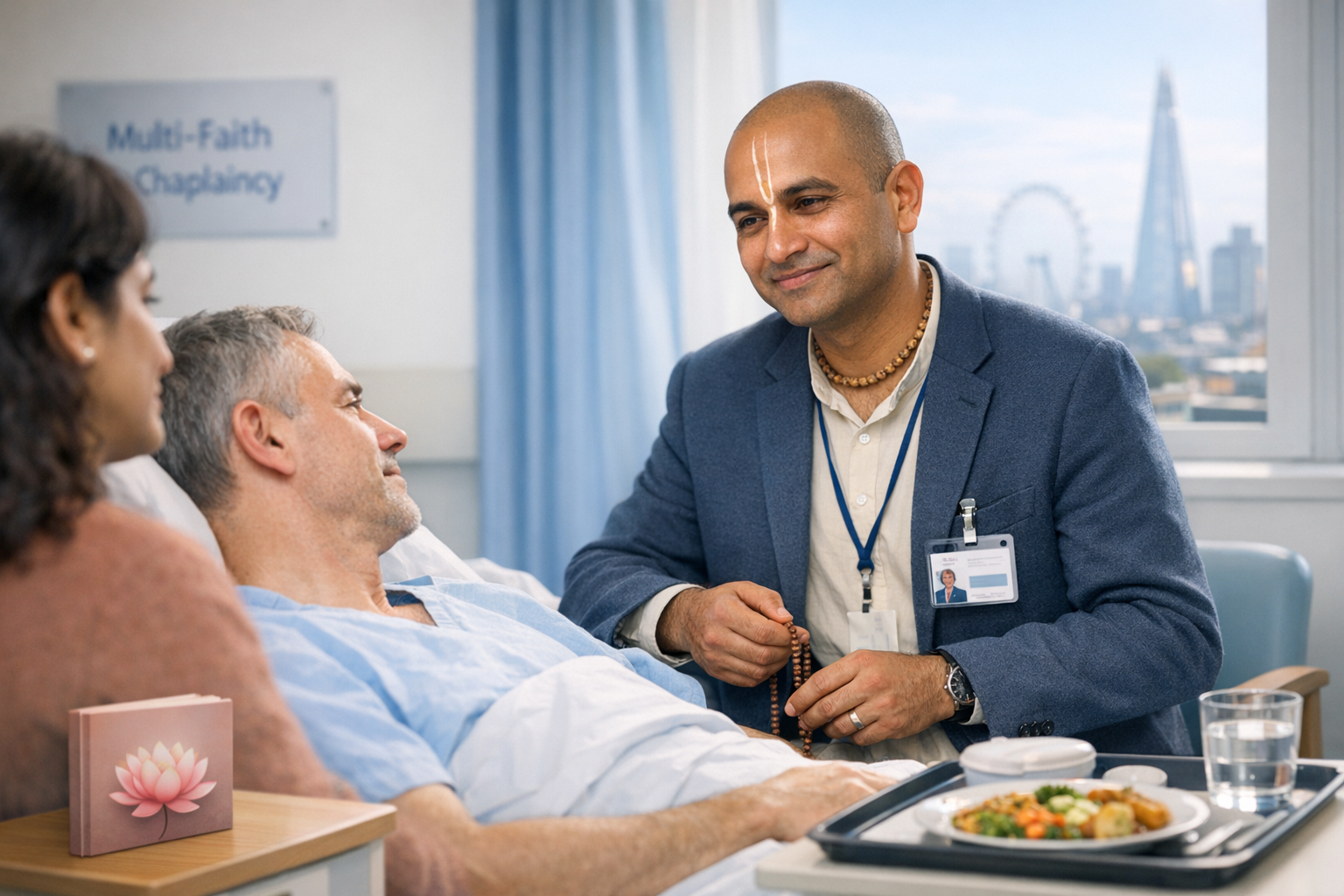
Bhaktivedanta Manor’s Devotee Care Team is advancing a structured chaplaincy initiative that prepares Hindu–Vaishnava practitioners to provide professional spiritual care across NHS hospitals, hospices, and care homes in Greater London and other UK cities with sizeable Dharmic communities. Rooted in ISKCON (International Society For Krishna Consciousness) principles of seva and bhakti, the programme complements existing multi-faith services with culturally competent support for patients, families, and staff at moments of acute vulnerability.
Within the UK healthcare landscape, pastoral, spiritual, and religious care is delivered through multi-faith chaplaincy teams in line with NHS guidance that emphasises equitable access, safety, and professionalism. The UK Board of Healthcare Chaplaincy (UKBHC) maintains a voluntary professional register and articulates competency expectations for chaplains and volunteers. Aligning with these frameworks, the emerging Hindu–Vaishnava chaplaincy pathway strengthens the capacity to meet the specific needs of Hindu patients while upholding the NHS commitment to inclusive, person-centred care.
Programme design focuses on rigorous recruitment, induction, and supervised practice. Candidate preparation typically includes modules in safeguarding (with enhanced DBS clearance), equality, diversity and inclusion, information governance, infection prevention and control, confidentiality, and professional boundaries. Structured reflective practice, clinical shadowing, and mentorship with experienced chaplains support a steady transition from volunteer support to advanced roles aligned with UKBHC competencies.
Technical capability is developed through evidence-informed approaches to spiritual assessment and communication. Trainees learn to apply structured frameworks such as FICA or HOPE for spiritual histories, integrate SBAR-style clarity when communicating with clinical teams, and document encounters in accordance with local policies. Skills in crisis intervention, bereavement support, end-of-life care, and ethical decision-making ensure safe, responsive engagement across clinical settings.
Professionalism is reinforced by governance practices common to UK chaplaincy services: supervised placements, reflective journaling, continuing professional development (CPD), and adherence to non-proselytisation standards. Consistent with NHS values, spiritual care is delivered only with patient consent and is shaped by patient-led goals, ensuring that spiritual and religious support enhances clinical care rather than competes with it.
Scope of practice spans acute wards, intensive care, oncology and palliative units, maternity and neonatal services, mental health settings, and community care. Hindu–Vaishnava chaplains contribute to multi-disciplinary team discussions where appropriate, advocate for religious and cultural needs, and offer debriefs or reflective spaces for staff following challenging events. Because London and other major cities host diverse South Asian communities, this chaplaincy builds bridges across clinical, cultural, and familial contexts.
Within a Vaishnava context, customary supports may include softly recited maha-mantra, guided meditation on the names of Krishna, or reading selections from the Bhagavad-gita, all adapted to ward policies and patient preference. Familiar religious artefacts—such as tilaka markings, japa mala, or Tulasi kanti-mala—are treated with respect and managed in accordance with hospital hygiene and safety guidance. For patients approaching end of life, coordination with families and community clergy helps facilitate appropriate rites and remembrance, always in partnership with hospice protocols.
Dietetics and ritual accommodation are frequent areas of practical impact. Chaplains liaise with catering and ward teams to support sattvic, lacto-vegetarian diets and to accommodate common Vaishnava preferences (for example, no onion or garlic) where clinically appropriate. Awareness of vrata and fasting observances such as Ekadashi allows teams to balance religious commitments with clinical safety, fostering trust and cultural safety without compromising medical care.
Palliative and bereavement support is a core competency. Hindu perspectives on the self (atma), karma, and compassionate remembrance can help patients and families frame difficult decisions with meaning and dignity. Chaplains coordinate with hospice staff to support quiet devotional practice at bedside, facilitate family presence consistent with policy, and ensure follow-on bereavement signposting within the community.
Consistent with the blog’s commitment to unity among Dharmic traditions, the training emphasises broad Dharmic literacy and collaboration. While grounded in Vaishnava bhakti, practitioners are trained to recognise and respect the distinct needs of Buddhists, Jains, and Sikhs—facilitating metta-bhavana or silent meditation upon request, supporting Jain ahimsa-informed dietary strictures, or liaising with Sikh colleagues for shabad kirtan or Ardas. This cooperative approach strengthens interfaith cohesion and ensures patients receive the right support at the right time.
Vignettes from practice illustrate the human impact. On an oncology ward, a patient’s anxiety eased after hearing the maha-mantra softly recited during a difficult night, with nursing staff reporting improved rest. In a hospice setting, coordinating a no-onion, no-garlic vegetarian diet brought tangible comfort to a devotee who had struggled to eat. In a surgical ward, signposting to a Sikh chaplain enabled a family to arrange appropriate prayers before a complex procedure. Each instance reflects patient-led care that honours tradition while integrating seamlessly with clinical priorities.
Candidate qualities associated with effective Hindu–Vaishnava chaplaincy include emotional steadiness, attentive listening, cultural fluency, and a disciplined personal practice that sustains presence in crisis. Training reinforces non-judgemental stance, trauma awareness, and capacity to recognise when to escalate or refer to mental health professionals, safeguarding teams, or alternative faith representatives. These habits of safe practice align with NHS safeguarding and professional accountability expectations.
Evidence from pastoral and spiritual care research indicates that well-delivered chaplaincy can improve patient experience, strengthen shared decision-making, and reduce feelings of isolation—particularly near end of life. In multicultural urban systems such as London, culturally congruent spiritual care also enhances staff confidence in meeting religious needs, reduces avoidable tensions, and supports equity commitments central to the NHS Long Term Plan.
Operationally, Hindu–Vaishnava chaplains coordinate with Trust chaplaincy leads to establish on-call coverage, define referral pathways from wards, and clarify documentation practices. Orientation sessions for ward staff introduce core Hindu and wider Dharmic practices, dietary frameworks, modesty considerations, and family decision-making patterns. This shared understanding allows clinicians and chaplains to act as a single compassionate team.
Digital and telephone chaplaincy, used extensively during pandemic restrictions, remain valuable options for patients and carers who cannot meet in person. Quiet bedside prayer via phone, video-enabled family participation in rites, or post-discharge check-ins (as locally approved) illustrate how technology can extend reach while respecting consent and confidentiality requirements.
Community integration is central to continuity of care. Chaplains liaise with temples, gurdwaras, sanghas, and Jain sanghs for aftercare, bereavement groups, and practical support. This community linkage honours the Dharmic emphasis on shared duty (dharma) and compassionate service (seva), while easing the transition from hospital to home or hospice.
Ethical practice is non-coercive, consent-based, and grounded in respect for religious plurality. Chaplains do not proselytise; they respond to expressed needs, uphold confidentiality, and advocate only for accommodations that are safe, proportionate, and clinically indicated. This stance both protects patients and preserves the integrity of the clinical environment.
The initiative is designed for scale across regions with significant Hindu and broader South Asian populations, including London and major cities such as Leicester, Birmingham, and Manchester. A hub-and-spoke approach—anchored by training at Bhaktivedanta Manor—enables consistent standards, local adaptability, and rapid response to trust-level priorities.
Quality assurance includes supervised caseloads, reflective portfolios, periodic observation, and CPD tracking in line with local policy and UKBHC expectations. Service evaluation may draw on patient-reported experience measures, feedback from ward teams, and audits of dietary or ritual accommodations. Transparent learning cycles ensure that spiritual care remains safe, inclusive, and demonstrably beneficial.
In sum, the ISKCON chaplaincy pathway strengthens the UK’s multi-faith care model by offering evidence-aligned, culturally fluent, and compassion-driven Hindu–Vaishnava support. By embracing unity among Dharmic traditions and collaborating across faith teams, the programme enhances patient dignity, supports families through crisis and loss, and equips NHS staff to meet spiritual needs with confidence and respect.
Inspired by this post on Dandavats.