Saturday, February 28, 2026 (Hindu Calendar, Panchang): In most regions, the day carries Shukla Paksha Dwadashi the twelfth lunar day of the waxing phase until 8:04 PM. From that time onward, it becomes Shukla Paksha Trayodashi, the thirteenth lunar day of the light fortnight.
These February 28, 2026 Tithi timings in the Panchang are central to household worship, temple routine, and vrata observances across communities. The attention to the lunar calendar strengthens a shared rhythm that is familiar not only in Hindu traditions but also resonates with the lunar mindfulness seen in Buddhism, Jainism, and Sikhism, fostering a sense of inter-dharmic unity grounded in time-honored calendrical practice.
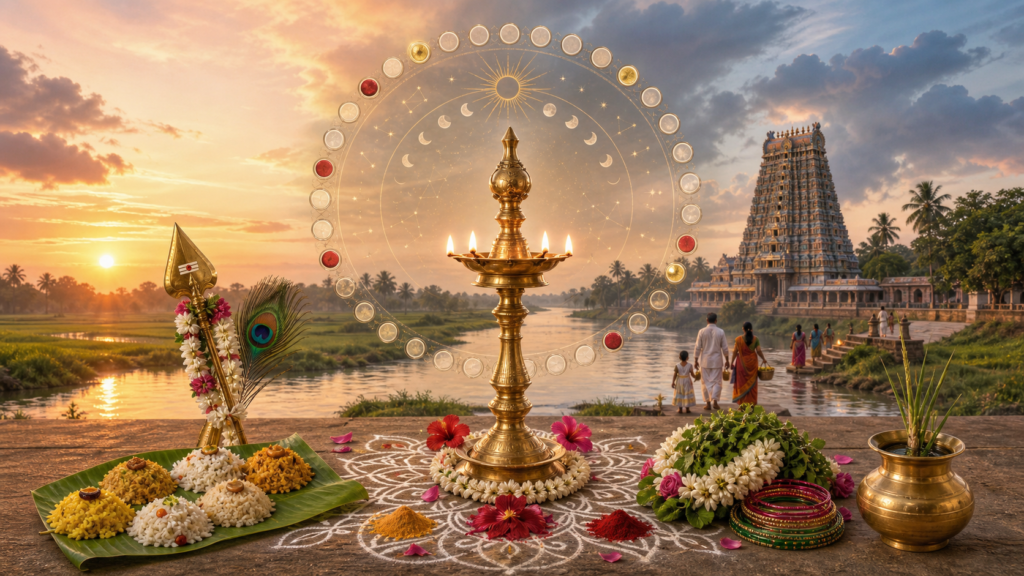
Technical definition (Tithi): A tithi marks each 12° increment of the Moon’s elongation from the Sun. Thus, the 30 lunar days (15 in Shukla Paksha and 15 in Krishna Paksha) complete a synodic month. Shukla Paksha Dwadashi corresponds to the Moon–Sun angular separation from 132° to 144°; Shukla Paksha Trayodashi spans 144° to 156°. Because the Moon’s apparent motion is variable, tithi lengths are not uniform in clock time, and their start and end can occur at any hour of the civil day.
Implication for February 28, 2026: With Shukla Paksha Dwadashi lasting until 8:04 PM and Trayodashi beginning thereafter, morning and afternoon activities align with Dwadashi. Evening practices after 8:04 PM align with Trayodashi, subject to local time, longitude, and sunrise/sunset at one’s location. In practice, local Panchang data should be consulted to confirm the precise transition.
Religious observances: Dwadashi is traditionally associated with Sri Vishnu’s worship and, in many households, is the day for parana (completion of the Ekadashi fast) when Ekadashi has concluded the preceding day. Families often emphasize sattvic meals, dana (charity), and quiet japa. The progression into Trayodashi may orient attention to evening worship and preparation for Pradosha if Trayodashi is present during the local Pradosha kala. These rhythms cultivate mindfulness that many practitioners across dharmic paths recognize as a shared anchoring to lunar time.
Good time (Shubh Muhurat) frameworks on this date: Apart from the tithi, practical muhurta selection often references Brahma Muhurta (roughly 1.5 hours before sunrise) for meditation and study, and Abhijit Muhurat around local solar noon for balanced undertakings. Because muhurta is location-dependent, the same date can yield different windows of auspiciousness by city and latitude; local sunrise and sunset times must be used for accuracy.
Rahu Kalam, Yamaganda, and Gulika (Saturday method): Daylight is divided into eight equal parts from local sunrise to sunset. On Saturdays, Rahu Kalam falls in the second segment of daylight (traditionally avoided for new beginnings), Yamaganda in the sixth, and Gulika in the first. To compute precisely, determine the total daylight duration for the location, divide by eight, and map the segments to the day’s scheme; adjust the resulting intervals to the actual sunrise in that locale.
Abhijit Muhurat (midday window): Abhijit spans a short interval centered on local solar noon (not clock noon if the time zone is offset from the location’s meridian). Many practitioners use it for activities requiring clarity and steadiness. On February 28, 2026, the Abhijit Muhurat should be computed from the location’s solar transit time to ensure precision.
Choghadiya guidance (daytime and nighttime): Choghadiya divides day and night into segments labeled Amrit, Shubh, Labh (generally auspicious) and Kal, Rog, Udveg (to be used cautiously). Because segment ordering depends on weekday and sunrise/sunset, the February 28, 2026 Choghadiya for Saturday must be generated from local solar events. This offers a practical, region-sensitive way to refine auspicious windows amid Dwadashi transitioning to Trayodashi.
Nakshatra and Rashi (Moon’s placement): Nakshatra is determined by the Moon’s ecliptic longitude through the 27 equal divisions of 13°20′ each; Chandra Rashi (Moon sign) follows the 12-sign zodiac of 30° each. Because the Moon moves quickly, nakshatra today and rashi today can shift within the same civil day depending on time and location. For rigorous accuracy on February 28, 2026, use a standard astronomical ephemeris or a trusted local Panchang to read the Moon’s longitude and then identify the corresponding Nakshatra and Rashi.
Yoga and Karana (additional Panchang limbs): The classical Panchang tracks five limbs vara (weekday), tithi, nakshatra, yoga, and karana. Yoga (based on the sum of solar and lunar longitudes) and karana (half-tithi divisions) refine the qualitative feel of the day. As with nakshatra and rashi, these parameters on February 28, 2026 vary by locality and exact time and should be consulted from a precise Panchang to complement the tithi-based view.
Trayodashi and Pradosha consideration: Pradosha Vrat is observed when Trayodashi prevails during the local Pradosha kala (around sunset). If, at a given location on February 28, 2026, Trayodashi does not begin until after the local sunset, Pradosha would not be observed that evening; conversely, if Trayodashi has begun before sunset, it would qualify (and, because it is Saturday, be identified as Shani Pradosh). The 8:04 PM transition time provided applies to most regions but must be verified against local sunset for the proper observance rule.
Regional calendrical notes: Around late February, different regional schools may refer to the month as Magha or Phalguna depending on whether the amanta (month from new moon to new moon) or purnimanta (month from full moon to full moon) convention is followed. This does not change the tithi sequence but can alter month names printed in regional Panchangs for the same Gregorian date.
Step-by-step for location-specific accuracy on February 28, 2026: (1) Obtain local sunrise and sunset times; (2) Confirm tithi start and end to verify Dwadashi until 8:04 PM and Trayodashi thereafter for the locality; (3) Derive Rahu Kalam, Yamaganda, and Gulika by dividing daylight into eight equal parts and applying the Saturday scheme; (4) Compute Abhijit Muhurat using local solar noon; (5) Read the Moon’s ecliptic longitude from an ephemeris to determine Nakshatra and Chandra Rashi; (6) Cross-check Yoga and Karana to complete the five-limb Panchang picture.
Practical rhythm for the day: Many households complete Ekadashi-related parana on Dwadashi morning, maintain a sattvic routine through the afternoon, and, where applicable, prepare for Trayodashi-sensitive evening worship after the transition. The gentle cadence from Dwadashi to Trayodashi encourages steadiness, gratitude, and mindful action values deeply shared across Hinduism, Buddhism, Jainism, and Sikhism in their respective reflections on time, discipline, and compassion.
Summary for quick reference: Saturday, February 28, 2026 Shukla Paksha Dwadashi prevails until 8:04 PM; thereafter Shukla Paksha Trayodashi. Select auspicious times (Shubh Muhurat) using local Brahma Muhurta, Abhijit, and Choghadiya; avoid Rahu Kalam (Saturday’s second daylight segment). Determine nakshatra today and rashi today from a precise Panchang for the location. Observe Pradosha only if Trayodashi is present at local sunset (Shani Pradosh in that case). This date’s Panchang encourages harmonized practice and inter-dharmic goodwill grounded in careful, location-aware timekeeping.
Inspired by this post on Hindu Blog.