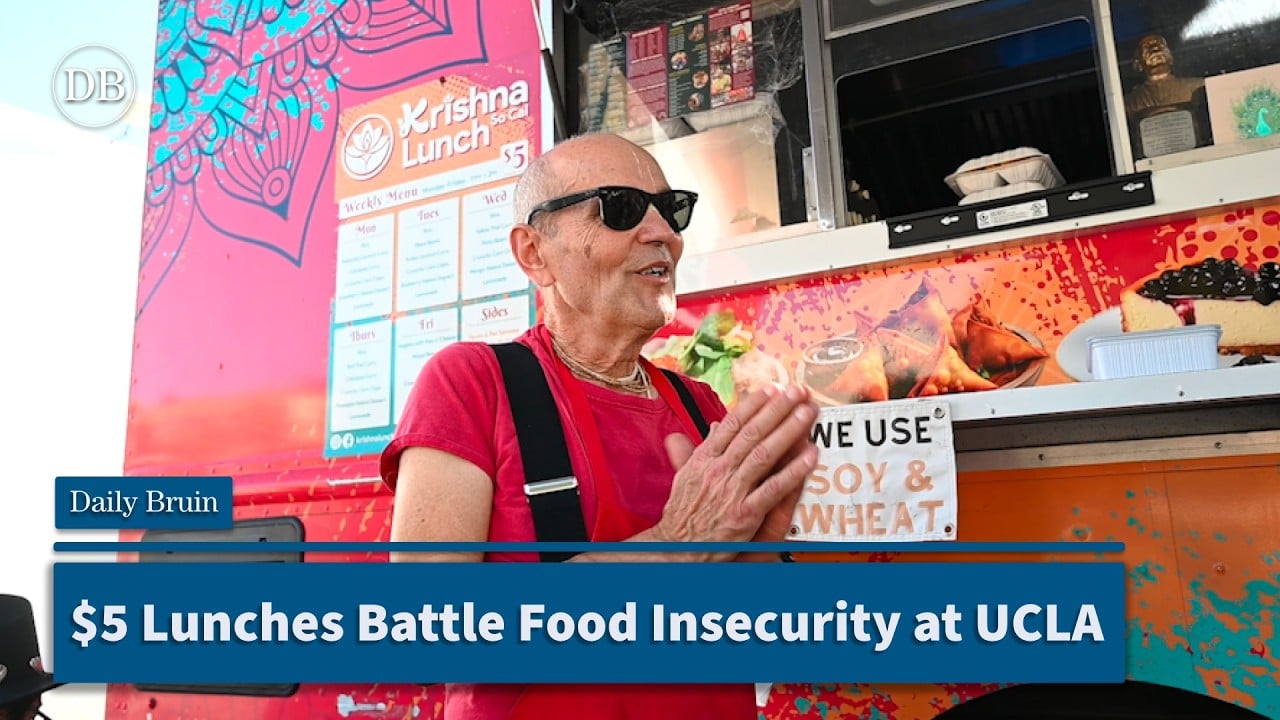
In Westwood, a quiet, consistent act of service has become a lifeline for students navigating the high cost of living and the volatility of campus schedules. The Krishna Lunch program, profiled in a Daily Bruin video, offers $5 lunches that directly address student food insecurity while preserving dignity, community, and cultural continuity. At the heart of this effort are Govinda Datta Dasa and Shantatma, who begin cooking at approximately 5:30 AM and often return home around 7 PM, five days a week, to ensure that nutritious, low-cost meals meet students where they arephysically, financially, and emotionally.
Daily Bruin’s portrait of Govinda Datta Dasa situates the initiative within the living tradition of the Hare Krishna movement (a Hindu devotional movement centered on Krishna). The program translates devotion into social service, channeling spiritual discipline into well-organized, community-oriented food distribution. In doing so, it exemplifies how faith-based community kitchens can operate as agile, dignity-first responses to a pressing public-health and educational challenge: campus food insecurity.
Food insecurity among college students is now widely acknowledged across the United States. It manifests not only as insufficient caloric intake, but also as inconsistent access to nutritious, affordable meals that support concentration, mental health, and academic performance. Westwood’s elevated costs for housing and dining intensify this challenge, making the flat $5 price point more than symbolic; it is a pragmatic design choice that narrows the gap between limited student budgets and sustained daily nourishment.
The operational cadence describedstarting pre-dawn and returning late eveningsignals more than hard work; it reflects an integrated service model. Early hours enable large-batch preparation, careful quality control, and predictable service windows for students moving between classes. The five-day rhythm aligns with academic routines, building trust through reliability and a shared expectation that a meal will be available when needed.
The program’s animating ethic is sevaselfless servicea concept that runs through Hindu spirituality and, more broadly, dharmic traditions. In Vaishnava practice, preparing food in devotion and sharing it with the community forms a core expression of compassion-in-action. The meal becomes more than a transaction; it becomes a social and spiritual connector, a site where nutritional adequacy, cultural memory, and mutual respect reinforce one another.
This ethic resonates across dharmic lineages. Sikh langar institutionalizes free, dignified community meals; Buddhist dana emphasizes generosity and shared well-being; Jain commitments to compassion and restraint encourage mindful, non-harmful consumption. Placed within this larger landscape of service, the Krishna Lunch program exemplifies a unifying principle: nourishing bodies and minds through care, simplicity, and respect for the diversity of human experience.
Crucially, the $5 model advances a dignity-centered approach. Instead of positioning students as recipients of charity, a modest flat fee welcomes participation without stigma. This reduces barriers to entry, normalizes help-seeking, and fosters a sense of mutual responsibility between providers and participants. Over time, such design principles can shift campus norms: accessing an affordable, nutritious lunch becomes an ordinary, community-affirming act rather than a sign of personal crisis.
From a nutritional and behavioral-health perspective, consistent access to home-style meals can stabilize energy levels, reduce reliance on ultraprocessed snack foods, and improve focus during peak academic hours. The predictability of a daily, low-cost lunch also mitigates decision fatiguea frequent, underappreciated burden for students managing coursework, employment, and tight budgets. Predictability and routine, in this context, are themselves forms of care.
While the Daily Bruin profile emphasizes people and purpose, the program’s evident operational rigor merits attention. Early-morning batch cooking increases throughput while enabling tighter cost controls; a repeatable menu cadence streamlines procurement; and consistent service windows simplify student planning. Each of these choices reflects a system-level understanding: that affordability, quality, and reliability are co-dependent, not competing, objectives in a successful community kitchen.
The Westwood context raises an additional dimension: community kitchens can function as social infrastructure that complements campus food closets, financial aid offices, and basic-needs programs. Where pantries provide staples students prepare themselves, ready-to-eat meals address time scarcity, limited kitchen access, and gaps in cooking skills. When harmonized, these supports create a full stack of solutionsingredients, prepared meals, and guidancethat reduce the frictions that otherwise push students toward skipping meals or making poor dietary substitutions.
Programs like Krishna Lunch also forge social connections that are protective in their own right. Lines become informal meeting points; the act of sharing a meal fosters conversations across majors, years, and cultural backgrounds. For many students, that regular, welcoming touchpoint can reduce stress, expand peer networks, and increase familiarity with dharmic traditionsHindu spirituality in particularthrough lived, tangible experience rather than abstraction.
The Daily Bruin’s focus on Govinda Datta Dasa highlights the human engine behind the system. Sustaining a five-day schedule from early morning to evening requires discipline, logistical skill, and a service mindset. In this frame, devotion and management are not opposites; they are partners. Faith provides motive force and resilience; organizational method delivers safety, consistency, and scalability.
For campus and municipal stakeholders evaluating impact, several outcome domains are salient: reduced self-reported food insecurity among regular participants; improved meal regularity; lower monthly food expenditures; perceived dignity and inclusion; and increased student engagement in volunteerism. Tracking these outcomes over time can inform resource allocation, refine service windows, and calibrate price points without compromising accessibility.
A modest, flat-fee model also supports financial sustainability. Even partial cost recovery through a predictable price point can stabilize procurement and planning, especially when paired with donations in kind, community partnerships, or occasional volunteer support. Importantly, a single, clearly communicated price minimizes administrative overhead and avoids gatekeeping dynamics that can introduce stigma.
Policy alignment and compliance are equally vital. Community kitchens operating in urban centers typically coordinate with local health departments, observe standard food-safety protocols, and adopt transparent, repeatable procedures for preparation, storage, and service. When these systems are embedded in a stable weekly cadence, risk decreases and confidence grows among students, campus administrators, and neighbors alike.
The broader implications for higher education are significant. Food insecurity is not only a welfare issue; it is an academic one, with downstream effects on retention, grade performance, and time-to-degree. By intervening at the level of daily routineand making wholesome lunch a predictable constantprograms like Krishna Lunch function as upstream academic support, translating cultural values into educational equity.
There is also a durable lesson in pluralism. The Krishna Lunch program advances a Hindu expression of seva while harmonizing with dharmic analogues: the communal meal of Sikh langar, the generosity of Buddhist dana, and the compassion-centered ethics found in Jain practice. This alignment underscores a shared civilizational insight: communities become resilient when nourishment is treated as a common good, offered with humility and without coercion or sectarian gatekeeping.
For institutions considering replication, three elements tend to be decisive. First, a clear, affordable price point that prevents stigma and enables predictable planning. Second, a reliable schedule that maps to class timetables, ensuring meals appear when need is highest. Third, an operational culture rooted in caresevathat treats every guest with respect, turning a simple meal into a restorative social ritual. Within that framework, partnerships with student groups, campus services, and local vendors can be layered to achieve scale without sacrificing quality.
Ultimately, the Daily Bruin profile of Govinda Datta Dasa and the Krishna Lunch program documents more than a budget-friendly offering. It reveals how spiritual conviction, cultural tradition, and practical management can converge to solve a complex, real-world problem on a modern campus. By centering dignity, reliability, and community, this $5 lunch in Westwood demonstrates that an age-old dharmic principlefeeding others as an expression of love and dutyremains one of the most effective, unifying tools for student well-being and educational success.
Inspired by this post on Dandavats.