
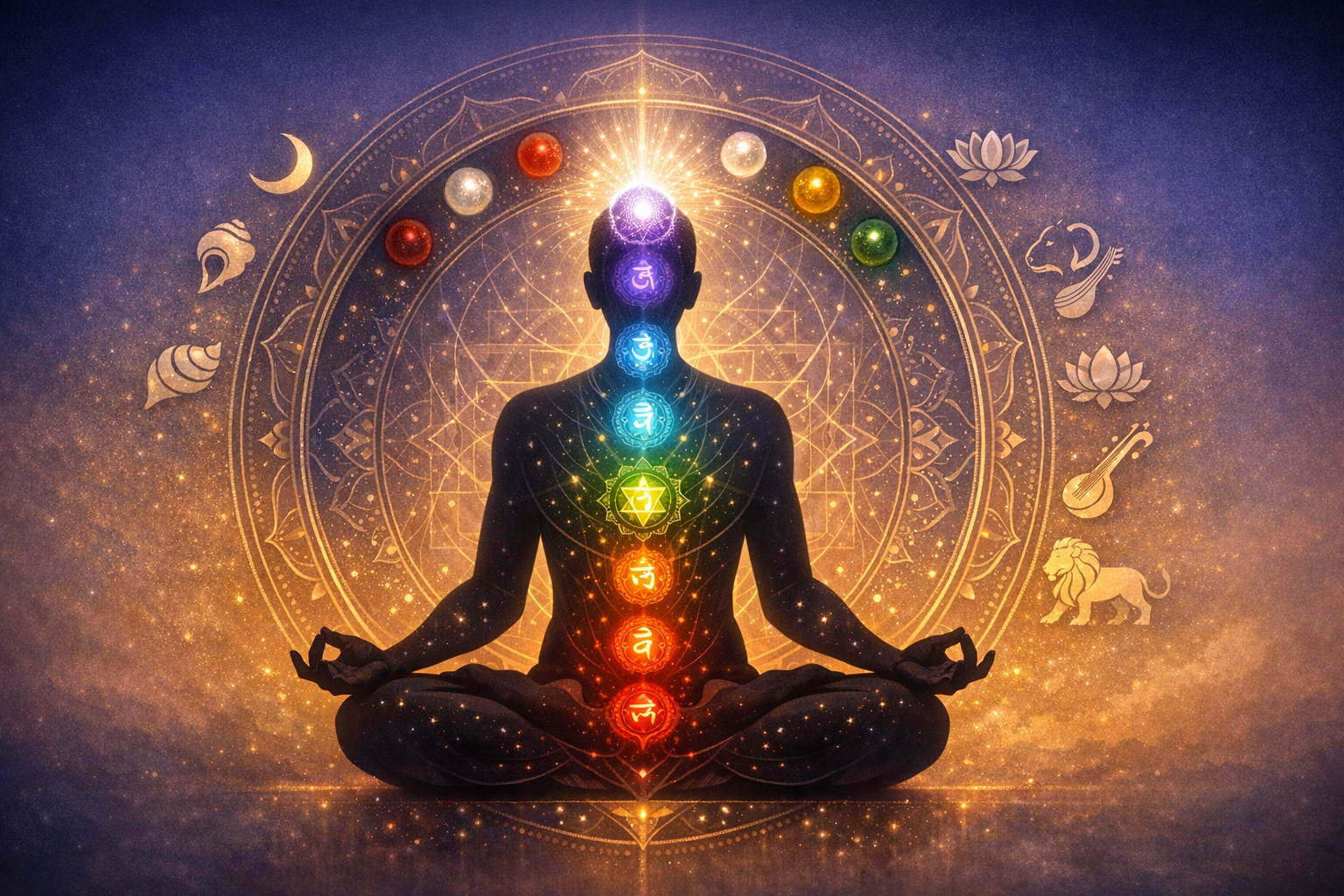
In Hindu traditions, sound is not limited to communication; it is a primary expression of cosmic intelligence. This vision, often summarized as nada brahma or sound as the ground of reality, frames mantras as distilled vibrations that shape mind, meaning, and experience. Alongside this acoustic potency, many lineages teach that mantras possess a visual radiance, a subtle color or light quality that can be contemplated to deepen meditation and ritual focus.
Mantras are defined by their structure and intentionality: phonemes and seed-syllables, measured by chandas, devoted to a devata, empowered by shakti, and guarded by kilaka. Within this matrix, color operates as a contemplative aid and a symbol system, aligning sound with sensory imagery to steady attention. The Sanskrit term varṇa, in different contexts, denotes both letter and color, hinting at an old intuition that speech-sounds and hues share a subtle kinship in consciousness.
This color dimension is not a single, universally fixed code; it arises from multiple streams: Shakta and Tantric visualization practices, Yoga texts, temple iconography, and ritual materials. In practical terms, it functions as upaya, a skilful means to cultivate dharana, deepen japa, and harmonize inner perception. Approached with clarity and humility, it strengthens contemplative practice without demanding dogmatic uniformity.
Across the dharmic family, this sound-light understanding appears in diverse yet resonant forms. Hindu mantras, Buddhist dharanis and seed-syllables, the Jain Namokar Mantra, and Sikh Naam Simran each highlight sacred utterance as a path to inner luminosity and ethical clarity. Recognizing these shared intuitions fosters unity in spiritual diversity while honoring the distinctive vocabularies of each tradition.
Color is most frequently taught today through the subtle-body paradigm of chakras, nadis, and prana. While classical descriptions vary across texts and commentaries, many modern lineages align the seven principal centers with a visible spectrum for ease of contemplation. Works such as the Shat-chakra-nirupana, along with later Yoga and Tantra manuals, inform these contemplations, even as teachers acknowledge legitimate variations in hue and emphasis across schools.
One widely used mapping pairs chakra bija mantras and elemental qualities with specific colors to facilitate dharana. Muladhara with lam is often visualized as red, Swadhisthana with vam as orange, Manipura with ram as yellow or gold, Anahata with yam as green, Vishuddha with ham as blue or turquoise, Ajna with om or a cognate seed as indigo or violet, and Sahasrara with the contemplative silence of om as violet, white, or a radiant blend. These correspondences function as practice aids; they are not dogmatic requirements and may be adapted according to guidance received from a qualified teacher.
Beyond chakras, color associations are derived through multiple lenses: the elemental tattvas, guna theory, the iconographic palette of deities, planetary traditions in Jyotisha, and the temporal grammar of worship. The confluence of these sources explains why colors assigned to the same mantra can differ by lineage, region, or intended outcome while still serving contemplative stability and devotional intimacy.
Om is a foundational example. As the pranava, it is contemplated as a complete spectrum coalescing into luminous white, violet, or gold. Many visualize Om at Ajna or Sahasrara as a radiant stillness in which distinctions of hue resolve, reflecting its role as a seed of integration across body, breath, and awareness. This approach naturally resonates with Buddhist contemplations on seed-syllables and Sikh reflections on the luminous Name.
The Gayatri Mantra, devoted to Savitar, is commonly meditated upon with a golden, dawn-like brilliance that evokes clarity and ethical discernment. Its color emphasis emerges from the imagery of rising light and from the mantra’s use in sandhya, the transitional brilliance of morning and evening. Many visualize the syllables as radiant streams of gold entering the heart and the brow, aligning aspiration with understanding.
The Maha Mrityunjaya Mantra to Tryambaka Shiva is frequently linked to ash-white, moon-silver, and a healing green aura. Ash and moonlight mirror Shiva’s iconography, while a gentle green visualization is used by some lineages to suggest cellular renewal, equanimity, and compassionate strength. The aim is not rigid symbolism but to cultivate steadiness and fearlessness before impermanence.
Sri Vidya and allied Shakta traditions offer nuanced color tonality for seed mantras frequently used in practice. Aim, associated with Saraswati, is often contemplated as white or pale yellow, reflecting knowledge and clarity. Shrim, linked with Lakshmi, is visualized as golden or radiant yellow, signaling abundance and auspiciousness. Hrim, a powerful heart seed, is visualized as deep crimson or ruby light, connoting creative potency and spiritual magnetism. Klim, a Kama bija used for attraction in a broad, transformative sense, is often held as rosy-crimson or soft ruby glow. These hues support stable attention when used with care and ethical intention.
Ganesha mantras such as gam frequently carry orange-red or vermilion tones. The color arises from both ritual materials like sindura and turmeric, and the association of Ganesha with Muladhara, the elemental steadiness of earth, and the auspicious removal of obstacles at the foundation of endeavor.
Durga mantras, including dum, are commonly visualized as red, evoking protective shakti, courage, and the dynamism of sattvic power facing adversity. Kali mantras such as kreem may be held as blue-black or smoky indigo, pairing fierce compassion with the spaciousness that dissolves fear and attachment. Each palette supports a distinct devotional mood and contemplative effect.
Vishnu-oriented mantras, including om namo narayanaya, often combine a deep oceanic blue with a golden aura, integrating preservation, balance, and grace. Shiva-oriented mantras, such as om namah shivaya, are visualized by many as ash-white, silver, or indigo, mirroring the ascetic calm and boundless awareness commonly expressed in iconography and hymn.
Devotional mantras for Rama and Hanuman frequently include saffron, gold, and warm sunrise tones. Saffron suggests valour tempered by dharma, while gold reflects steadfast devotion and uplift. Practitioners describe that visualizing these warm hues during japa stabilizes attention and inspires disciplined service.
Navagraha mantras reflect established color correspondences in Jyotisha. Surya is golden-red, Chandra is white-silver, Mangala is red, Budha is green, Guru is yellow-gold, Shukra is white, Shani is dark blue or indigo, Rahu is smoky indigo-gray, and Ketu is smoky white or orange-white. These colors guide offerings, attire, and visualization in remedial practice, while teachers caution against mechanical or fear-driven application divorced from ethical living.
Parallels appear in related dharmic streams. In Vajrayana Buddhism, mantras such as om mani padme hum are linked to a spectrum of six colors, integrating compassion with wisdom and the purification of afflictive states. In Jain practice, the Namokar Mantra is often contemplated as pristine, luminous white, reflecting nonviolence, purity, and equanimity. Sikh Naam Simran places emphasis on the radiant remembrance of the Divine Name, experienced by many as white-gold or clear brilliance. Together these approaches underscore a common insight: sacred sound and inner light co-arise within contemplative life.
From a contemporary lens, psychoacoustics and neurophenomenology suggest plausible mechanisms for these experiences without reducing them to mere physiology. Sustained chanting modulates breath, lengthens exhalation, and gently stimulates the vagus pathway, supporting parasympathetic balance and attentional stability. Cross-modal imagery, including spontaneously perceived color, is a known feature of human cognition, and in some individuals approaches synesthetic vividness. Mantra and color practice, therefore, may work by coupling rhythmic sound, steady breath, and structured imagery to entrain attention and emotion.
This does not negate traditional explanations grounded in prana and subtle anatomy. Rather, it offers a complementary account of why specific sadhanas effectively calm the nervous system, enhance focus, and cultivate resilience. Crucially, both frames emphasize consistent practice, humility, and ethical orientation as prerequisites for authentic progress.
A practical approach to color-inflected mantra practice can be structured in stages. First, articulate sankalpa, the clear intention of practice aligned with dharma. Second, select a mantra transmitted by a trustworthy lineage or teacher. Third, adopt a simple seat, steady the spine, and allow breath to settle into an even rhythm. Fourth, visualize the chosen color softly at the associated chakra or heart center while reciting japa, keeping the visualization gentle, stable, and non-strained.
Fifth, pair sound and light with count using a mala, letting the hand rhythm complement breath and syllable. Sixth, conclude in silence, allowing residual color and tone to dissolve into open awareness. Seventh, maintain a brief journal to note effects on mood, clarity, and ethical conduct, keeping attention on steady transformation rather than dramatic experiences. Guidance from an experienced mentor is recommended for intensive practice.
Seasonality, time of day, and directionality refine these contemplations. Dawn practice with Gayatri amplifies golden radiance and clarity; evening japa may lean toward cooling or moonlike hues. Solar mantras harmonize with eastward orientation and steady, bright visualization, while heart-centered mantras on compassion pair well with soft green at Anahata. These refinements emerge from living traditions rather than rigid rules, adapting practice to context and constitution.
Ritual materials concretize the palette. Kumkum, haldi, chandan, and vibhuti carry stable color cues that echo visualization: red for protective shakti, yellow-gold for auspiciousness and prosperity, sandalwood’s pale calm for clarity, ash-white for purity and renunciation. Lamp light, flower selection, and alankara function as embodied color mantras that educate the senses and the heart.
Yantra, nyasa, and murti dhyana further integrate sound and color. Yantras are often rendered with deliberate color families to signal tattva and deity qualities while providing a visual grid to steady attention. In nyasa, syllables are touched to body regions as subtle light, training awareness to perceive the body as sanctified space. Murti dhyana, with its rich iconographic language, instructs perception so that mantra, hue, and gesture align as a single contemplative whole.
Ethics is the interpretive key. Yama and niyama ground mantra practice, and color contemplation is never a substitute for truthfulness, restraint, nonviolence, or generosity. A sattvic lifestyle stabilizes perception, making both sound and light vivid without strain. From this base, color serves not spectacle but sincerity, quietly aligning inner life with compassionate action.
Common pitfalls include reifying one color chart as the only truth, chasing dramatic inner imagery, or divorcing practice from ethical commitments. Teachers consistently encourage gentle visualization, steady japa, and readiness to let colors evolve with understanding. Where health conditions or psychological sensitivities exist, moderation and mentorship are essential.
Historically minded readers may note that classical texts present varied palettes. Shat-chakra-nirupana, Hatha Yoga Pradipika, and allied works emphasize function and experience over uniform chromatic systems. Modern pedagogy often adopts the visible spectrum for accessibility while preserving lineage-specific details in advanced instruction. This layered approach explains both the continuity and the diversity evident across Hindu, Buddhist, Jain, and Sikh contemplative cultures.
In sum, the colors of Hindu mantras are a pedagogical grace, a way to let sacred sound bloom in contemplative light. Through careful alignment of sound, breath, and hue, practitioners report enhanced focus, emotional regulation, and a felt sense of proximity to the divine. When framed within shared dharmic values, these practices nurture unity in diversity, honoring distinct lineages while celebrating a common pursuit of wisdom and compassion.
Inspired by this post on Hindu Blog.
