The Muktikopanishad stands as a compelling articulation of Vedic wisdom within the broader corpus of the Upanishads. Often classed as a “minor” Upanishad, it has nevertheless shaped philosophical study and spiritual practice because it translates profound metaphysics into an organized, practicable roadmap to liberation. Traditionally assigned to the Shukla Yajurveda, the Muktikopanishad presents a pedagogically rich dialogue and a structured canon that continue to inform both academic scholarship and contemplative life.
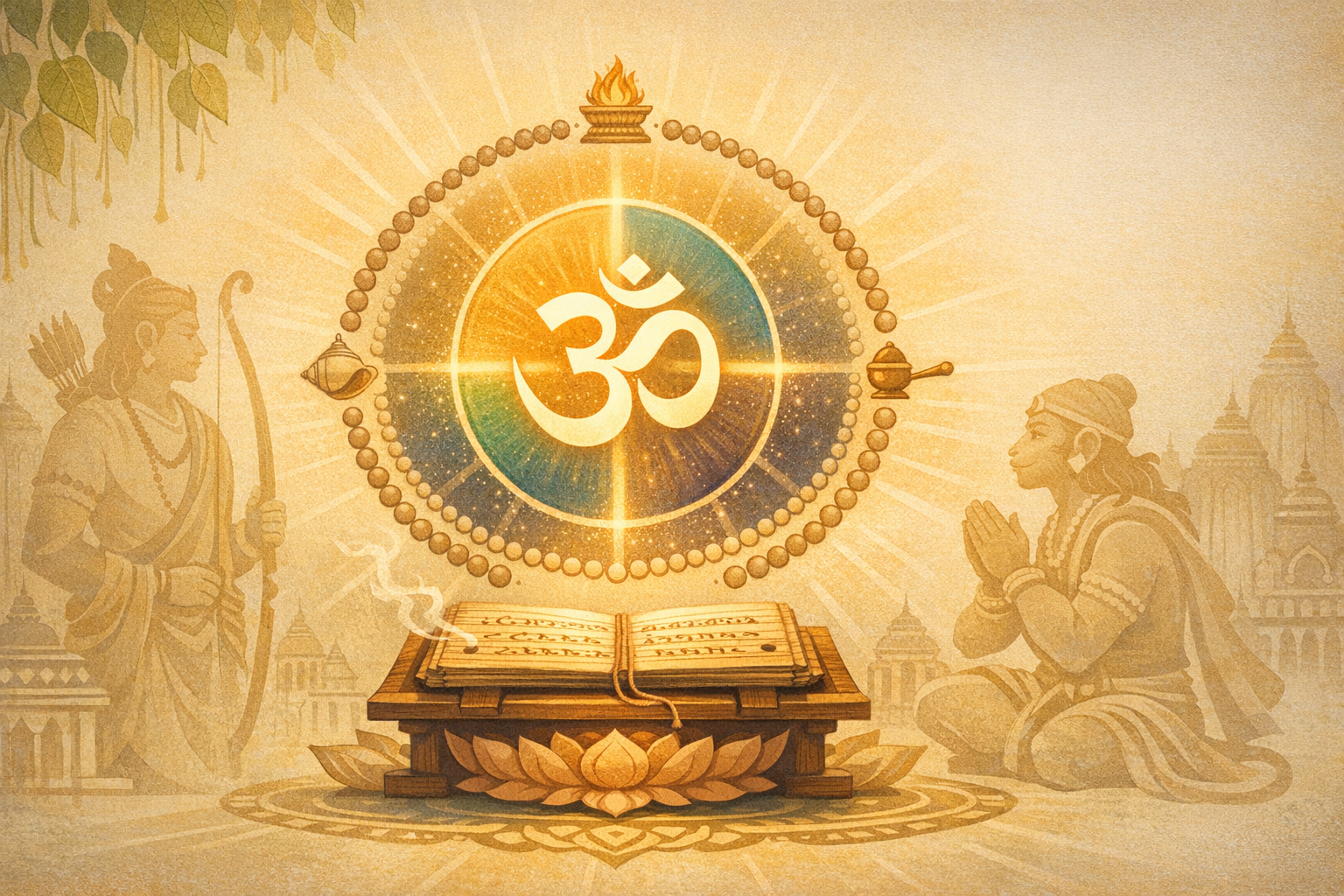
At the heart of the text lies a didactic exchange between Śrī Rāma and Hanumān. Hanumān inquires into the nature of bondage and release, and Rāma responds with a methodical exposition that moves from principles to practice. This narrative frame is not incidental; it renders complex Vedānta intelligible, memorable, and transmissible, while offering an archetype of the guru–śiṣya relationship that is foundational to the transmission of Hindu scriptures.
One of the Muktikopanishad’s enduring contributions is its enumeration of 108 Upanishads. In organizing a widely-cited list, it acts as a guide to the literature itself, consolidating a dispersed and historically layered tradition into a clear syllabus. This list foregrounds the ten principal (mukhya) Upanishads while recognizing the larger contemplative heritage affiliated with the four Vedas, thereby giving seekers and scholars a reliable pathway through a vast archive.
In its soteriological teaching, the Muktikopanishad exhibits a distinct Advaita Vedānta orientation while accommodating devotion and meditative discipline. It proposes a tiered approach to study: concentrated engagement with select Upanishads for rapid assimilation of nondual insight, extended study of the ten principal Upanishads for robust grounding, and comprehensive immersion in the full set of 108 for a panoramic understanding. This pedagogic gradation respects differences in temperament, time, and aptitude, reflecting the plural and inclusive spirit of Hindu spiritual traditions.
The text famously extols the Māṇḍūkya Upanishad (often with Gauḍapāda’s Kārikā) as a direct gateway to liberation because it distills the essence of nondual insight into the analysis of Om and the fourfold schema of waking, dreaming, deep sleep, and turiya. This prioritization is not a dismissal of the rest of the canon; rather, it highlights a hermeneutical center of gravity that can illuminate the whole. Many practitioners find the clarity of this recommendation emotionally reassuring: it offers a precise foothold from which the ascent toward moksha can begin.
Beyond reading strategies, the Muktikopanishad anchors liberation in a seamless integration of śravaṇa (systematic listening to śruti), manana (critical reflection), and nididhyāsana (deep contemplative assimilation). These practices presuppose ethical steadiness and mental clarity; hence, the text’s practical vision aligns with disciplines emphasized across dharmic traditionsself-restraint, truthfulness, non-injury, and sustained meditative attention.
Ethical prerequisites are not mere preliminaries; they are constitutive of knowledge. Yamas and niyamas, devotion to truth, disciplined speech, and non-possessiveness support the cognitive luminosity required to internalize the mahāvākyas that Advaita Vedānta esteems. The Muktikopanishad’s practical tenor thereby converges with the Yoga Sūtras’ insistence that ethical clarity is the ground of stable samādhi.
Mantra recitationespecially contemplative engagement with Omfigures as both method and metaphysical symbol. By tracing the resonance of Om through the modalities of consciousness, aspirants learn to read experience as scripture and to recognize awareness as the invariant ground. For many seekers today, this disciplined interiorization offers a relatable entry point into a textually demanding path.
Although the Muktikopanishad privileges knowledge (jñāna) as the decisive means to moksha, it does not negate the formative power of devotion (bhakti) and meditation (dhyāna). Rather, it situates them as complementary streams that purify and steady the mind, preparing it to receive the nondual insight that ends ignorance (avidyā). In this integrative spirit, the text offers an inclusive template that resonates across the Hindu spiritual landscape and aligns closely with shared values among Buddhism, Jainism, and Sikhismethical discipline, meditative depth, and reverence for truth.
In a broader dharmic context, moksha (liberation) may be fruitfully compared with cognate ideals such as nirvāṇa in Buddhism, kevala-jñāna in Jainism, and the culminating union suggested in Sikh teachings through nām-simran. While doctrinal grammars differ, the Muktikopanishad’s emphasis on inner freedom through knowledge, compassion, restraint, and contemplation affirms a unifying aspiration: the ending of delusion and the blossoming of fearless, non-harming awareness.
Textually, the Muktikopanishad is recognized by many scholars as a relatively late composition within the Upanishadic traditionearly modern rather than Vedic in originyet it is a deeply traditional work in aim and method. Its systematic list of 108 Upanishads helped standardize study cycles, shape manuscript anthologies, and influence later printed collections, particularly in South Asia. Variations in the exact lists that circulate alongside the Muktikopanishad underscore the dynamic history of transmission and the living character of the tradition.
As a guide to hermeneutics, the Muktikopanishad implicitly commends the classical triad of śruti (revelation), yukti (reasoning), and anubhava (direct realization). Students are encouraged to read the mahāvākyas“tat tvam asi,” “ahaṁ brahmāsmi,” “prajnānam brahma,” and “ayam ātmā brahma”through the disciplined removal of superimpositions (adhyāropa) and the discriminative method that clarifies identity through negation and ascertainment (neti-neti and lakṣaṇā). This slow clarification stabilizes the understanding that the Self (ātman) is non-different from Brahman.
Importantly, the Muktikopanishad balances renunciation with responsibility. It respects the householder’s path when animated by karma-yogadedicated action without attachmentand indicates that inner renunciation can mature amidst worldly duties. This realism, familiar across Hindu scriptures, prevents spiritual bifurcation and supports a culture in which liberation is pursued through ethical action and interior clarity, not escapism.
For contemporary readers, the text’s most serviceable gift is an actionable study pathway. Many find it helpful to begin with the Māṇḍūkya Upanishad (with the Kārikā), proceed to the ten principal Upanishads for a broad Vedāntic framework, and then engage the wider 108 for thematic depth across yoga, devotion, and renunciation literature. Coupled with daily contemplative practice and ethical self-audit, this curricular arc translates a vast tradition into steady, transformative learning.
Experientially, sustained study often cultivates a quiet, confident clarity. Practitioners describe a shift from conceptual fascination to existential simplicity: attention relaxes into awareness; devotion matures into reverence without dependency; and action flows from insight rather than agitation. In this way, the Muktikopanishad not only maps the road to moksha but also animates the journey with discernment, compassion, and steadiness.
Questions of canonicity frequently arise: Is the list of 108 Upanishads fixed? How “minor” is a minor Upanishad? The scholarly consensus allows for historical plurality in lists and recognizes that influence follows lived use as much as it follows antiquity. The Muktikopanishad’s persistent authority derives from its pragmatic clarity and the continuity of practice it has nourished, not merely from its putative date.
By affirming multiple temperaments and methods, the Muktikopanishad models a generous, unifying ethos that is vital for inter-traditional harmony among Hinduism, Buddhism, Jainism, and Sikhism. It locates the quest for ultimate truth in shared commitments: disciplined ethics, contemplative rigor, compassionate conduct, and freedom from sectarian rivalry. Such an orientation safeguards the interior purpose of spiritual life while strengthening social cohesion.
In sum, the Muktikopanishad is both map and mirror. As a map, it charts a credible, graded approach to the Upanishads and to moksha. As a mirror, it reflects aspirants back to the immediacy of awareness wherein liberation is realized. Rooted in the Shukla Yajurveda and articulated through the luminous dialogue of Rāma and Hanumān, it remains a definitive companion for anyone seeking to integrate textual study, contemplative practice, and the unifying values that bind the dharmic family.
Inspired by this post on Hindu Blog.