The Shiva Purana preserves a luminous episode in which Lord Shiva manifests before Goddess Pārvatī in His five-faced, or Panchamukha, form. This vision stands as a profound articulation of Hindu scriptures’ insight into divine plurality within unity, revealing the inseparable bond of Śiva and Śakti while guiding devotees toward wisdom, devotion, and inner transformation.
In this sacred narrative, the five facesSadyojāta, Vāmadeva, Aghora, Tatpuruṣa, and Īśānaexpress a comprehensive theology. Each face embodies a dimension of reality and spiritual growth: manifestation, preservation, dissolution, concealment, and grace. Together, they communicate the essence of Panchamukha Shiva as the cosmic Lord who both transcends and pervades creation, aligning metaphysics with lived devotion.
Sadyojāta signifies emergence and creative potential; Vāmadeva signifies preservation, beauty, and harmony; Aghora signifies transformation through the dissolution of limiting forms; Tatpuruṣa signifies the inward path of contemplation; and Īśāna signifies revelation and the rain of grace. The fivefold structure aligns with key Hindu concepts: the five elements (pañca bhūtas), the five senses, the five sheaths (pañca kośas), and the sacred five-syllable mantra, Na–Ma–Śi–Vā–Ya. Through these correspondences, the vision becomes a living map for meditation and spiritual practice.
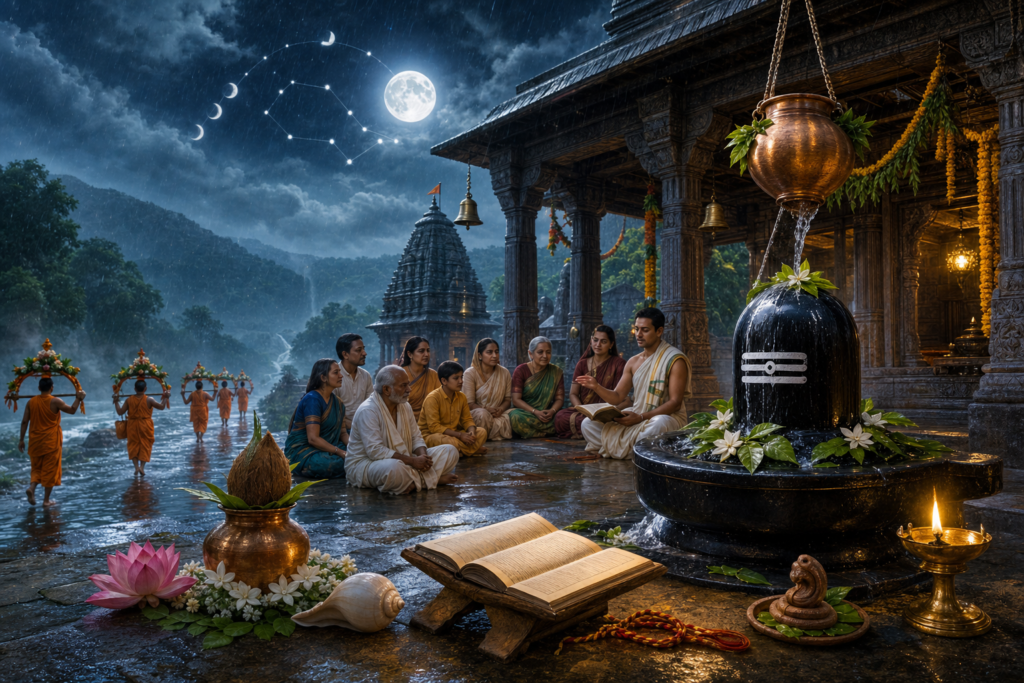
Iconographically, this revelation is echoed in temple traditions that honor the fivefold presence of Shiva, inviting contemplation of His all-encompassing awareness. In devotional practice (bhakti), the narrative evokes reverence and surrender; in contemplative inquiry (jñāna), it illuminates non-duality by affirming that all facets of existence arise from and return to the one consciousness. The vision before Goddess Pārvatī thereby affirms the inseparability of Śiva and Śakti, love and wisdom, form and formlessness.
The Panchamukha framework resonates with the broader dharmic heritage. Buddhism’s five Buddha families organize wisdom qualities that purify the mind; Jainism honors the Pañca-Parameṣṭhi and the discipline of five great vows; Sikhism celebrates Ik Onkār, the oneness of the Divine, alongside meaningful fivefold disciplines such as the Panj Kakaar. These parallel structures highlight a shared civilizational commitment to unity-in-diversity, ethical living, and spiritual depth across Hinduism, Buddhism, Jainism, and Sikhism.
For contemplative practice, devotees may meditate on each face of Shiva as a guiding virtue: creativity (Sadyojāta), compassion and balance (Vāmadeva), courage in transformation (Aghora), centered awareness (Tatpuruṣa), and openness to grace (Īśāna). Aligning breath or mantra with these qualities integrates body, mind, and spirit, while the pañcākṣarī mantra Na–Ma–Śi–Vā–Ya offers an accessible focal point that mirrors the narrative’s depth.
Read as scripture and lived wisdom, Shiva’s five-faced manifestation to Goddess Pārvatī becomes more than a theophany; it is a pedagogical vision that instructs, consoles, and elevates. By presenting multiplicity as an expression of one truth, it nurtures mutual respect among dharmic traditions and guides seekers toward harmony, devotion, and discernment in daily life.
Inspired by this post on Hindu Blog.