This Ramayana in Brief offers a clear, carefully researched summary of the Sanskrit epic attributed to Valmiki, presenting Lord Rama’s life as a luminous guide to dharma, leadership, and compassion. As a touchstone of Indian epics and Hindu scriptures, the Ramayana’s appeal also extends across dharmic traditionsHinduism, Buddhism, Jainism, and Sikhismwhere its ethical vision resonates with shared values such as ahiṁsā, duty to community, and inner restraint. Readers familiar with Ram Navami, Dussehra, and Deepavali will recognize how this narrative anchors living traditions even today, while newcomers find in it a practical map of virtues epitomized by Maryada Purushottama.
Traditionally, the Valmiki Ramayana comprises about 24,000 ślokas in anuṣṭubh metre, organized into seven kāṇḍas: Bala, Ayodhya, Aranya, Kishkindha, Sundara, Yuddha, and Uttara. Multiple manuscript traditions survive, and modern scholarship has also prepared a Critical Edition to document textual variations. Alongside this Sanskrit core, influential retellings include Tulsidas’s Ramcharitmanas (Awadhi), Kamban’s Kambaramayanam (Tamil), Ezhuthachan’s Adhyatma Ramayana (Malayalam), as well as widespread Southeast Asian versions such as the Ramakien (Thailand) and the Reamker (Cambodia). This plurality reaffirms the epic’s inclusive, civilizational reach.
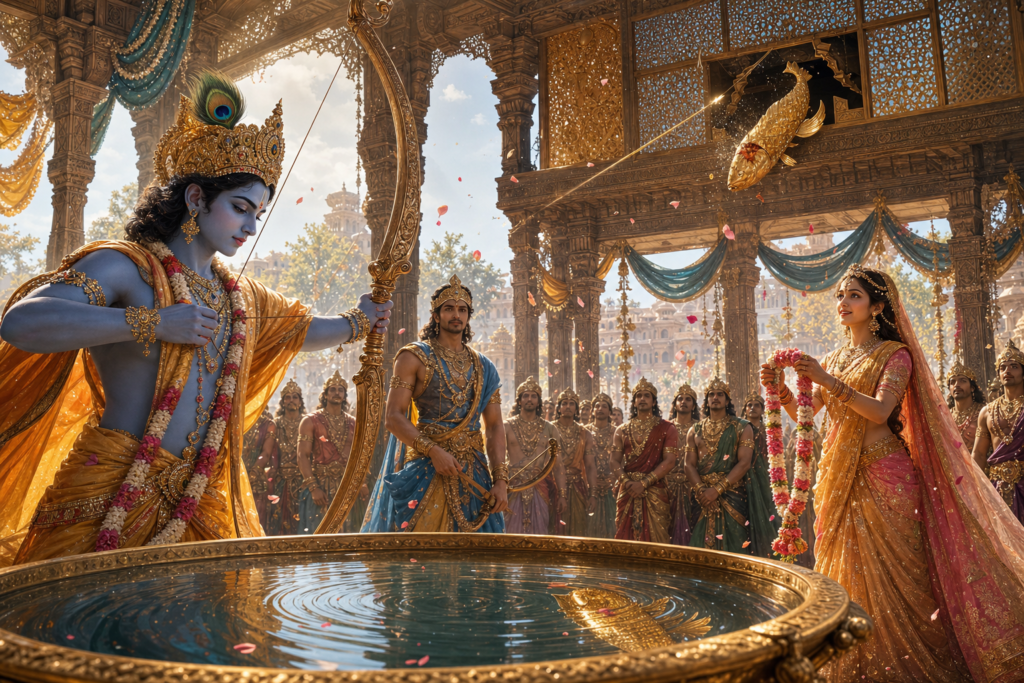
Bala Kanda The Birth of Rama: In the ancient city of Ayodhya on the Sarayu, King Dasharatha longed for heirs. Following a putrakāmeṣṭi yajña, his queens Kausalya, Kaikeyi, and Sumitra bore Rama, Bharata, Lakshmana, and Shatrughna. As Rama came of age, sage Vishvamitra guided Rama and Lakshmana to protect sacrificial rites, during which Rama subdued Tāṭakā and liberated Ahalya at Mithila. At King Janaka’s court, Rama strung and broke the great bow of Shiva to win Sita’s swayamvara; their marriage, and those of the brothers to Sita’s kin, sealed alliances of virtue. The encounter with Parashurama affirmed Rama’s divine destiny and tempered valor with restraint.
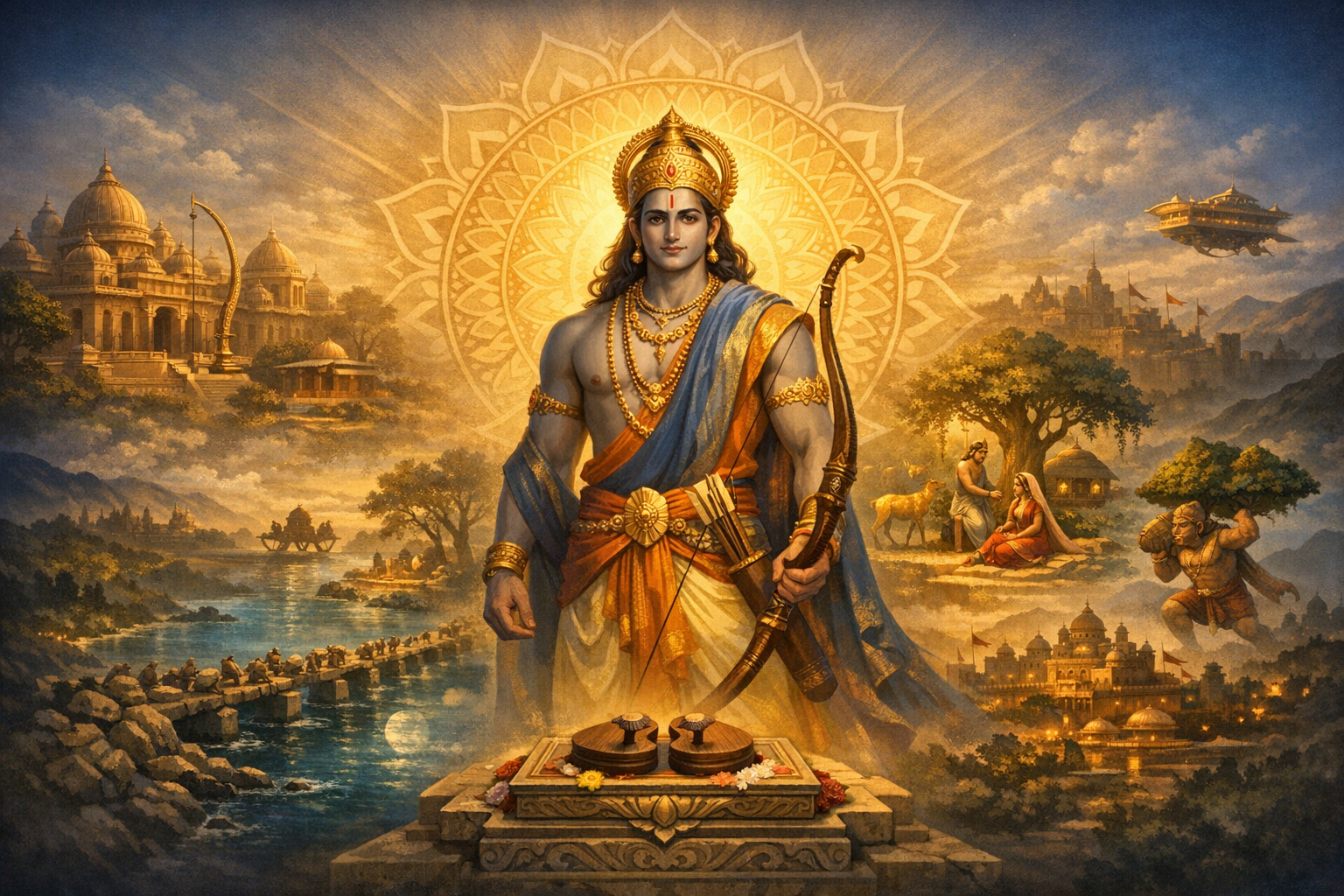
Ayodhya Kanda Exile and Renunciation: Courtly intrigue unfolded when Manthara persuaded Queen Kaikeyi to claim her two boons: Bharata’s coronation and Rama’s exile for fourteen years. Rama accepted this reversal with equipoise, upheld by Sita’s steadfast companionship and Lakshmana’s fraternal devotion. Bharata, grieving the injustice, refused the throne and enshrined Rama’s sandals, ruling Ayodhya as regent from Nandigrama. The moral center of the epic sharpened here: personal sacrifice in service of rajadharma and the commonweal.
Aranya Kanda Forest Trials: In Dandakaranya, the trio upheld rishi-dharma, counseled by sages and sustained by simplicity. Shurpanakha’s advances and Lakshmana’s rebuff precipitated conflict; Rama and Lakshmana defeated Khara and Dushana. Maricha, disguised as a golden deer, lured Rama away, enabling Ravana to abduct Sita. The valiant vulture Jatayu fell defending her, while Rama’s grief at Panchavati remains one of epic literature’s most human portraits of loss. Guidance from Shabari led Rama toward Kishkindha and a decisive alliance.
Kishkindha Kanda Alliance and Resolve: Rama allied with the exiled Sugriva, pledging to restore him against Vali in return for search support. After Vali’s fall, Sugriva dispatched vānara scouts in all directions. Jambavan’s counsel and Sampati’s sighting pointed Hanuman toward Lanka, setting the stage for a mission of courage and discernment that epitomizes service (seva) fused with devotion (bhakti).
Sundara Kanda Hanuman’s Leap and Sita’s Hope: Hanuman crossed the ocean, entered Lanka, and found Sita in Ashoka Vatika, steadfast in virtue despite Ravana’s coercion. He offered Rama’s ring as token, received Sita’s chudamani in return, and delivered words of comfort. Captured and bound, Hanuman chose strategic submission to assess Lanka’s defenses, then blazed the city before returning to report. Generations turn to Sundara Kanda parayana for strength in adversity; its cadence of hope, ethics, and resolve is timeless.
Yuddha Kanda Bridge, Battle, and Return: Under Nala and Nila’s direction, the vānara-sena built the Setu to Lanka, a feat of organization, faith, and engineering symbolism. In the great war, Kumbhakarna fell, and Indrajit’s mastery was broken by Lakshmana. When Lakshmana was gravely wounded, Hanuman’s retrieval of the Sanjivani herb from the Himalayas restored life to the cause. Sage Agastya’s teaching of the Aditya Hridaya fortified Rama before the decisive combat. Ravana’s defeat restored dharma, Vibhishana was crowned king of Lanka, and Sita’s agni-pariksha publicly affirmed her chastity. The Pushpaka Vimana bore the party back to Ayodhya, where Sri Rama Pattabhishekam inaugurated a model of ethical governance cherished as Rama Rajya.
Uttara Kanda Duty, Dissent, and Destiny: Later tradition relates that public censuredespite the agni-parikshacompelled Rama to exile the pregnant Sita to Valmiki’s hermitage, where Lava and Kusha were born. During an Ashvamedha yajña, the twins recited the Ramayana before Rama, leading to recognition and reconciliation. In the end, Sita returned to Bhumi (the Earth), and Rama, having fulfilled the arc of duty, departed this world in accordance with cosmic order. While some view Uttara Kanda as later redactional strata, its devotional reception across the centuries remains integral to the epic’s spiritual pedagogy.
Ethical Architecture Maryada Purushottama: The Ramayana continually returns to a single question: how should one act when dharma pulls in multiple directionstoward family, kingdom, truth, compassion, and justice? Rama’s maryada (ethical bounds) models self-mastery; Sita embodies fortitude and inner luminosity; Lakshmana exemplifies unwavering service; Bharata elevates renunciation in leadership; Hanuman fuses strength with humility; and Vibhishana shows integrity even inside adversarial structures. The epic’s moral clarity arises not from simple choices, but from deliberation, restraint, and willingness to bear personal cost for collective good.
Geography, Pilgrimage, and Living Memory: The narrative traces a sacred geographyAyodhya, Chitrakoot, Dandakaranya, Panchavati, Kishkindha, Rameshwaram, and Lankaenshrined in temples, festivals, and local lore. Traditional identification of the Rama Setu (also called Adam’s Bridge) evokes tangible memory, while practice centers on meaning rather than proof. Key observances include Ram Navami (birth of Sri Rama), Dussehra (the triumph over adharma), and Deepavali (the return to Ayodhya), with Sundara Kanda readings offering solace and resolve in households worldwide.
Unity Across Dharmic Traditions: The Ramayana’s ethical core has inspired Jain and Buddhist tellings that emphasize ahiṁsā and introspection, as well as Sikh reflections on maryada and seva. The Daśaratha Jātaka in Buddhist literature reframes elements of the tale in a didactic key; Jain works such as Vimalasuri’s Paumacariya reinterpret episodes to align with non-violence while retaining a recognizably Ramayana moral arc. This cross-pollination underscores a shared commitment to virtue, tolerance, and spiritual uplift that unites Hinduism, Buddhism, Jainism, and Sikhism without erasing their distinct philosophies.
Comparative Literature and Cultural Reach: Beyond the Valmiki corpus, Tulsidas’s Ramcharitmanas distilled devotion for North India; Kamban’s Kambaramayanam shaped Tamil poetics and aesthetics; the Adhyatma Ramayana mapped a more inward, Vedantic reading of the story. In Southeast Asia, the Ramakien, Reamker, Kakawin Ramayana, Hikayat Seri Rama, and Phra Lak Phra Lam localized characters, landscapes, and courtly codes, integrating the epic into dance, theatre, and statecraft. This diffusion testifies to a civilizational imagination that travels, adapts, and endures.
Leadership, Law, and Just War: The Ramayana engages statecraft through rajadharma, counsel, and consent. Rama seeks perspectives from sages and allies, keeps promises even under duress, and wages dharma-yuddha with proportionality and clarity of purpose. Decisions are tested against the triad of truth, compassion, and public trust. The result is an ethic of governance where ends do not justify means; rather, the manner of conduct creates legitimacy and lasting peace.
Devotion, Practice, and Inner Work: Bhakti to Rama and Sita, service to Hanuman, and remembrance through Rama-nama japa become means for cultivating inner steadiness. Many observe weekly Sundara Kanda parayana to navigate illness, grief, or uncertainty, finding courage in Hanuman’s mission and hope in Sita’s endurance. These practices are not escapism; they are intentional training in attention, patience, and courage, aligning personal character with the epic’s moral North.
Symbols and Motifs From Setu to Pushpaka: The Setu signifies collective endeavor built on trust; Hanuman’s leap reflects the mind’s disciplined potential; the Aditya Hridaya frames luminous awareness as strength; and the Pushpaka Vimana symbolizes return, restoration, and rightful order. In every symbol, poetic imagination and ethical instruction reinforce each other, preserving accessibility while sustaining philosophical depth.
Text, Time, and Method: Historical dating of the Ramayana spans scholarly ranges; what remains constant is its life in recitation, performance, and commentary. A sound approach combines respect for the text’s sacred status with careful reading of language, character, and context, allowing devotional, literary, and historical lenses to enrich rather than negate one another. This integrated method mirrors the epic’s own harmony between action and contemplation.
How to Read A Practical Pathway: Beginners benefit from a kāṇḍa-by-kāṇḍa approachBala and Ayodhya for foundations, Aranya for moral testing, Kishkindha and Sundara for service and hope, Yuddha for resolution, and Uttara for reflection. Pairing a faithful translation of the Valmiki Ramayana with a regional retelling such as Ramcharitmanas illuminates how devotion and ethics interplay. Periodic reflection on episodesAhalya’s redemption, Bharata’s renunciation, Hanuman’s courage, Vibhishana’s integritygrounds learning in daily life.
In Brief The Enduring Promise of the Ramayana: The Ramayana’s narrative splendor rests on a disciplined ethic: truth without rigidity, compassion without naivety, courage without cruelty, and leadership without ego. Its influence across Hinduism, Buddhism, Jainism, and Sikhism affirms a shared quest for inner mastery and social harmony. As a Summary of Ramayana intended for modern readers, this account preserves accuracy while clarifying themes, inviting engagement with the epic’s wisdom in family life, public service, and spiritual practice.
Inspired by this post on Hindu Pad.