
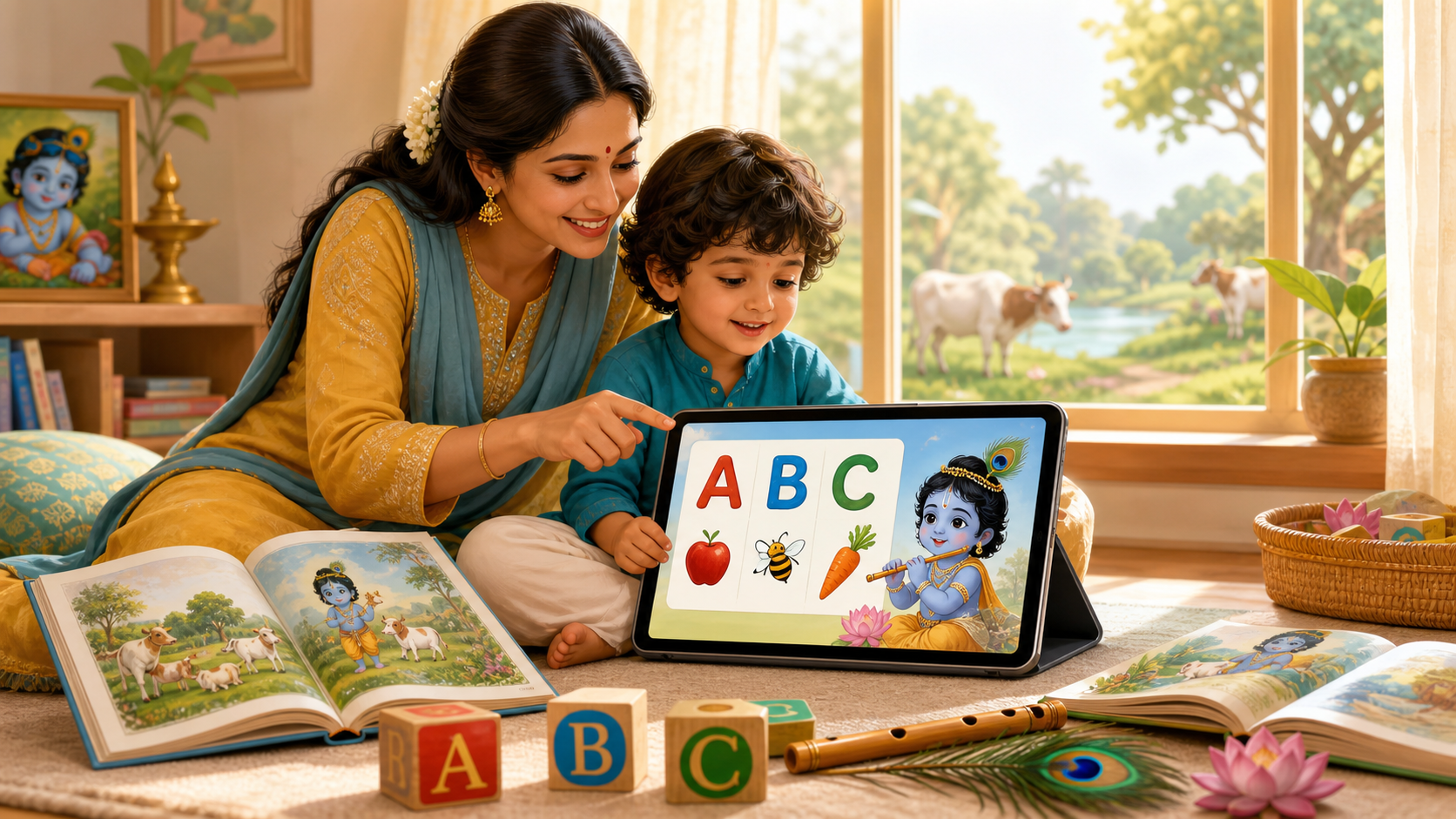
Krishna ABC Kids presents an interesting example of how early childhood education can be shaped by both literacy science and cultural imagination. At its simplest level, the app is introduced as a way for children to learn the English alphabet with Krishna, combining ABC learning with a devotional and family-friendly visual environment. The original source offers only minimal information, centered on the title and promotional image, so the most accurate reading is that the project belongs to the growing category of culturally rooted educational apps for young learners.
For families seeking educational technology that does more than repeat letters on a screen, the idea has clear emotional appeal. Many parents and grandparents want children to grow up comfortable with modern learning tools while still feeling connected to Hindu culture, Krishna stories, devotional imagery, and the wider dharmic inheritance that includes Hinduism, Buddhism, Jainism, and Sikhism. A child learning “A, B, C” in a gentle Krishna-themed setting is not merely memorizing symbols; the child is being introduced to language through familiarity, affection, rhythm, and cultural confidence.
Early alphabet learning is technically more complex than it appears. A child must recognize letter shapes, distinguish similar visual forms, connect letters with sounds, develop phonemic awareness, and gradually understand that written marks can represent spoken language. Good alphabet instruction therefore depends on repetition, clarity, visual contrast, sound association, and emotional reinforcement. When a learning environment is warm, predictable, and meaningful, children often remain engaged longer and revisit lessons more willingly.
A Krishna-centered ABC app can be especially effective when it uses visual storytelling with restraint. Lord Krishna is already familiar to many children through stories of Vrindavan, the flute, cows, friends, family affection, courage, compassion, and playful intelligence. These associations can help reduce the dryness often found in mechanical alphabet drills. The best educational use of such imagery would not be to overwhelm the child with symbolism, but to create a calm learning frame in which letters, sounds, and words remain the primary focus.
From an educational design perspective, an app like Krishna ABC Kids should ideally support three connected goals: letter recognition, sound awareness, and vocabulary growth. Letter recognition helps children identify uppercase and lowercase forms. Sound awareness helps them associate letters with phonetic patterns. Vocabulary growth gives meaning to the exercise, because children remember letters more easily when those letters are attached to images, words, stories, and emotional experiences. A culturally sensitive design can bring these layers together without turning learning into passive screen time.
The most valuable feature of this type of application is not simply that it is digital. Its value lies in how it can make early learning feel personal. Children often learn best when adults participate, repeat sounds aloud, ask small questions, and connect screen-based content to real objects at home. If a child sees a letter, hears a sound, repeats the sound, and then connects the lesson to a story or image of Krishna, the experience becomes multisensory. This is important because early literacy develops through sight, sound, speech, movement, memory, and emotional context working together.
For Hindu Education and broader Cultural Heritage, such tools also raise a larger question: how can dharmic families use technology without losing depth? The answer is not to reject digital learning, nor to treat every app as a substitute for family teaching. A more balanced approach places the app in a supporting role. Parents can use Krishna ABC Kids as a short, structured learning aid, while still relying on conversation, storytelling, books, songs, temple visits, and intergenerational learning to build deeper understanding.
This balance matters because devotional themes should be presented with care. Krishna is not merely a decorative figure; Krishna carries profound meaning in Hindu philosophy, bhakti traditions, music, poetry, and daily worship. A child-friendly learning product should therefore maintain reverence while remaining accessible. The tone should be joyful rather than heavy, simple rather than simplistic, and inclusive rather than sectarian. This is especially important for a blog committed to unity among dharmic traditions, where cultural education should strengthen respect, humility, and shared spiritual confidence.
There is also a practical parenting dimension. Many families worry about screen time, advertising, privacy, and overstimulation in children’s apps. Any educational app for young children should be used with clear boundaries: short sessions, adult supervision, no unnecessary distractions, and regular movement away from the screen. Parents should review app store details, privacy practices, permissions, and in-app purchase settings before allowing independent use. A thoughtful Krishna-themed alphabet app can be helpful, but it works best as part of a larger learning routine.
Technically, the strongest version of Krishna ABC Kids would include clean typography, accurate pronunciation, slow pacing, simple navigation, responsive touch targets, and repetition that does not feel monotonous. Children in the early learning stage need large letters, uncluttered screens, clear audio, and immediate feedback. If the app includes songs, animations, or games, those elements should reinforce the alphabet rather than distract from it. Educational technology succeeds when every visual and sound choice serves learning.
The cultural promise of this app category is significant. It allows children to encounter Krishna, Hindu culture, and alphabet learning in the same environment, making education feel rooted rather than imported. For diaspora families in particular, this can be meaningful. Children may live in English-speaking societies while their homes preserve Indian languages, stories, rituals, and devotional practices. A Krishna-based ABC experience can gently bridge those worlds by making English literacy compatible with Hindu identity rather than separate from it.
At the same time, educational quality must remain the standard. A cultural theme alone does not make an app pedagogically strong. The app should help children actually recognize letters, pronounce sounds, remember patterns, and enjoy returning to practice. The ideal outcome is not only cultural pride, but measurable learning progress. Parents can observe this by asking whether the child can identify letters outside the app, connect letters to sounds, and remain curious about books, words, and stories after the screen is turned off.
Krishna ABC Kids should therefore be understood as part of a broader movement toward values-based educational technology. It reflects a desire to make learning beautiful, familiar, and spiritually connected. When used wisely, such a tool can support early literacy while also giving children a gentle introduction to Krishna, Hindu traditions, and the emotional world of dharmic culture. Its deepest benefit lies not in promotion, novelty, or app-store visibility, but in its potential to make a child’s first steps into language feel joyful, meaningful, and rooted.
Inspired by this post on Dandavats.










Leave a Reply
You must be logged in to post a comment.