
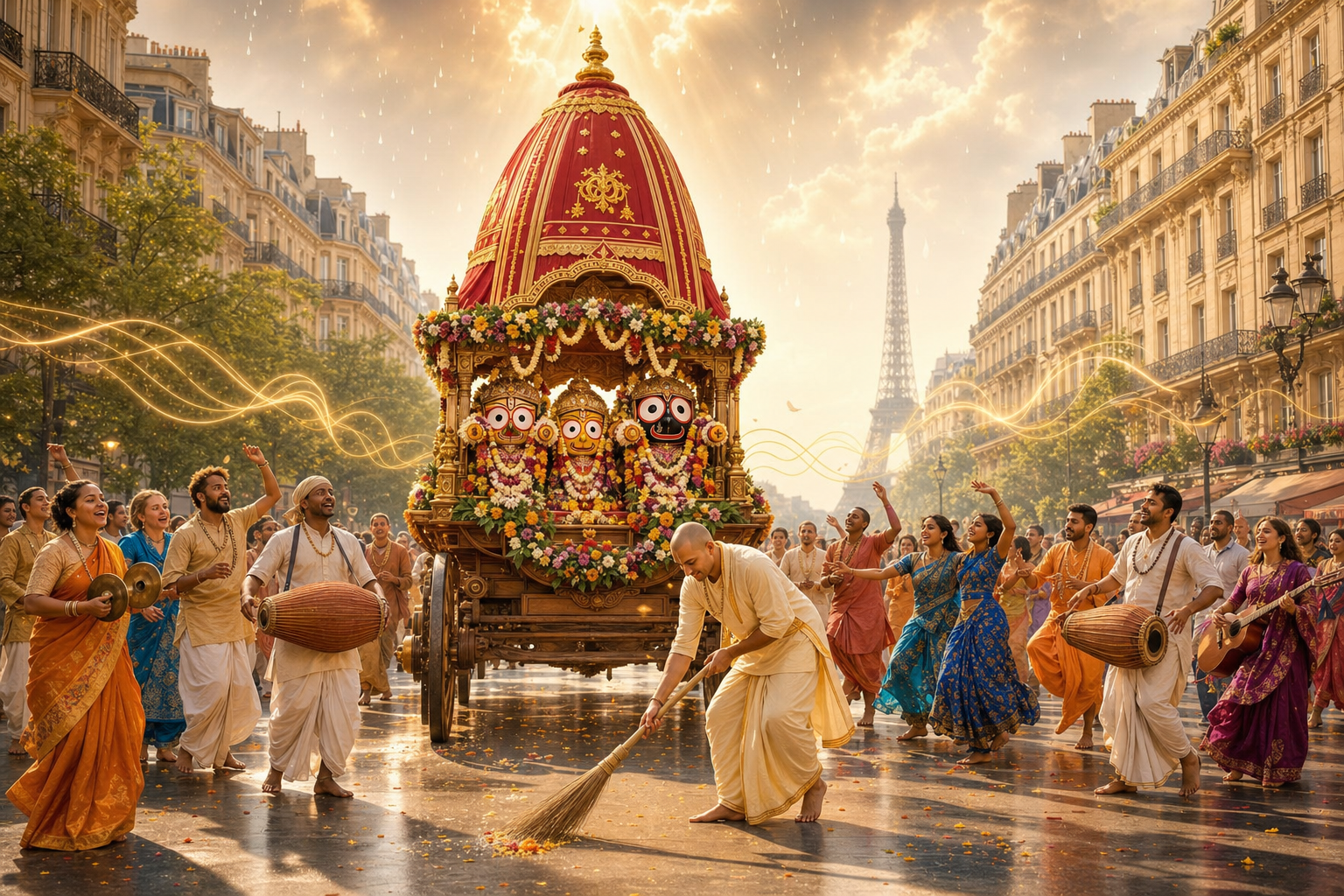
The title “ISKCON Paris | CC Madhya 13.47-60 HH Janananda Goswami Maharaj” points toward a focused study of Śrī Caitanya-caritāmṛta, Madhya-līlā, Chapter 13, verses 47-60, a compact but theologically dense passage within the Gauḍīya Vaiṣṇava account of Lord Jagannātha’s Ratha-yātrā. The subject is not merely a festival scene, nor only a historical memory preserved in sacred literature. It is a study of saṅkīrtana, devotional organization, humility, divine accessibility, and the subtle relationship between public worship and inner realization.
These verses describe Śrī Caitanya Mahāprabhu arranging seven saṅkīrtana groups before Lord Jagannātha’s chariot. Four parties chant and dance in front of Lord Jagannātha, two stand at the sides, and one remains behind. The passage gives a vivid sense of sacred choreography: devotees, singers, dancers, and mṛdaṅga players are not presented as a loose crowd but as a disciplined devotional body. The technical structure matters because bhakti is not treated as emotional disorder; it is devotion intensified through order, sound, rhythm, humility, and shared sacred intention.
In CC Madhya 13.47-48, the formation of seven kīrtana parties and fourteen drums establishes the collective scale of the event. The Ratha-yātrā procession becomes a moving temple of sound. The mṛdaṅgas do not function as entertainment instruments; they support nāma-saṅkīrtana, the congregational chanting of the holy names. In the Gauḍīya Vaiṣṇava tradition, this is central to the spiritual method taught by Śrī Caitanya Mahāprabhu: devotion is made audible, communal, embodied, and accessible.
The passage then moves from organization to spiritual intensity. The Vaiṣṇavas are compared to clouds, and their tears are compared to rain. This imagery is significant. Clouds gather, become heavy, and release water that nourishes the earth. Similarly, devotional association gathers spiritual feeling and releases it through chanting, tears, movement, and surrender. The metaphor does not romanticize sentimentality; it presents bhakti-rasa as a disciplined devotional emotion rooted in remembrance of Kṛṣṇa and service to Lord Jagannātha.
CC Madhya 13.50 states that the sound of saṅkīrtana filled the three worlds, overwhelming all other sounds. Theologically, this is more than poetic exaggeration. It expresses the Gauḍīya understanding that the divine name is not a symbol separate from the divine presence. The name of Hari, Kṛṣṇa, and Jagannātha is treated as spiritually potent. When the holy name is chanted with devotion, it reorganizes perception: ordinary noise recedes, and the listener encounters a world interpreted through sacred sound.
For many devotees, this explains why kīrtana can feel transformative even when one does not fully grasp Sanskrit, Bengali, theology, or ritual detail. The experience is carried through rhythm, repetition, humility, and association. A person standing in a temple room, a public procession, or a city street may begin with curiosity, but the collective chanting gradually shifts attention from personal anxiety to shared devotion. This is one reason the Hare Krishna movement and ISKCON communities across the world, including ISKCON Paris, continue to place kīrtana at the center of spiritual practice.
Verses 51-53 describe Śrī Caitanya Mahāprabhu moving among all seven groups, raising His arms, chanting “Hari, Hari!” and glorifying Lord Jagannātha. The astonishing development is that each group experiences Him as present with them. The devotees perceive His mercy intimately, as though He has chosen their own circle alone. This is a major theological moment: divine grace is not diminished by being shared. In ordinary human experience, attention seems limited; when one person receives it, another may feel deprived. In the devotional logic of the text, divine presence expands without loss.
This theme has practical relevance for dharmic traditions more broadly. Hinduism, Buddhism, Jainism, and Sikhism all preserve distinctive paths of discipline, devotion, wisdom, ethics, and liberation. Their differences need not be flattened into sameness, but they can be approached with reverence rather than rivalry. The Ratha-yātrā scene shows a sacred plurality held together by a common center. Many groups chant, many devotees serve, many experiences unfold, yet the orientation remains toward the divine. Such a model supports unity without erasing diversity.
CC Madhya 13.54 adds that the Lord’s inconceivable potency could not be seen by everyone. Only confidential devotees absorbed in pure, unalloyed devotional service could understand the mystery. This introduces an important epistemological principle in bhakti traditions: spiritual reality is not grasped merely by physical proximity or intellectual cleverness. Sacred perception depends on purification, humility, service, and grace. The text does not reject reason; rather, it places reason within a wider spiritual discipline.
King Pratāparudra’s role is crucial. Earlier in the chapter, he performs the humble service of sweeping the road before Lord Jagannātha’s chariot. Though he is a king, he accepts what appears externally to be a menial task. CC Madhya 13.60 explains that Śrī Caitanya Mahāprabhu is pleased by this humility, and by that mercy the king is able to perceive the mystery of Mahāprabhu’s activities. The lesson is precise: status does not grant spiritual vision; service does.
This is one of the most powerful social teachings in the passage. A ruler becomes spiritually qualified not by command, wealth, prestige, or ceremonial authority, but by taking up a broom for the pleasure of Lord Jagannātha. In dharmic ethics, leadership is not meant to be self-display. It is measured by seva, restraint, responsibility, and the willingness to serve something higher than personal ego. The image of King Pratāparudra sweeping the road remains a corrective to every age in which power forgets humility.
The passage also offers a technical insight into devotional community management. Śrī Caitanya Mahāprabhu arranges singers, responders, dancers, and instruments in coordinated groups. This demonstrates that ecstatic devotion does not exclude structure. In fact, structure protects and amplifies devotion. A successful saṅkīrtana gathering requires rhythm, leadership, response, spatial arrangement, shared purpose, and sensitivity to the deity, the devotees, and the public. Modern temple communities can draw from this model when organizing Ratha Yatra, nagar kīrtana, festival programs, and public chanting.
ISKCON’s global practice of public kīrtana rests on this same theological foundation. Whether in Puri, Mayapur, Vrindavan, Paris, London, New York, or a small local gathering, saṅkīrtana is not treated as cultural performance alone. It is sadhana, outreach, remembrance, and community formation. The public nature of the practice matters because Śrī Caitanya Mahāprabhu’s movement does not confine spiritual sound to private spaces. It carries the name of Kṛṣṇa into streets, hearts, and shared civic life.
At the same time, the passage warns against reducing sacred events to spectacle. The crowd sees dancing, music, drums, and chariots; confidential devotees perceive divine exchange. The difference is not in the outward event but in the depth of consciousness. This has enduring relevance for contemporary religious life. Festivals can become photographs, logistics, tourism, or identity display. They regain spiritual force when participants remember the inner purpose: humility before the divine, service to the community, and sincere chanting of the holy names.
The “mystery” of Śrī Caitanya Mahāprabhu’s simultaneous presence in seven groups may be read devotionally as an expression of acintya-śakti, inconceivable divine potency. Gauḍīya Vaiṣṇava theology often speaks of the divine as simultaneously one and many, near and beyond, personal and unlimited. In this Ratha-yātrā scene, that theology becomes visible through devotional experience. Mahāprabhu is seen as fully present with each group, and Lord Jagannātha’s chariot pauses as if to witness the chanting and dancing.
There is also an emotional lesson here. Devotees often long to feel personally seen by the divine. These verses affirm that such longing is not spiritually immature when purified through service. Each group feels Mahāprabhu’s presence as personal mercy, yet this does not produce competition in the final theological vision. The true devotee rejoices that the same mercy is available to others. This is a profound antidote to sectarian insecurity: divine love is not a scarce resource.
For readers approaching the passage from the wider dharmic world, the emphasis on sound, humility, and shared practice is familiar. Sikh kīrtan, Buddhist chanting, Jain stavan, Vedic recitation, bhajan, nāma-japa, and temple music all show that sacred sound has long served as a vehicle of memory, discipline, and transcendence. The specific theology differs across traditions, and those differences deserve respect. Yet the shared intuition remains powerful: sound can refine consciousness when joined with reverence, ethics, and inner discipline.
Thus, CC Madhya 13.47-60 is not simply a description of a historic Ratha-yātrā procession. It is a miniature theology of community. It teaches that devotion can be organized without becoming mechanical, ecstatic without becoming chaotic, public without becoming superficial, and personal without becoming possessive. It honors the role of the individual devotee while showing that the highest devotional experience unfolds in association.
The enduring message is clear: sacred unity is not produced by uniformity. It is produced when many voices, bodies, instruments, and forms of service align around a transcendent center. The seven kīrtana parties remain distinct, but the saṅkīrtana is one. King Pratāparudra remains a king, but he becomes spiritually qualified through humble service. Lord Jagannātha remains the object of worship, yet He is also portrayed as responsive to the devotion before Him. Śrī Caitanya Mahāprabhu moves among all, revealing that grace can be intimate, expansive, and transformative at once.
In this way, the ISKCON Paris theme connected with HH Janananda Goswami Maharaj’s class invites a deeper reading of Ratha-yātrā, bhakti, and saṅkīrtana. The passage encourages contemporary practitioners to approach devotional life with scholarship, humility, and lived participation. It asks that kīrtana be heard not only as music, Ratha-yātrā not only as procession, and scripture not only as text, but as a living discipline capable of reshaping the heart toward seva, unity, and love of the divine.
Inspired by this post on Dandavats.





Leave a Reply
You must be logged in to post a comment.