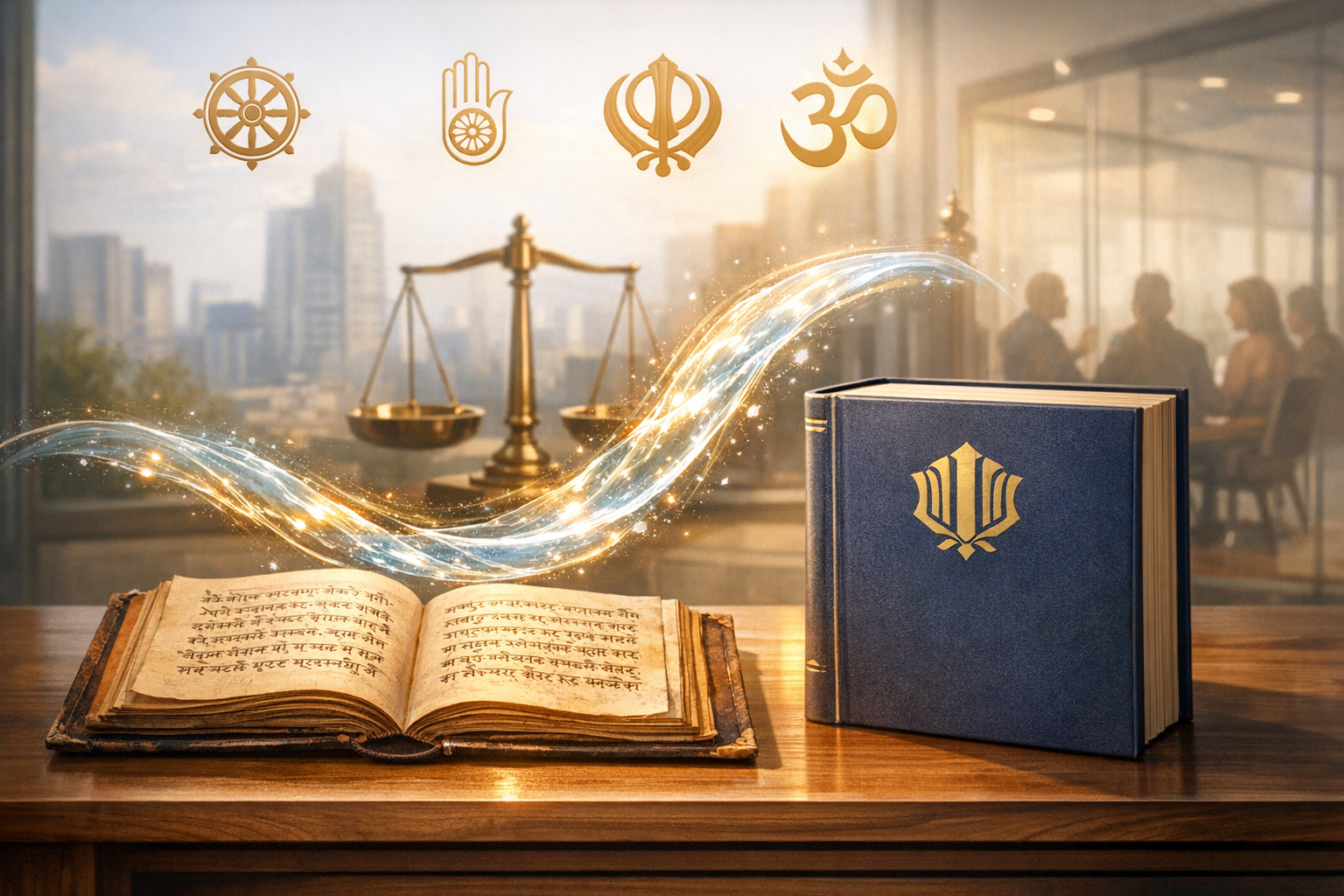
Is Manusmriti relevant today? The question resurfaces whenever a verse is quoted on social media or when public debate turns to the history of Hindu law, women’s rights, or the caste system. Clarity begins by asking what the text is, how it functioned historically, and how it can be read responsibly alongside the ethical aspirations of contemporary India and the broader dharmic family—Hinduism, Buddhism, Jainism, and Sikhism.
Manusmriti (the Mānava-Dharmashāstra) is traditionally attributed to Manu, remembered in Indic memory as a wise lawgiver and archetypal king. In textual scholarship, it is situated within the Dharmashastra corpus—human-authored Smriti literature that systematizes norms for social conduct, rites, and jurisprudence. Composed and redacted across centuries, it now survives in multiple recensions totaling approximately 2,700 verses across twelve chapters.
Scholars generally date the core layers of Manusmriti between the last centuries BCE and the early centuries CE, with subsequent interpolations and regional redactions. Its reception has been mediated by a vast commentarial tradition, including Medhātithi (c. 9th–10th century), Govindarāja, and Kullūka Bhaṭṭa (c. 15th century). These commentaries do not merely explain; they also select, reconcile, and sometimes reformulate, revealing that even in premodern India the text’s authority was dialogical, negotiated, and historically aware.
As Smriti, Manusmriti is not revelation (Śruti) but remembered tradition—normative, humanly composed, and explicitly conditioned by deśa (place), kāla (time), and ācāra (custom). Dharmashastra repeatedly recognizes desa-ācāra, kula-ācāra, and śiṣṭa-ācāra (the conduct of the learned) as authoritative sources of dharma. In practice, this meant flexibility: written norms interacted with living custom, local usages, and royal edicts (rājaśāsana), making the legal order a braided stream rather than a single channel.
Accordingly, Manusmriti was never the sole or uniform “law code of India.” Adjudication drew upon multiple Smritis (e.g., Yājñavalkya Smriti, Nārada Smriti), influential digests (nibandhas), and juristic commentaries such as Mitākṣarā by Vijñāneśvara. Inscriptions and historical records show that courts respected local custom, professions’ bylaws, and guild rules. Buddhist, Jain, and later Sikh polities carried parallel ethical and institutional vocabularies—Vinaya, Acaranga, and the maryādā—underscoring the plural and dialogical character of dharmic governance.
Modern misunderstandings were amplified during colonial codification. In 1794, Sir William Jones’s English translation elevated Manusmriti as “the” Hindu law for British courts, flattening a dynamic plurality into a single textual authority. The resulting Anglo-Hindu law both preserved and distorted tradition by privileging select Sanskrit texts and elite commentaries while downplaying lived customs and regional jurisprudence. This colonial reification still colors contemporary perceptions that Manusmriti was a monolithic, prescriptive state code for all Hindus.
Independent India re-centered law on the Constitution. Fundamental Rights, Directive Principles, and codified statutes—particularly the Hindu Marriage Act (1955), Hindu Succession Act (1956, amended 2005), and allied enactments—govern personal law for Hindus, Buddhists, Jains, and Sikhs. Today, Manusmriti has historical and intellectual significance, but it does not carry legal force in Indian courts, which may cite Smriti material only as historical context or ancillary learning, never as binding authority contrary to constitutional guarantees.
Two sets of verses fuel most contemporary controversy: passages on women and on caste. The well-known line pita rakṣati kaumāre bhartā rakṣati yauvane, putrā rakṣanti vṛddhake, often paraphrased as a claim that “women must always be protected,” is frequently presented in isolation. Within the Dharmashastra idiom, “rakṣā” historically denotes a spectrum from guardianship to welfare obligations tied to property, marital, and succession regimes. Commentarial traditions grappled with how to balance household stability with women’s agency. Alongside guardianship assumptions, Smriti literature recognized strīdhan (women’s property) and offered protections for certain inheritances and gifts, a concept later refined by jurists and acknowledged in modern law. Read historically and comparatively, the discourse is more variegated than the caricature of blanket subordination suggests; nevertheless, by present constitutional ethics, any denial of women’s equal personhood is normatively rejected.
On caste, Manusmriti delineates varṇa-specific duties and discusses mixed lineages in ways that reflect an ancient social taxonomy. However, varṇa (theory) and jāti (lived community) have never mapped one-to-one; social mobility, occupational change, and regional exceptions are amply recorded in inscriptions, narrative sources, and ethnography. Colonial gazetteers and courtroom practices further hardened fluid identities into fixed categories. In contrast, the broad dharmic ethos across Hinduism, Buddhism, Jainism, and Sikhism orients toward the moral worth of all persons—through ahimsa and karuṇā (Buddhism, Jainism), seva and sarbat da bhala (Sikh tradition), and the Hindu insight that dharma’s core virtues (satya, dayā, dama, dāna, śauca) are universal. In modern ethical terms, birth-based hierarchy and discrimination are unambiguously incompatible with constitutional equality and with the inclusive aspirations of the dharmic family.
What then is Manusmriti’s positive relevance today? First, method. It models a responsibility-centered ethics: duties toward family, society, and the more-than-human world. A rights-forward constitutional order is best complemented—not undermined—by a dharma vocabulary of responsibilities, which helps structure civic virtue, institutional trust, and environmental care. Second, Manusmriti belongs to a knowledge ecosystem in which norms evolve through critique, commentary, and custom. This deliberative process, visible in texts and inscriptions alike, is a living resource for plural societies seeking principled ways to adapt tradition to new contexts.
Third, reading Manusmriti comparatively enriches a shared dharmic conversation. Anekāntavāda in Jain philosophy invites multi-perspectival humility; Buddhist skillful means (upāya) emphasizes context-sensitive application of ethical intent; Sikh maryādā embodies disciplined equality and service. The Sanskrit maxim Vasudhaiva Kutumbakam—“the world is one family”—captures a civilizational horizon within which textual differences can be held in creative, compassionate balance. Framed this way, Manusmriti becomes a partner in a larger dialogue rather than a weapon for division.
Consider a practical scenario: a university ethics committee in Bengaluru seeks a framework for academic integrity and non-discrimination. A responsibility-centered dharma lens would emphasize truthfulness (satya) in research, respect for persons (dayā), restraint (dama) in wielding institutional power, and generosity (dāna) in mentorship and attribution. These are not legal substitutes but cultural reinforcements of rights-based norms, aligning institutional culture with constitutional morality and dharmic values alike.
Responsible engagement with classical texts benefits from four simple tests. Contextual test: read verses within their chapter, genre, and historical moment, not as floating aphorisms. Comparative test: consult parallel Smritis (e.g., Yājñavalkya, Nārada), nibandhas, and regional customs to see how norms varied or evolved. Commentarial test: weigh how authorities like Medhātithi or Kullūka Bhaṭṭa interpreted or prioritized rules. Constitutional test: filter every claim through today’s non-negotiables—dignity, equality, and freedom of conscience.
This approach also addresses recurrent misquotations. Many sensational lines circulated online are mistranslated, decontextualized, or drawn from late, disputed strata. Where exact provenance is uncertain, caution is warranted. Reliable, critical translations—such as those by Patrick Olivelle—alongside the juristic syntheses of scholars like P. V. Kane, Robert Lingat, and J. D. M. Derrett, provide the philological scaffolding needed to separate historical texture from polemical noise.
For women’s rights in particular, reading across the dharmic spectrum strengthens an inclusive ethic. Buddhist and Jain narratives foreground female renouncers and householders as moral exemplars; Sikh history honors women who led with courage and seva; and modern Hindu reform—backed by constitutional law—articulates equality in marriage, inheritance, and public life. Where older textual formulations reflect patriarchal structures, contemporary dharmic ethics, informed by both spiritual principles and constitutional mandates, move deliberately toward agency, safety, and flourishing for all gender identities.
With caste, the same method applies. Historical description does not entail contemporary prescription. Dharmic commitments to compassion, non-harm, and the dignity of labor can, and do, propel affirmative action, social solidarity, and the dismantling of stigmatizing practices. Manusmriti then serves as a historical source to understand how social regulation was theorized, while the dharmic conscience—alive in lived traditions—guides society toward non-discrimination and unity.
Finally, the value of Manusmriti for modern readers lies less in literal rule-following and more in cultivating ethical discernment (viveka). The text’s insistence on intention, restraint, and reciprocity can inform contemporary debates on technology, ecology, and governance without importing archaic hierarchies. Read as part of a plural dharmic canon—and held accountable to the Constitution—it contributes insight, not injunction; wisdom, not warrant.
In sum, Manusmriti remains relevant as a window into India’s legal-intellectual heritage and as a prompt for responsibility-centered ethics, provided it is read critically, comparatively, and compassionately. When approached within a broader dharmic and constitutional frame, it can help nurture a culture of dignity, interfaith respect, and civic trust—goals shared by Hinduism, Buddhism, Jainism, and Sikhism, and vital to a just, inclusive future.
Inspired by this post on Hindu Pad.