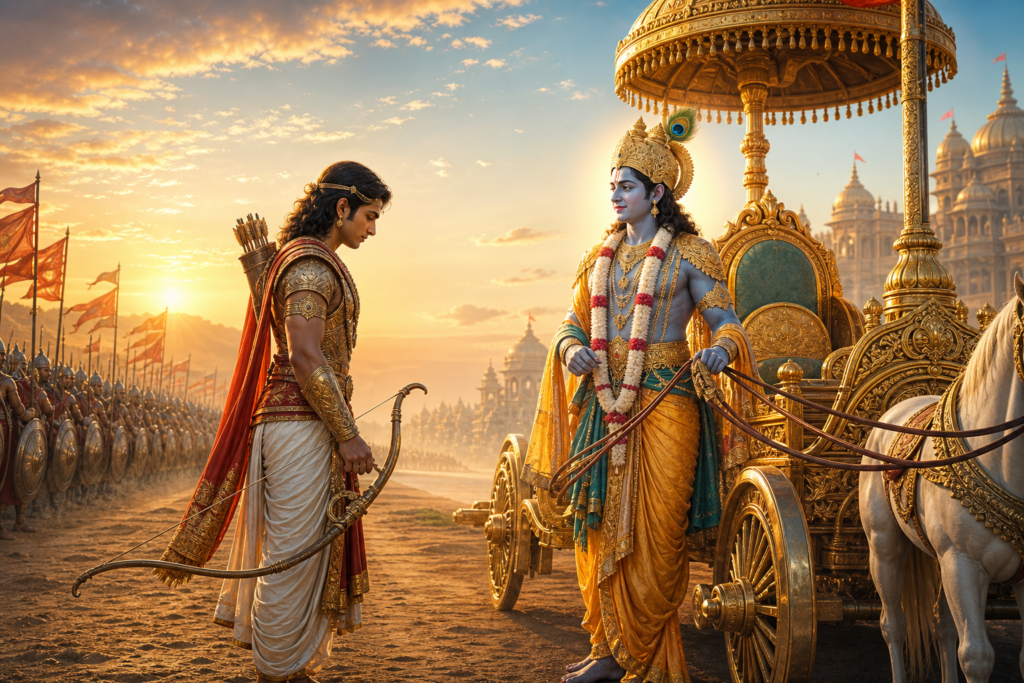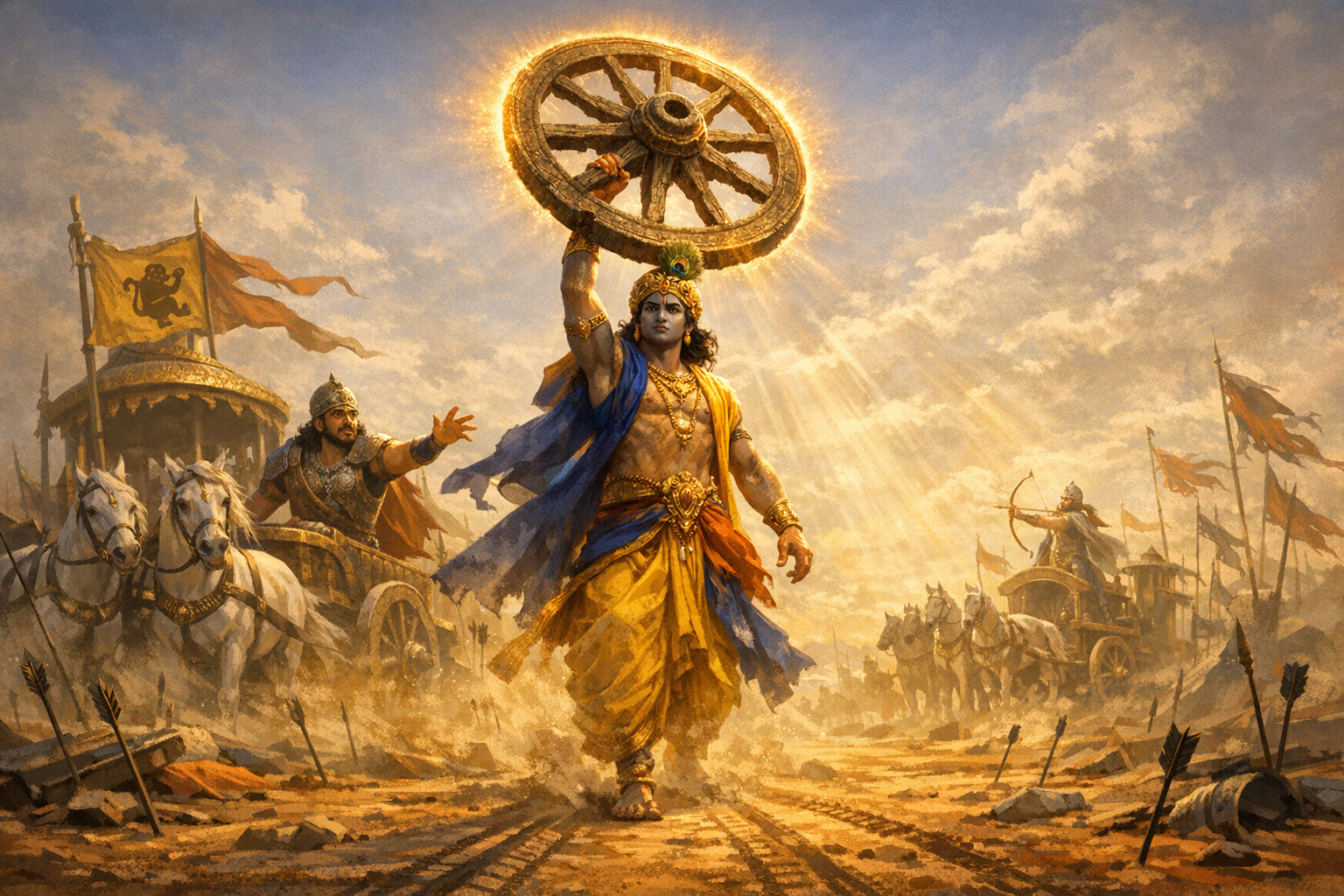
Epic tradition situates the Kurukshetra War millennia in the past, and within that vast canvas one scene stands out as a defining revelation of dharma, devotion, and leadership. Amid dust-darkened skies, shattered standards, pounding hooves, and the tumult of clashing arms, Sri Krishna reined in Arjuna’s chariot and leapt to the ground. Grasping the wheel of a disabled chariot, He charged toward the Kuru general Bhishma like a lion toward an elephant, collapsing the distance between divine resolve and mortal peril.
Moments earlier, Bhishma’s archery had transformed the battlefield into a near-impenetrable curtain of shafts. Arjuna and his charioteer vanished behind a torrent of arrows that rattled against armor and yokes, threatening to overwhelm even the most disciplined warrior of the Pandavas. To bystanders, it appeared that Arjuna was on the verge of defeat. It was at this precipice that Krishna’s action, at once startling and luminous, unfolded.
The episode’s force lies not only in martial intensity but also in the tension between vows and duty. Krishna had pledged not to wield weapons in the Kurukshetra War, while Bhishma had vowed to fight so fiercely that Krishna would be compelled to intervene. When the vow of a guardian confronted the vow of a guide, a deeper ethical stratum emerged: to preserve a devotee and the just cause (dharma-yuddha), Krishna chose to risk His own promise rather than allow adharma to triumph through formalism.
Arjuna, seeing Krishna rush forward with the chariot wheel, implored Him to honor His commitment and restrain the charge. In that exchangeArjuna pushing himself to rise to the duty of kshatra-dharma and Krishna disclosing the lengths to which He would go to safeguard justicean intimacy unique to the Mahabharata was revealed. The scene distilled a central insight of Vedic philosophy: vows are instruments of dharma, not substitutes for it.
In later remembrance, Bhishmarevered as both a consummate commander and a devoteewould recall this very vision as sublime. On his bed of arrows, he treasured the sight of Krishna, dust-coated and battle-flushed, advancing with the wheel raised high. This paradox of adversaries linked by spiritual affection highlights the epic’s refusal to reduce complex relationships to simple enmity. The Kurukshetra War, for all its ferocity, remained a crucible for devotion (bhakti) as much as for strategy.
Context sharpens the meaning of the wheel. As a broken ratha-chakra seized in urgency, it was a practical object. As a symbol, it echoes the dharma-chakraIndia’s enduring emblem of moral order and right action. Across dharmic traditions, the wheel signifies the turning of teaching into lived reality: the Dharma Wheel in Buddhism, the dharma-chakra motif in Jainism, and the chakkar within the Sikh khanda. In this light, Krishna lifting the wheel may be read as dharma itself mobilizedprinciples becoming protection when lives and justice are at stake.
The narrative also stands at the intersection of the Bhagavad Gita’s counsel and battlefield praxis. The Gita frames action (karma) as a disciplined offering aligned with loka-sangrahathe welfare and cohesion of the worldeven when outcomes remain uncertain. Kurukshetra thus embodies a last-resort confrontation after diplomacy fails, as recounted in the Udyoga Parva, where Krishna’s peace mission is rebuffed. The war’s ethical grammar is one of proportion and purpose: fight without hatred, uphold truth without cruelty, and accept responsibility without attachment to triumph.
Within the Mahabharata’s legal-philosophical arcs, this scene invites reflection on apad-dharma (duty under emergency), raja-dharma (the ethics of governance), and kshatra-dharma (the martial code). Each recognizes that rules exist to preserve life, justice, and social order; when their literal application threatens these ends, dharma requires discernment. Krishna’s near-breaking of His vow dramatizes the principle that devotion and duty converge in the protection of the innocent and the restoration of balance.
Read through the broader unity of dharmic thought, the episode resonates beyond sectarian lines. Buddhism, Jainism, Hinduism, and Sikhism each place ethical intention, self-mastery, and compassion at the center of spiritual life. While emphases varyJainism enshrines ahimsa with exceptional rigor; Buddhism foregrounds non-harm and skillful means; Sikh tradition articulates dharam yudh as a last resort; Hindu texts hold ahimsa alongside the necessity of just defensethe shared aspiration is to reduce suffering and stabilize a just peace. The wheel in Krishna’s hands thus serves as a pan-dharmic reminder: moral insight must move to protect life when dialogue is exhausted and harm is imminent.
For contemporary readers and leaders, the scene provides a template for crisis ethics. When bound by competing commitmentspolicy versus protection, promise versus persona purely procedural fidelity can paradoxically abet injustice. The Kurukshetra moment counsels principled flexibility anchored in first principles: guard the vulnerable, prevent greater harm, and act transparently for loka-sangraha. Such action is never license for expedience; its legitimacy depends on restraint, accountability, and sincere alignment with dharma.
Literarily, the passage compresses speed, sound, and symbol into a single kinetic image: a charioteer who is more than a charioteer, a weapon that is not quite a weapon, and a general who welcomes his opponent’s zeal as an exalted darshan. Historically, it punctuates the turning of the war’s first phase under Bhishma and anticipates the following day’s strategy that brings the grandsire down without hate and without triumphalism. Philosophically, it fuses devotion with dutyrevealing a Lord described in the Puranic tradition as conquered by love (bhakta-parādhīna), yet unconquered in purpose.
The enduring power of this event lies in how it allows readers to locate their own moral struggles within a larger, coherent framework. Anyone who has faced a crossroadswhere keeping a lesser promise would betray a higher responsibilitycan recognize the heart of the dilemma. Kurukshetra is therefore not only a place in the Mahabharata; it is the inner field where conscience must decide, swiftly and with clarity, what must be upheld when everything seems to be falling apart.
Seen through this integrated lensMahabharata narrative, Bhagavad Gita teaching, and the shared ethics of dharmic traditionsthe wheel Krishna lifted becomes more than battlefield improvisation. It becomes a universal call to align courage with compassion, vows with values, and strategic action with the protection of life. In that alignment, the intimacy between the Divine and the devotee, and between ethical vision and effective action, is uniquely and indelibly realized.
Inspired by this post on Dandavats.