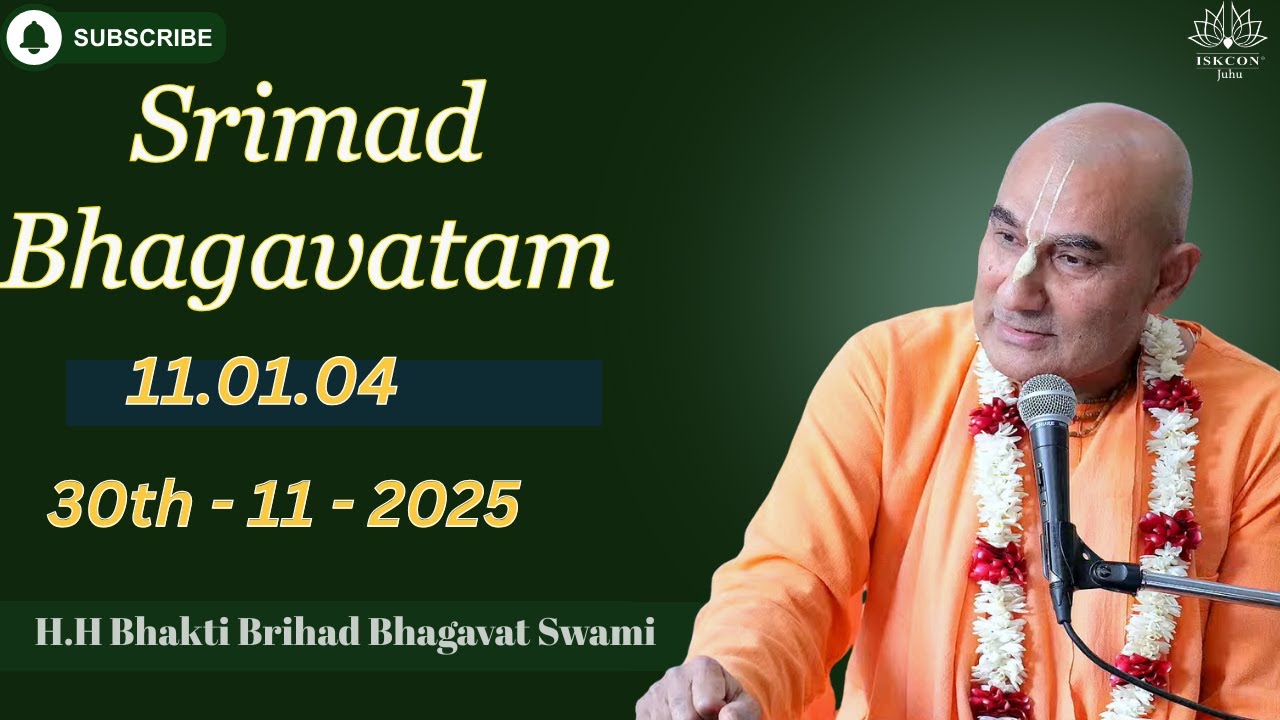
Srimad Bhagavatam 11.1.4, discussed by H.H Bhakti Brihad Bhagavat Swami at ISKCON Juhu on 30 November 2025, addresses a striking theological question: why did Lord Krishna not permit others to end the Yadu dynasty? The verse explains that the Yadus were the Lord’s own family; therefore, no being within the universe— not even the demigods— was empowered to destroy them. Their dissolution unfolded through their own actions, in alignment with divine will, as part of the orderly conclusion of Krishna’s earthly pastimes.
This teaching emphasizes divine responsibility and impartiality. Rather than delegating the burden of violence to external agents, the Lord ensured that no other parties accrued karmic entanglement for the destiny of the Yadu dynasty. Such restraint safeguards the moral coherence of the cosmic order (dharma) and illuminates a key bhakti insight: the Supreme protects the dignity of others, even when resolving the most difficult destinies.
The narrative also speaks to leadership and accountability. Decisions that carry grave consequences are not outsourced for convenience or deniability. In the tradition of Hindu Dharma and the Bhakti Tradition, responsibility is accepted directly, demonstrating that justice can be delivered without compromising compassion. Listeners often find in this principle both ethical clarity and a humbling call to self-examination.
Practitioners across dharmic paths recognize resonances here. The Jain and Buddhist commitments to ahimsa and self-restraint, the Sikh emphasis on seva, santokh, and principled responsibility, and the Hindu centering of dharma and devotion converge in this account. The unity of these traditions is reflected in a shared conviction that inner regulation, rather than outward blame, upholds moral order and nurtures communal harmony.
For devotees of Krishna, the episode reframes power, kinship, and renunciation. Pride in lineage yields to surrender, and confidence in divine timing replaces reactive judgment. Srimad Bhagavatam thus offers not only doctrinal precision but also practices for daily life: cultivating humility, watching for the seeds of discord within, and aligning action with devotion.
In contemporary contexts— family decisions, community leadership, and public service— this teaching offers practical guidance. True stewardship does not export moral risk to others; it assumes it with clarity and care. Such integrity builds trust, prevents cycles of resentment, and aligns human action with the higher purpose articulated in Hindu scriptures.
The lecture’s contemplative tone, drawing directly from Srimad Bhagavatam 11.1.4, interweaves textual fidelity with lived application. Many listeners report that this perspective transforms the episode from a historical puzzle into a mirror for personal conduct and communal responsibility.
Ultimately, the account of the Yadus illustrates how divine compassion and justice harmonize. By ensuring that no external agent became the instrument of their end, Krishna preserved universal fairness, protected others from unnecessary karma, and taught future generations how responsibility, restraint, and devotion work together to uphold dharma.
Inspired by this post on Dandavats.