

Śrīmad-Bhāgavatam 4.8.54 stands at a decisive moment in the story of Dhruva Mahārāja. A wounded child has left the palace, not because he fully understands renunciation, but because humiliation has awakened an intense search for dignity, recognition, and spiritual power. Nārada Muni meets him in that raw condition and gradually redirects his ambition toward disciplined devotion. The verse centers on the sacred mantra oṁ namo bhagavate vāsudevāya and explains that worship should be performed with proper mantra, meaningful offerings, and thoughtful attention to place, time, and practical circumstances.
This teaching is technical, but it is not cold. It brings together mantra-śāstra, Deity worship, guru-paramparā, devotional psychology, and social inclusion. Its depth lies in the way it refuses to separate inner devotion from outer discipline. The mantra is not treated as a decorative sound, nor are ritual objects treated as empty symbols. Sound, form, offering, intention, and circumstance are woven together into a complete practice of bhakti.
The verse itself presents a compact theology of worship: oṁ namo bhagavate vāsudevāya. This dvādaśākṣara-mantra, the twelve-syllable mantra, is directed to Vāsudeva, Lord Kṛṣṇa as the all-pervading Supreme Person. The mantra begins with oṁ, moves through an act of surrender expressed by namaḥ, and culminates in the recognition of Bhagavān as Vāsudeva. In a few syllables, it contains reverence, surrender, relationship, metaphysics, and devotional focus.
In practical terms, the mantra trains consciousness to move from self-centered agitation toward sacred orientation. Dhruva begins his journey with a burning desire to surpass his father and ancestors. Nārada does not mock that desire; he refines it. The child who wants a kingdom is given a mantra that opens the door to God-realisation. This is one of the most compassionate features of the Bhāgavata tradition: imperfect motives can become purified through disciplined contact with divine sound.
The instruction also emphasizes dravyamayīṁ saparyām, worship performed through tangible offerings. Flowers, fruits, water, foodstuffs, fragrance, lamps, and other materials become instruments of devotion when offered with mantra and proper consciousness. This principle matters because Hindu spirituality is often misunderstood as either abstract philosophy or ceremonial habit. Śrīmad-Bhāgavatam presents a more integrated view. Matter is not rejected as spiritually useless; it is consecrated through service.
This has a direct philosophical basis. In Vaiṣṇava Vedānta, the world is not independent of the Supreme. The objects used in worship are not worshiped as isolated material things; they are returned to their source through devotion. A flower remains a flower, yet its role changes when it is offered. Food remains food, yet it becomes prasāda when lovingly offered and received as grace. The technical structure of worship therefore carries a relational theology: the devotee gives, the Lord accepts, and the world becomes re-enchanted through service.
The phrase deśa-kāla-vibhāgavit is especially important. It describes one who understands distinctions of place and time. Nārada’s instruction does not reduce devotion to mechanical imitation. Worship must be faithful to śāstra, guided by guru, and rooted in paramparā, yet it must also recognize real circumstances. What is available in one region may not be available in another. What is practical in one social setting may require adjustment elsewhere. This principle protects bhakti from both careless invention and rigid formalism.
This balance is crucial for a global Hindu and Dharmic world. A practitioner in Vṛndāvana, Toronto, Nairobi, Sydney, London, Singapore, or a small apartment far from any temple may not have the same ingredients, climate, language, or social support. The essence of worship is not lost because the local fruit differs, the calendar requires careful calculation, or the home altar is modest. The Bhāgavata principle is that devotion should be authentic, disciplined, and intelligently adapted.
Such adaptation should not be confused with dilution. The verse does not say that anyone may invent anything in the name of convenience. It says that a learned person, a budhaḥ, offers worship according to mantra, prescribed method, and awareness of circumstance. In other words, flexibility belongs in the hands of responsibility. Tradition remains alive when its custodians understand both principle and application.
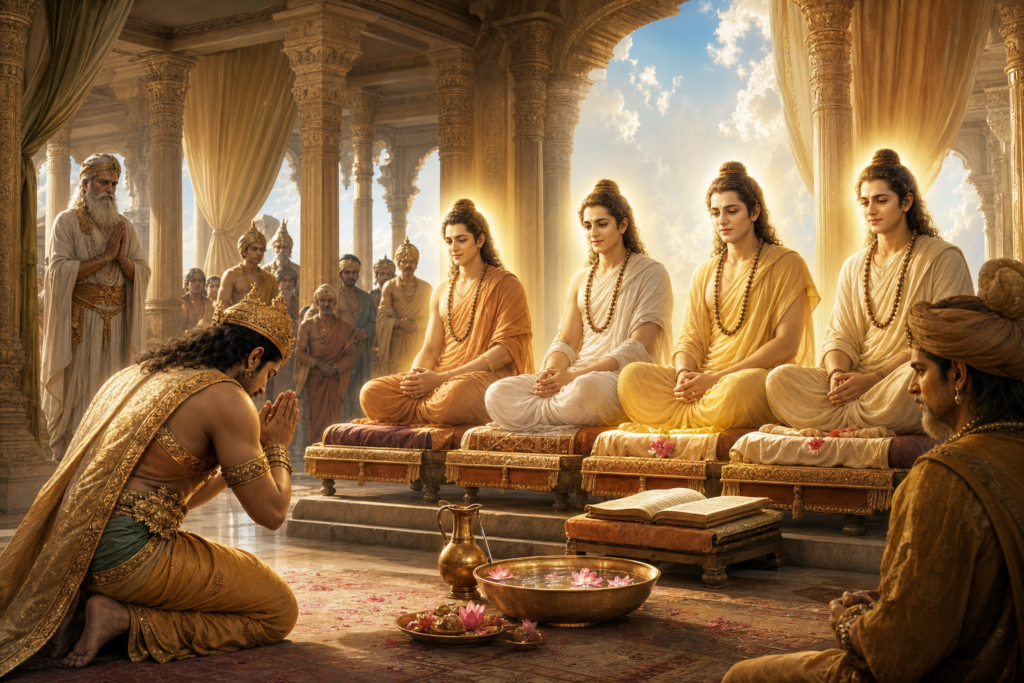
The context of Dhruva Mahārāja also reveals the importance of the guru. Dhruva receives direction from Nārada Muni, not merely information. A mantra is not presented as a casual formula picked up from curiosity. It is received within a relationship of guidance, correction, and blessing. The guru does not erase Dhruva’s personality; he redirects it. The same determination that could have hardened into pride becomes the engine of sādhana.
This is one reason Dhruva’s story remains emotionally powerful. Many people begin spiritual life from places that are not serene. There may be rejection, anger, grief, comparison, family conflict, or the ache of being unseen. The Bhāgavata does not pretend that only already-peaceful people can approach the Divine. It shows how wounded desire can be educated by mantra, discipline, and sacred association until it becomes luminous devotion.
Śrīmad-Bhāgavatam 4.8.54 also carries a strong theme of spiritual access. Dhruva is a kṣatriya child, not a renounced brāhmaṇa scholar. Yet he is entrusted with a powerful mantra and a serious method of worship. The tradition thereby affirms that eligibility in bhakti is not reducible to birth, social status, or inherited prestige. Sincerity, discipline, initiation, and devotion are central.
This point has major social significance. Dharmic traditions have always contained both inherited forms and reforming energies. The Bhāgavata’s emphasis on devotion allows spiritual dignity to reach beyond narrow social boundaries. Lord Caitanya Mahāprabhu later gives this inclusive impulse a world-embracing form through nāma-saṅkīrtana and kṛṣṇa-kathā. The sacred name is not a private possession of a cultural elite; it is a path of upliftment meant for all sincere seekers.
At the same time, inclusion does not mean flattening all traditions into sameness. Hindu Dharma contains many sampradāyas, deities, rituals, philosophical schools, languages, and regional practices. Buddhism, Jainism, and Sikhism also preserve profound disciplines of ethics, meditation, self-control, compassion, and liberation. A mature Dharmic outlook can honor these traditions without erasing their distinctions. Unity is strongest when it is rooted in respect, not forced uniformity.
The mantra oṁ namo bhagavate vāsudevāya belongs specifically to Vaiṣṇava devotion, yet its broader mood can be appreciated across Dharmic life: humility before truth, surrender of ego, disciplined practice, and the sanctification of daily action. A Jain emphasis on self-restraint, a Buddhist commitment to mindfulness and compassion, a Sikh orientation toward nām and seva, and a Hindu practice of mantra and pūjā can all contribute to a shared civilizational ethic of inner refinement and responsible living.
The technical side of the verse deserves careful attention. Mantra is not merely sound in the ordinary sense. In the traditional understanding, mantra is revealed sound, received through lineage, repeated with attention, and empowered by meaning, purity, and devotion. The syllables discipline the mind; the meaning directs the heart; the repetition forms a new interior rhythm. Over time, mantra becomes less like an external task and more like a current of remembrance.
Deity worship functions in a complementary way. Human beings are embodied. They see, touch, prepare, arrange, clean, decorate, cook, and bow. The Deity allows devotion to become embodied rather than remaining an idea. The altar becomes a school of attention. Carelessness becomes visible. Cleanliness becomes meaningful. Time becomes sacred. Food preparation becomes service. Beauty becomes theology in visible form.
For many practitioners, this is where the teaching becomes deeply relatable. A small act, such as placing water before the Lord, lighting a lamp, or chanting before beginning work, can interrupt the restless momentum of ordinary life. The home is no longer only a site of consumption, anxiety, and routine. It becomes a place where consciousness is repeatedly turned toward the sacred. This transformation is subtle, but over time it changes the emotional atmosphere of daily living.
The verse also guards against performative religiosity. If worship is adjusted according to deśa and kāla, then spiritual seriousness cannot be measured only by external abundance. A wealthy offering without humility may be spiritually thin, while a simple offering made with attention may carry profound devotional weight. The Bhāgavata repeatedly values bhāva, inner disposition, while still respecting vidhi, proper method. The mature practitioner learns to hold both together.
Dhruva’s later transformation confirms this. He begins with the desire for a kingdom, but after attaining the Lord’s presence he recognizes that what he sought was small compared with what he received. This is not a rejection of human longing; it is the purification of longing. The heart often asks for power when it is really seeking belonging, asks for recognition when it is really seeking love, and asks for victory when it is really seeking security in the Divine.
From an academic perspective, Śrīmad-Bhāgavatam 4.8.54 can be read as a concise statement of applied bhakti theology. It includes mantra, mūrti, ritual offering, guru-mediated practice, social eligibility, contextual adaptation, and the transformation of desire. It also shows how a Purāṇic narrative can carry sophisticated religious philosophy without becoming abstract. The story teaches through character, emotion, instruction, and practice.
The reference to place and time has contemporary importance for diaspora communities. Hindu temples outside India often face different legal regulations, food supply chains, work schedules, building codes, school calendars, and intergenerational language shifts. The challenge is not merely to reproduce inherited forms externally, but to transmit their meaning faithfully. A child who understands why prasāda matters, why mantra is repeated, and why the altar is treated with reverence receives more than cultural memory; that child receives a living practice.
This principle also applies within India, where urbanization, migration, apartment living, professional pressures, and changing family structures affect ritual life. The solution is not nostalgia alone. The Bhāgavata invites thoughtful continuity. If the full traditional arrangement is not possible every day, a sincere daily rhythm of chanting, offering, study, and ethical conduct can preserve the heart of sādhana while still honoring fuller temple and festival practices whenever possible.
There is also an ethical dimension. Worship of Vāsudeva should deepen humility, not superiority. If the mantra begins with namaḥ, then surrender must soften the ego. A person may know procedure, vocabulary, and lineage, yet still miss the devotional mood if pride dominates. Dhruva’s story is therefore a warning and a hope: ambition can be purified, but it must be brought honestly before the Divine.
The unity of Dharmic traditions depends on this humility. Sectarian confidence need not become hostility. A Vaiṣṇava can worship Kṛṣṇa with full conviction while respecting Śaiva, Śākta, Smārta, Buddhist, Jain, and Sikh disciplines. A tradition becomes spiritually persuasive when its adherents embody steadiness, compassion, learning, and service. Polemics may attract attention, but character sustains civilization.
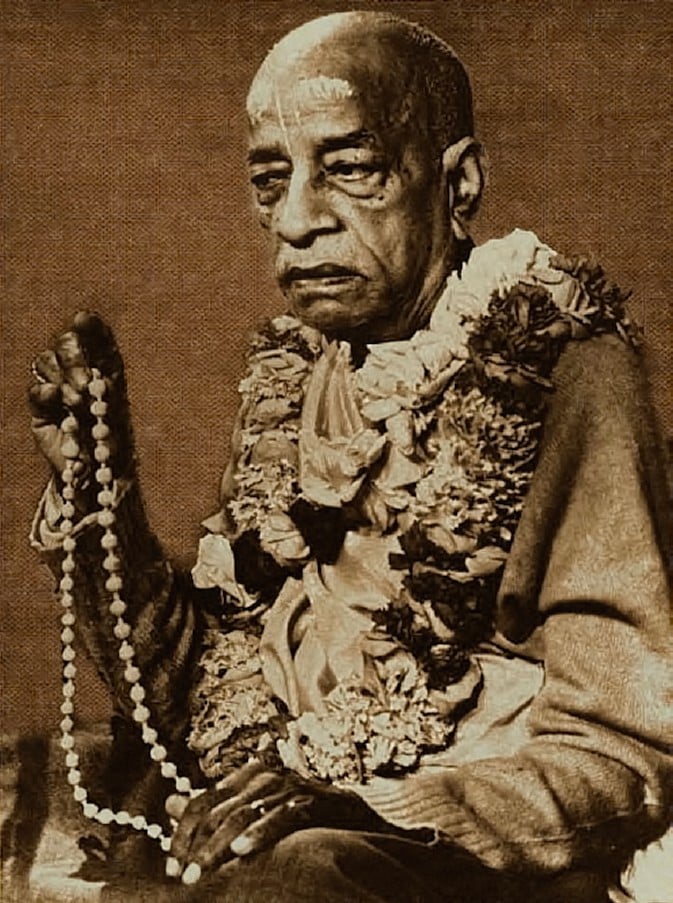
Śrīla Prabhupāda’s presentation of this verse highlights the universality of Kṛṣṇa consciousness and the importance of spreading spiritual knowledge beyond narrow social limits. That emphasis remains relevant because modern society is marked by loneliness, distraction, identity conflict, and spiritual fragmentation. The mantra offers a disciplined center. The practice of offering reconnects the body and mind to sacred purpose. The principle of deśa-kāla-vibhāga allows tradition to travel without losing its soul.
In this way, Śrīmad-Bhāgavatam 4.8.54 is not only a ritual instruction for Dhruva Mahārāja. It is a blueprint for living bhakti in changing conditions. It teaches that sacred sound should be received with reverence, worship should be performed with intelligence, offerings should be made according to real circumstances, and spiritual life should remain open to sincere seekers. Its message is both ancient and urgently contemporary: devotion becomes powerful when discipline, humility, adaptability, and grace meet in practice.
The enduring lesson is that the path of bhakti does not demand a perfect starting point. Dhruva begins in pain, receives guidance, chants with determination, worships with focus, and becomes transformed. That journey continues to speak to anyone seeking inner strength, spiritual belonging, and a practice that can survive the pressures of modern life. The mantra oṁ namo bhagavate vāsudevāya remains a call to surrender, a method of remembrance, and a bridge from wounded desire to divine relationship.
Inspired by this post on Dandavats.






Leave a Reply
You must be logged in to post a comment.