The narrative of Sage Vishwamitra, preserved in the Ramayana and echoed across the Puranas, offers a compelling study of how unfulfilled desires, disciplined tapasya, and humility intersect on the spiritual path. It illustrates how even the most resolute seeker can stumble, and yet, through insight and perseverance, rise to a state of profound realization. Read as an inner psychology of desire and restraint, his journey provides enduring guidance for contemporary spiritual life across Hinduism, Buddhism, Jainism, and Sikhism.
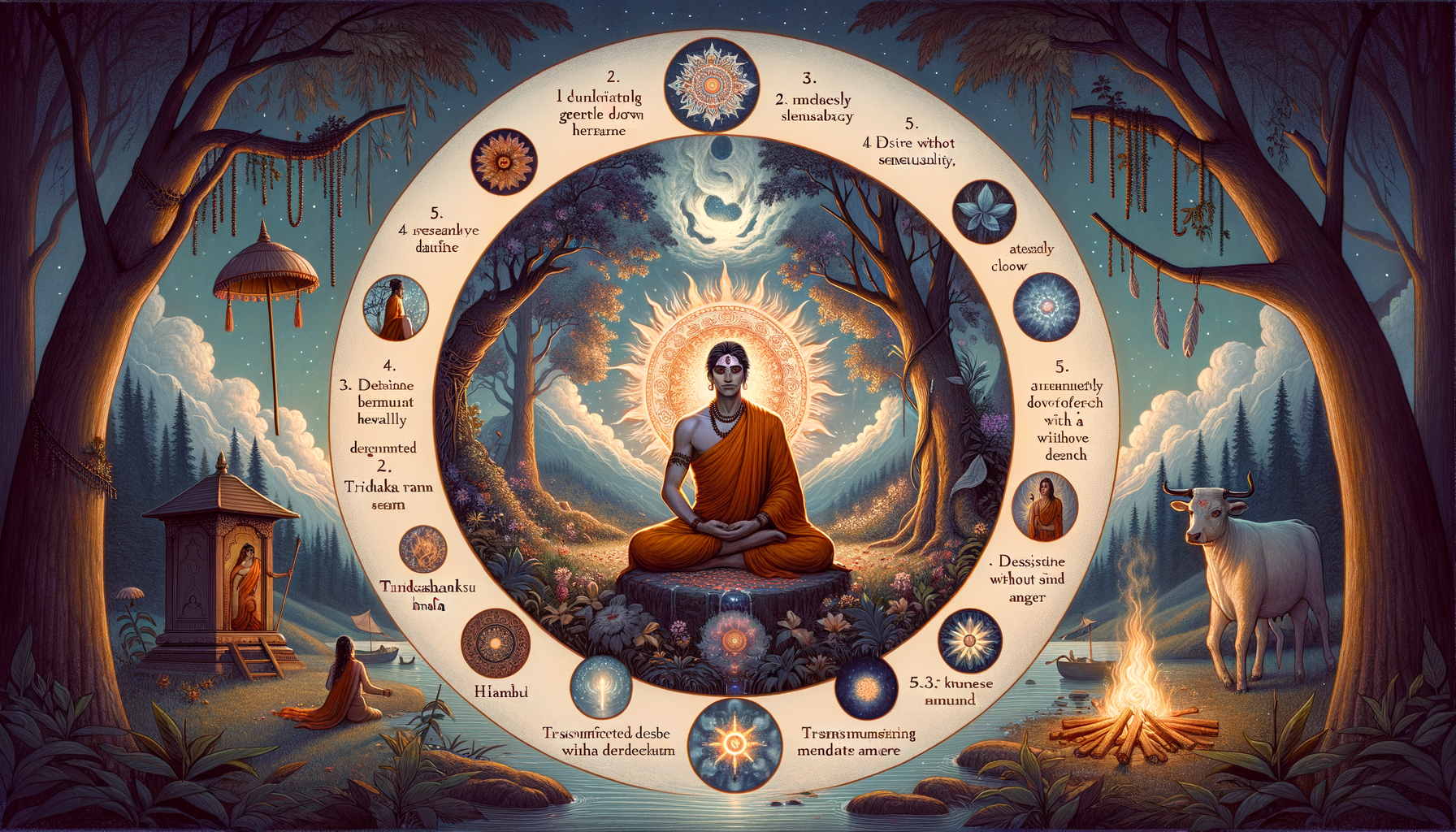
Vishwamitra’s story begins not as a renunciate but as a powerful kshatriya king, often identified as Kaushika. A fateful encounter with the sage Vashistha and the extraordinary powers of the divine cow Kamadhenu confronted him with the limits of royal power and the depth of brahma-tejas. Determined to master the inner sciences, he renounced the throne and undertook austere sadhana to attain the stature of a Brahmarshi.
Years of tapas followed, and with them came the first great test. Indra, concerned by the intensity of his penance, sent Menakā to distract him. Vishwamitra’s discipline faltered; love and attachment arose, and time flowed gently into the birth of Shakuntala. When clarity returned, he recognized that repression without understanding can convert desire (kāma) into new attachments. He parted with compassion rather than bitterness, learning that tenderness and responsibility are not opposed to renunciation, but must be harmonized with it.
Resuming tapasya with renewed focus, he faced a second trial when Rambhā approached. This time, anger (krodha) surged. He cursed her, only to witness how untransformed desire returns as fury and subtle pride. The lesson was exacting: conquering desire is not achieved through raw will alone; it requires insight, equanimity, and humility. In the language of the dharmic traditions, vairāgya must be joined to jñāna and steady abhyāsa.
Another episode, often retold for its philosophical depth, is the story of Trishanku. Denied entry to heaven in his embodied form, the king sought Vishwamitra’s help. Through extraordinary tapas and will, Vishwamitra raised Trishanku to a suspended realmTrishanku Svarga. This act simultaneously displays compassion and the peril of subtle ego. It underscores that spiritual power, if not tempered by dharma and humility, can drift away from inner freedom.
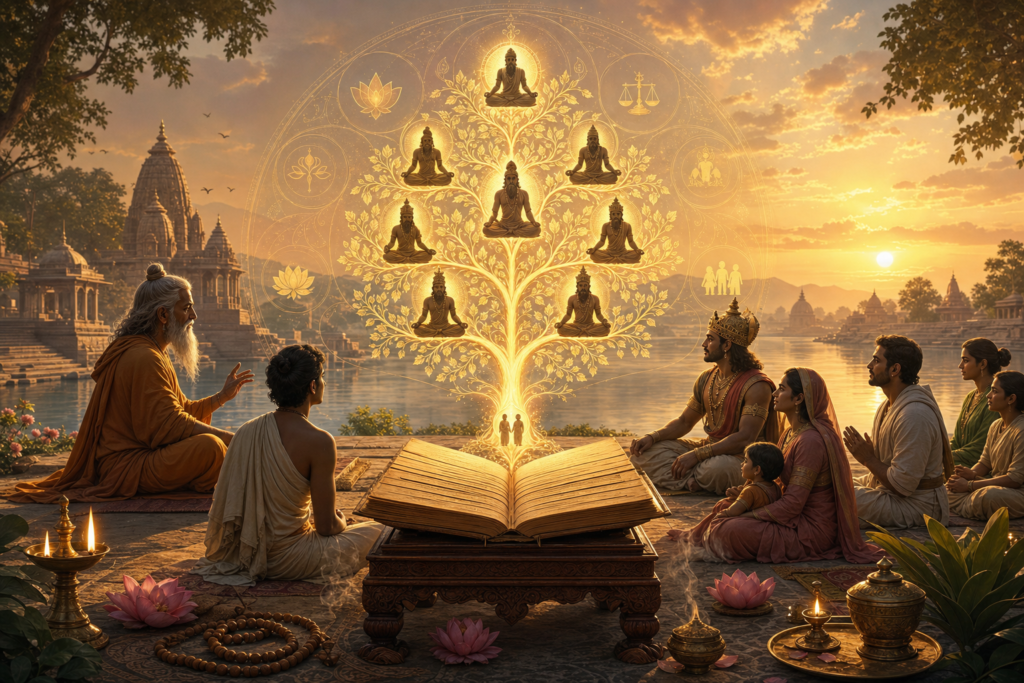
The culmination of Vishwamitra’s long journey was not marked by power but by surrender. Recognition by Vashistha as a Brahmarshi did not arise from feats alone; it was conferred when inner pride waned and compassion, clarity, and steadiness matured. Tradition also remembers Vishwamitra as the seer of the celebrated Gayatri mantra in the Rigveda, a sign that his tapas ripened into luminous insight offered for the welfare of all beings.
Viewed through the lens of spiritual psychology, the power of unfulfilled desires in Vishwamitra’s life teaches that desire need not be demonized, nor blindly indulged. It can be understood, refined, and redirected. This approach harmonizes the wisdom of multiple dharmic traditions: in Hinduism, the pairing of dhyāna and vairāgya; in Buddhism, mindfulness of tanhā and the cessation of dukkha; in Jainism, aparigraha and samayik as steadying disciplines; in Sikhism, remembrance through simran and alignment with hukam. Each tradition illuminates a facet of the same human struggle and its transformation.
For modern seekers navigating work, family, and aspiration, Vishwamitra’s arc offers practical counsel. When desire arises, notice it without judgment; name it, breathe with it, and observe its movement. Pause before reacting, and allow prāṇa to settle through simple breath awareness. Channel energy into sattvic actionseva, study, and measured sadhanaso that intensity becomes insight rather than compulsion.
His missteps also counsel patience and self-compassion. Spiritual progress is neither linear nor performative; reversals can become wisdom when met with honesty. Cultivating saṅgasupportive communityalong with śāstra study and guidance from a true guru helps integrate discipline with tenderness. In this way, unity across dharmic paths becomes a lived reality: diverse methods, shared ethics, and a common aspiration toward inner freedom.
Ultimately, Vishwamitra’s fall and rise articulate a pathway from raw will to luminous discernment. Desire that once entangled is clarified through tapas and transformed into care. Power that once asserted becomes service. And the restless mind that sought heaven outside discovers a quiet, unwavering center within. The journey is not from worldliness to world-denial, but from fragmentation to wholenessan insight that resonates across Hinduism, Buddhism, Jainism, and Sikhism, strengthening unity in spiritual diversity.
Inspired by this post on Hindu Blog.