
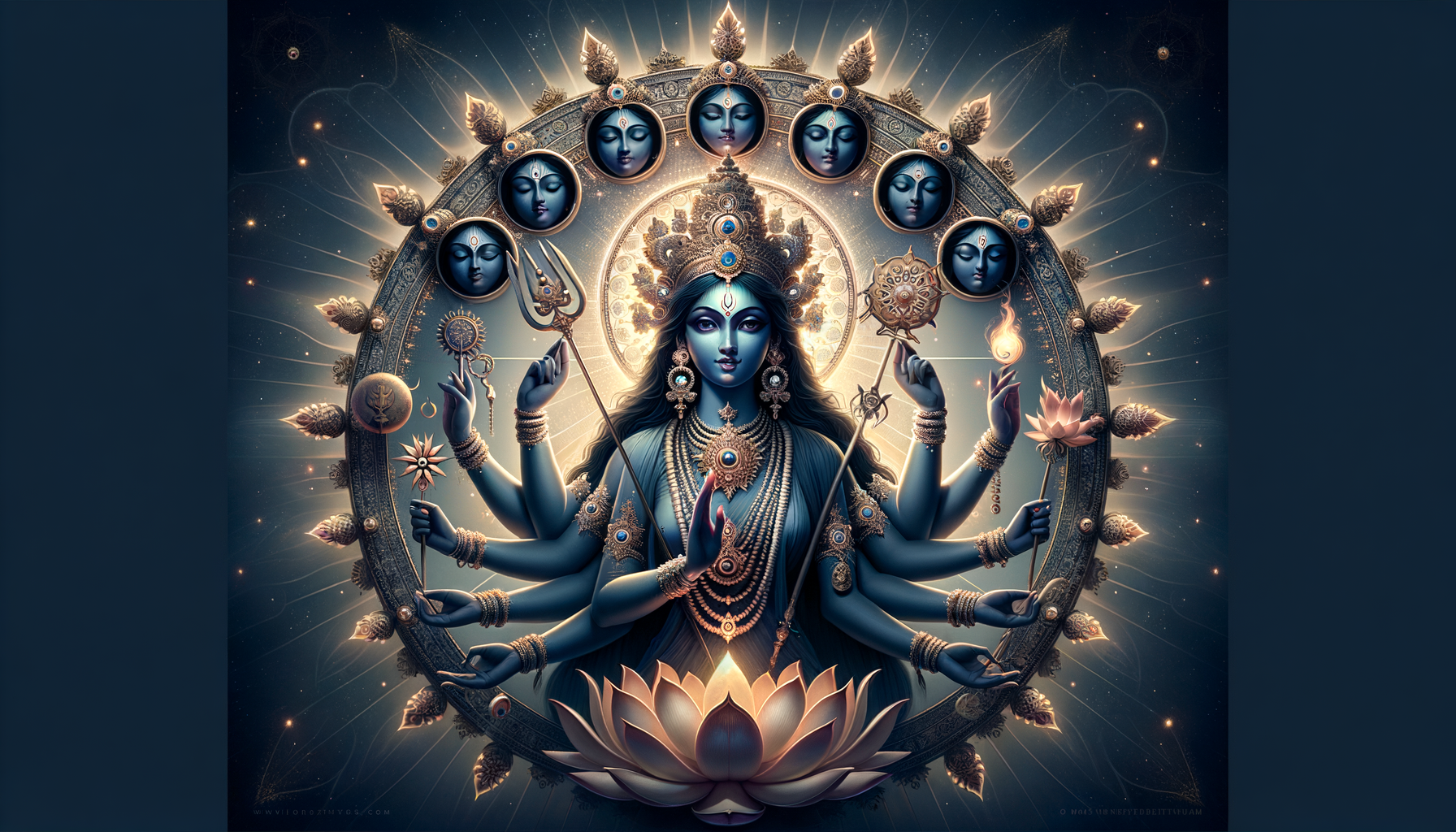
Maha Kali stands among the most awe-inspiring manifestations of the Hindu Goddess Kali, venerated across Shakta and Tantric traditions. In several regional and liturgical lineages that enumerate multiple formsoften spoken of as elevenMaha Kali appears in an extraordinary iconography: ten heads, ten arms, and ten legs. This rare and evocative portrayal does not merely magnify divinity; it encodes teachings on power, time, courage, and liberation (moksha) that continue to guide spiritual seekers within Hinduism and across the broader dharmic family.
The ten heads are read as a synthesis of complete awareness. In Shakta exegesis, ten suggests totalitythe ten directions (dasha dik), the completion signaled by the number ten in traditional numerology, and, for many practitioners, a subtle allusion to the ten Mahavidyas whose wisdom Maha Kali integrates and transcends. Through this lens, the tenfold headship symbolizes omniscience: vision that surveys all perspectives, dissolves partiality, and steadies discernment in the midst of change.
The ten arms signify dynamic Shakticapabilities deployed with precision. Texts and oral teachings describe these arms as instruments that cut ignorance, protect dharma, bestow guidance, and sustain inner resolve. The icon’s ten legs, though less commonly described in mainstream depictions, extend the same symbolic grammar: steadiness and sovereign movement in all directions. Together they convey the Goddess as the ground of stability and the energy of purposeful action, pervading the cosmos without constraint.
As the feminine power of time (Kala), Maha Kali embodies the mystery that devours limitation and reveals what is timeless. Her dark form, garland of heads, and battlefield setting are not depictions of cruelty but potent metaphors for the end of ego and the dissolution of fear. In devotional and contemplative practice, these images help practitioners face impermanence with clarity, courage, and compassion.
Practically, meditations on the ten-headed, ten-legged form are used to gather a scattered mind into unity. The ten heads teach panoramic understanding; the ten arms encourage skillful means; the ten legs ground ethical action in every direction of life. For many devotees, this visualization becomes a lived disciplinemoving from confusion to one-pointedness, from anxiety to trust, and from passivity to service.
Festivals such as Navaratri and Kali Chaudas invite communities to honor Maha Kali as both fierce protector and compassionate mother. Mantra-japa, homa, and temple darshan are approached not as ritual for its own sake, but as practices that cultivate fearlessness, humility, and responsibility. Devotees often recount a deepening sense of moral clarityfeeling both protected by the Goddess and compelled to protect others.
While rooted in Hindu traditions, the symbolism resonates across dharmic pathways. In Vajrayana Buddhism, protectors such as Mahakala reflect a parallel teaching: fierce compassion that removes obstacles to awakening. Jain insights into conquering inner passions (kashayas) mirror Kali’s slaying of ignorance, and Sikh ideals of Nirbhau, Nirvair affirm fearlessness and freedom from enmity. Read together, these streams emphasize unity in spiritual diversitydifferent languages of one quest for wisdom and liberation.
Interpreted ethically, Maha Kali’s tenfold form becomes a guide for contemporary life. Ten heads invite multi-perspectival thinking; ten arms encourage competent, compassionate action; ten legs anchor accountability wherever one stands. The image thus bridges devotion and daily duty: balancing inner stillness with outer service, personal transformation with social responsibility.
In essence, Maha Kali’s ten-headed, ten-legged iconography reveals a complete pedagogy of Shakti: the courage to confront time, the intelligence to discern truth, and the strength to walk the path of dharma in every direction. This is not a spectacle of power for its own sake, but a map toward liberationuniting seekers across Hinduism, Buddhism, Jainism, and Sikhism in a shared aspiration for wisdom, compassion, and fearless living.
Inspired by this post on Hindu Blog.
