The Nrisimha Tapaniya Upanishad stands within the Tapini or Tapaniya group of minor Upanishads, a set of Atharvavedic compositions that weave together mantra-shastra, meditative visualization (dhyana), and Vedanta. Dedicated to Lord Nrisimha—the half-man, half-lion avatara of Vishnu—this Upanishad is renowned for articulating fierce compassion, a protective spiritual force that does not negate tenderness but rather guards it. As a Vaishnava Upanishad, it illuminates how the language of sacred sound (mantra), contemplative rites (nyasa, kavacha), and non-dual insight converge in Sanatana Dharma to reveal an integral path of knowledge and protection. Readers seeking Vedic wisdom and the inner architecture of Hindu scriptures will find in this text a disciplined, technical, and contemplative guide to sadhana.
Across extant recensions, the Nrisimha Tapaniya Upanishad is most commonly transmitted in a Purva (earlier) and an Uttara (later) division, with chapters (adhyayas or prakarana) devoted to the Nrisimha mantras, their phonological seeds (bija), and the method of installation on and within the body (nyasa). The third chapter—on which this analysis focuses—centers the mantraraja of Nrisimha, discloses the bija kṣrauṁ, and integrates dhyana with ritual encoding to guide the aspirant from external recitation toward internal realization. While minor textual variants exist across manuscripts and printed editions, the thematic core of this chapter remains stable: protection and illumination through sound, form, and knowledge.
At the heart of the chapter is the mantraraja, the so‑called “king of mantras,” commonly transmitted as: ugraṁ vīraṁ mahāviṣṇuṁ jvalantaṁ sarvato-mukham nṛsiṁhaṁ bhīṣaṇaṁ bhadraṁ mṛtyor mṛtyuṁ namāmy aham. This compact formula compresses theology, cosmology, and soteriology. Ugraṁ names the energy as fierce and purifying; vīraṁ affirms heroic, world-protecting agency; mahāviṣṇuṁ locates the form in Vishnu’s all-pervading sovereignty; jvalantaṁ signals the blazing luminosity of pure awareness; sarvato‑mukham images consciousness as omnidirectional; nṛsiṁhaṁ names the liminal embodiment that dissolves binary categories; bhīṣaṇaṁ and bhadraṁ hold awe and auspiciousness in dynamic balance; mṛtyor mṛtyuṁ identifies the power as the “death of death,” the liberator from finitude. The mantra’s cadence carries protective resonance while its semantics point to non-dual truth.
A philological perspective clarifies why this mantraraja is both meditative and apotropaic. Each epithet functions as a semantic nyasa, installing qualities of the Supreme within awareness. The narrative subtext—Prahlada’s rescue—serves not as mythology alone but as an allegory for the annihilation of fear and adharma in the inner field of practice. Thus the third chapter positions the mantra not merely as a sound formula but as an Upanishadic upaya, a means of crossing from reactivity into luminous steadiness. In this reading, the mantra’s protective power arises precisely because it discloses Brahman as fearless presence.
Closely allied to the mantraraja, the chapter venerates the bija kṣrauṁ, regarded in Vaishnava mantra-shastra as the seed-syllable of Nrisimha. Traditions gloss kṣ as connoting kṣatra-tejas (the radiance of rightful protection) and the conjoint polarity of kṣaya / akṣaya (perishability / imperishability); r as the propulsive, rolling energy of transformation; au as a diphthong expanding awareness through subtle gradations of sound; ṃ (bindu) as integrative stillness completing the arc of expression. In practice, the bija is not a substitute for the mantraraja but its concentrated essence, deployed in nyasa, japa, and dhyana to anchor attention and mobilize pranic stability.
The third chapter’s ritual encoding appears in its instruction for nyasa—the mapping of mantra or bija across hands and limbs to sacralize the body as a field of realization. In many recensions, nyasa accompanies the mantraraja and the bija, moving from kara-nyasa (assignments to the fingers and palms) to anga-nyasa (assignments to heart, head, crown, armor, eyes, and missile). This is not external magic but embodied hermeneutics: the practitioner learns to read the body as scripture, to feel the mantra’s resonance as living protection (kavacha), and to stabilize attention in the present moment. In a contemplative setting, nyasa thus becomes the discipline that links doctrinal knowledge with lived, somatic insight.
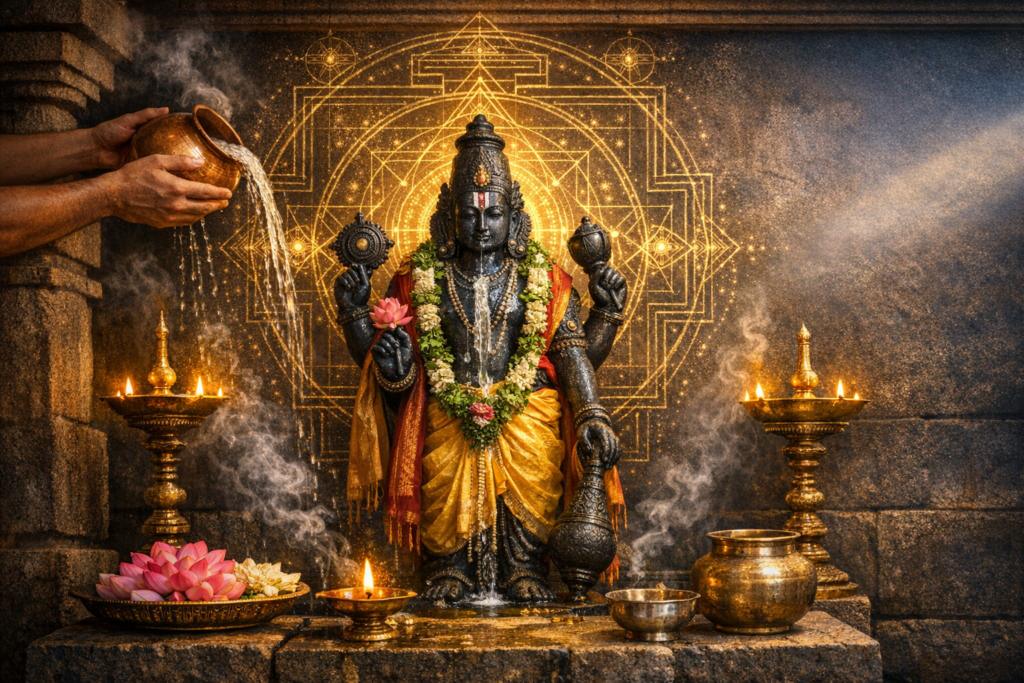
Dhyana verses associated with this Upanishad direct attention to Nrisimha’s luminous form emerging as fierce compassion that safeguards dharma. Iconographic cues—vajra-nakha (adamantine nails), vajra-damṣṭra (adamantine fangs), the gestures of granting refuge and fearlessness (varada and abhaya), and the calm presence that enfolds Prahlada—encode a paradox central to Vaishnava Upanishads: the Supreme as simultaneously terrifying to oppression and tender to the vulnerable. The third chapter leverages this paradox as a contemplative koan, inviting the mind to rest in a field where courage and care are no longer opposites.
Complementing the mantraraja, many lineages recite the Nrisimha Gayatri—oṁ nṛsiṁhāya vidmahe vajranakhāya dhīmahi tanno siṁhaḥ pracodayāt—either as a prelude to or consolidation of the chapter’s practice. Gayatri formulations condense doctrine into the triadic structure of vidmahe (we seek to know), dhīmahi (we contemplate), and pracodayāt (may That impel our understanding). Within the third chapter’s logic, the Gayatri reinforces the shift from supplication to realization, relocating protection from an external event to an internalized stance of lucid, fearless awareness.
Philosophically, the chapter aligns its ritual and sonic program with Upanishadic non-dualism. By naming the Supreme as mṛtyor mṛtyum and by folding the many-faced (sarvato‑mukham) radiance into jvalantam, it tacitly maps Nrisimha to Brahman, and Brahman to the very ground of consciousness. The protective efficacy of the practice thus emerges not from coercive force but from insight: fear subsides when awareness rests in what the Upanishads elsewhere call the fearless (abhaya) state. In this sense, the third chapter exemplifies the Vaishnava Upanishadic bridge between bhakti (devotional intimacy), mantra (sacred sound), and jñana (knowledge).
Readers often report that steady engagement with this chapter evokes a felt sense of grounded courage—a “fierce calm” that is neither aggressive nor passive. From a contemplative psychology perspective, the mantraraja functions as a precision tool: it interrupts spirals of anxiety, reorients attention to luminous immediacy, and anchors ethical resolve. The bija kṣrauṁ, when carefully placed through nyasa, can help one somatically perceive the difference between reactivity and resolute clarity, a distinction central to dharmic life and to the Upanishads’ pedagogy of freedom.
Inter-dharmic resonances strengthen this reading and align with the unity cherished across Hinduism, Buddhism, Jainism, and Sikhism. The chapter’s “fearless compassion” finds parallels in the Buddhist ideal of the bodhisattva’s protective karuṇā, in Jain emphasis on ahiṁsā as the most powerful armor, and in the Sikh affirmation of the Divine as Nirbhau (without fear). Far from promoting exclusivism, the Nrisimha Tapaniya Upanishad’s third chapter invites practitioners from Dharmic traditions to recognize shared aims: inner fearlessness, ethical steadfastness, and liberation grounded in wisdom.
Practice notes distilled from the chapter and allied Vaishnava paddhatis can guide a careful approach. A clear sankalpa (intention) is established, followed by gentle purification and breath regulation to steady attention. Nyasa is then performed with the mantraraja and/or the bija kṣrauṁ, after which dhyana on Nrisimha’s luminous presence unfolds. Japa proceeds at a sustainable pace—often in cycles of 28, 54, or 108—culminating not in restlessness but in quiet abidance. A closing peace invocation integrates the practice into daily conduct, translating fierce compassion into patient, ethical action.
Textually, the Nrisimha Tapaniya Upanishad is listed in the Muktika canon of 108 Upanishads and is transmitted in several late-medieval Vaishnava recensions. Its idiom reflects a living conversation between Upanishadic inquiry and the ritual-technical language of Pancharatra and mantra-shastra. Scholarly editions note minor divergences in chaptering and readings; yet the third chapter’s constellation—mantraraja, bija, nyasa, and dhyana—remains recognizable and coherent. For students of Sanskrit and religious history, these features illustrate how late Upanishads crystallize theological and practical developments already in motion.
Methodologically, the chapter rewards three complementary lenses. A hermeneutic lens tracks how epithets encode metaphysics; a philological lens parses mantra structure and phonetics; a phenomenological lens attends to what practice does in lived experience. Bringing these together clarifies why protection (raksha) and realization (moksha) are not sequential but simultaneous in the Upanishadic vision: when awareness recognizes itself as luminous and fearless, the most enduring armor is already present.
Responsible practice remains essential. The mantraraja and bija are traditionally approached under guidance (guru-upadesha), with steadiness (sthira), ethical non-harm (ahiṁsā), and a commitment to truthfulness (satya). The third chapter presupposes this ethos. Approached in haste or as mere technique, mantra reduces to sound; approached in reverence and clarity, it becomes what the Upanishads intend: a boat across the flood of fear and confusion.
In sum, the third chapter of the Nrisimha Tapaniya Upanishad integrates sound, symbol, and insight into a precise curriculum for inner protection and non-dual knowledge. By honoring fierce compassion as the face of wisdom, it models an Upanishadic path that is devotional without being sectarian, technical without losing warmth, and boldly protective without forfeiting tenderness. In the broader tapestry of Dharmic traditions, this synthesis encourages unity of purpose: to cultivate luminous fearlessness for the welfare of all beings.
Inspired by this post on Hindu Blog.