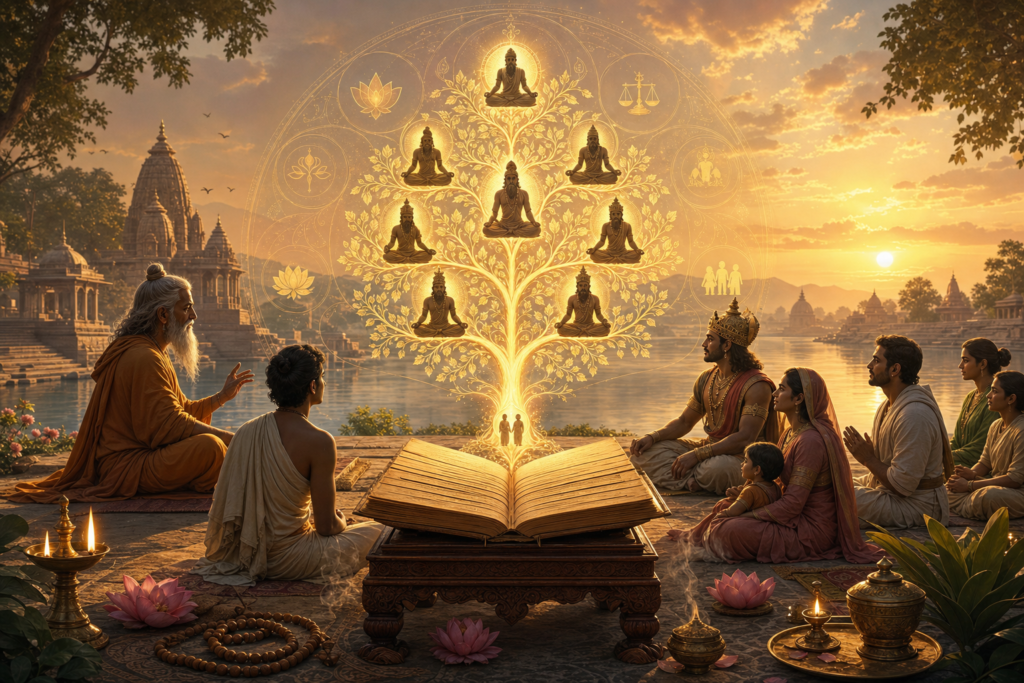
“Om krato smara kritam smara” appears in the closing movement of the Īśāvāsya Upaniṣad, where a terse, luminous instruction is offered at the threshold between life and death. The mantra, traditionally recited in Vedic funerary rites (antyeṣṭi) and also contemplated in daily practice, invites a rigorous, compassionate remembrance of one’s deeds. Read in its full context, the verse gathers the entire Upanishadic vision into a final ethical and contemplative imperative: this body will return to ash, breath will merge with breath, therefore let the inner will recall what has been done.
Textually, the line belongs to Īśāvāsya Upaniṣad 17 (Vājasaneyi Saṁhitā 40.17), the penultimate verse in a sequence of eighteen. The section closes with the celebrated prayer “Agne naya supathā rāye asmān” (verse 18), forming a diptych: first, a stark acknowledgment of impermanence and moral memory; second, a plea for infallible guidance along the auspicious path. Together they concentrate the Upanishad’s recurrent motifsrenunciation in action, the unity of the Self, and responsibility for one’s karmainto a brief liturgy of transition.
The composite verse is commonly presented as: “Vāyur anilam amṛtam athedaṁ bhasmāntaṁ śarīram. Om krato smara kṛtaṁ smara; krato smara kṛtaṁ smara.” In plain sense: breath (vāyu) returns to the immortal wind; this body becomes ashes; O kratuO sovereign will or directing intelligenceremember, remember what has been done. The deliberate repetition of “smara” intensifies urgency and care, as though the text leans in to ensure nothing ethically or spiritually essential is forgotten at life’s most decisive instant.
Philologically, “krato” is the vocative of “kratu,” a layered Vedic term that connotes sacrificial resolve, volition, and the determinative intellect that initiates and governs action. It can thus be heard as a summons to the inner agent that chooses, consecrates, and carries out deeds. “Smara” is the imperative singular of the root smṛ (to remember), while “kṛtaṁ” is the neuter past participle (that which has been done). The mantra therefore enjoins the faculty that authored action to turn back upon its own ledger, to recollect comprehensively and soberly.
On the horizon of doctrine, the instruction illuminates the karmic continuum. The Upanishadic worldview intertwines action (karma), impression (saṁskāra), and recollection (smṛti). To remember “what has been done” is to witness the arc by which intention becomes deed, deed becomes imprint, and imprint conditions future inclination. The Yoga-Sūtra defines memory as “anubhūta-viṣayāsampramoṣaḥ smṛtiḥ”the non-loss of what has been experiencedunderscoring its role as the mind’s ethical archive. In this light, remembrance at the end of life is not mere retrospection; it is a clarifying integration of one’s moral biography.
The Bhagavad Gītā (8.5–6) adds a wider soteriological frame: what is remembered at the last moment patterns the trajectory that follows. Īśāvāsya’s call to remember deeds does not contradict that vision; it prepares for it. A mind trained to review action without denial or despair becomes fit to remember the Highest without obstruction. Ethical lucidity and Godward memory reinforce one another.
Across the dharmic family, the same principle surfaces in distinctive practices that converge on shared wisdom. In Buddhism, maranāsati (mindfulness of death) and continuous mindfulness cultivate clarity and non-clinging at life’s close; karma (kamma) and intention (cetanā) remain central. In Jainism, pratikramana institutionalizes regular confession, contrition, and resolve, ensuring that memory, restraint, and renewal proceed hand in hand. In Sikh tradition, simran (remembrance of the Divine Name) and the ethic of truthful living integrate action and remembrance, orienting the mind to Ik Oankar in every deed. Each path highlights that clear memoryof truth, of intention, of conductsupports liberation and compassionate living, affirming a profound unity beneath diverse disciplines.
Ritually, the mantra’s force is felt in antyeṣṭi. When families hear or recite “Om krato smara kritam smara,” the words provide a language for closure and courage. For mourners, the instruction offers a humane psychology: grief can be accompanied by honest remembrance that neither romanticizes nor condemns a life but bears witness to its wholeness. For practitioners, the same instruction functions as a daily discipline, not a last-minute scrambleone that steadily refines awareness and responsibility.
As a practical sādhanā, the verse maps onto a simple rhythm many find sustainable. Each evening, let the inner resolve (kratu) review the day’s actions without embellishment: speech, choices, omissions. Where there is alignment with dharma, acknowledge and reinforce; where there is injury, clarify intention, make amends where possible, and resolve differently. A few breaths of prāṇāyāma and soft japa of Om calm the autonomic churn, and a succinct offering of all deeds to the indwelling Self or Īśvara prevents memory from hardening into guilt. Over weeks, this cultivates a stable smṛti that is resilient in crisis and lucid at life’s thresholds.
The metaphysical substrate of the verse is equally direct. “This body becomes ashes” returns attention to the Upanishadic insight that the Self (ātman) is not the perishable form. The wind returns to wind; the mortal sheath dissolves; yet that which knows dissolution is not itself diminished. Remembering deeds just as they areneither inflated nor deniedboth honors the law of karma and opens onto the law-transcending recognition of the Self, a recognition that the Īśāvāsya consistently extols.
Textual notes help prevent over-narrow readings. Some traditional exegesis hears “kratu” primarily as will or determinative intellect; others, drawing on Vedic resonance, include sacrificial resolve or even the officiant as the addressee. All converge on an ethically charged mindfulness. Likewise, the line’s placement before “Agne naya supathā” is not accidental: truthful remembrance prepares the ground for safe guidance. The Upanishad’s sequence itself becomes pedagogyfirst clear the mirror of memory; then walk the luminous path.
In sum, “Om krato smara kritam smara” is more than a funerary whisper. It is a comprehensive method that unites philosophy, ritual, and psychology: remember to become responsible; become responsible to become free. Read alongside cognate practices in Buddhism, Jainism, and Sikhism, the mantra discloses a shared dharmic conviction that honest remembrance, compassionate resolve, and unwavering orientation to the Real make a lifeand a deathconscious, courageous, and whole.
Inspired by this post on Hindu Pad.