Hindu scriptures repeatedly advance a paradox that is as rigorous as it is liberating: spiritual enlightenment does not require unthinking submission to divine authority. Instead, a disciplined willingness to question, wrestle with, and even confront the divinewithin a clear ethical and philosophical frameworkbecomes a potent catalyst for self-knowledge. This idea of sacred confrontation, present across the wider family of dharmic traditions, is not irreverence; it is a method for piercing illusion, clarifying dharma, and reaching moksha through reason, devotion, and lived experience.
In classical terms, such confrontation operates through inquiry (pariprashna), reasoned debate (tarka), and experiential verification (anubhava). Hindu scriptures, including the Upanishads, the Mahabharata, and the Bhagavad Gita, normalize a dialogical path to truth in which the seeker tests teachings against pramana (valid means of knowledge) and the guidance of guru, shastra, and satsaṅga. Far from weakening faith, this disciplined contestation strengthens it, transforming andha-shraddha (blind faith) into intelligent śraddhāan ethical trust that remains open to evidence, logic, and inner realization.
The Katha Upanishad offers a foundational model. Nachiketa, a fearless youth, challenges Yamanot in hostility, but in uncompromising search for the highest good. Offered celestial pleasures and longevity, he declines the ephemeral and insists on knowing the atman’s destiny. The text contrasts preyas (the pleasing) and shreyas (the truly good), showing how questioning divine authority can sift transient allure from ultimate reality. This is sacred confrontation as soteriology: a precise, stepwise path to self-knowledge through exacting inquiry.
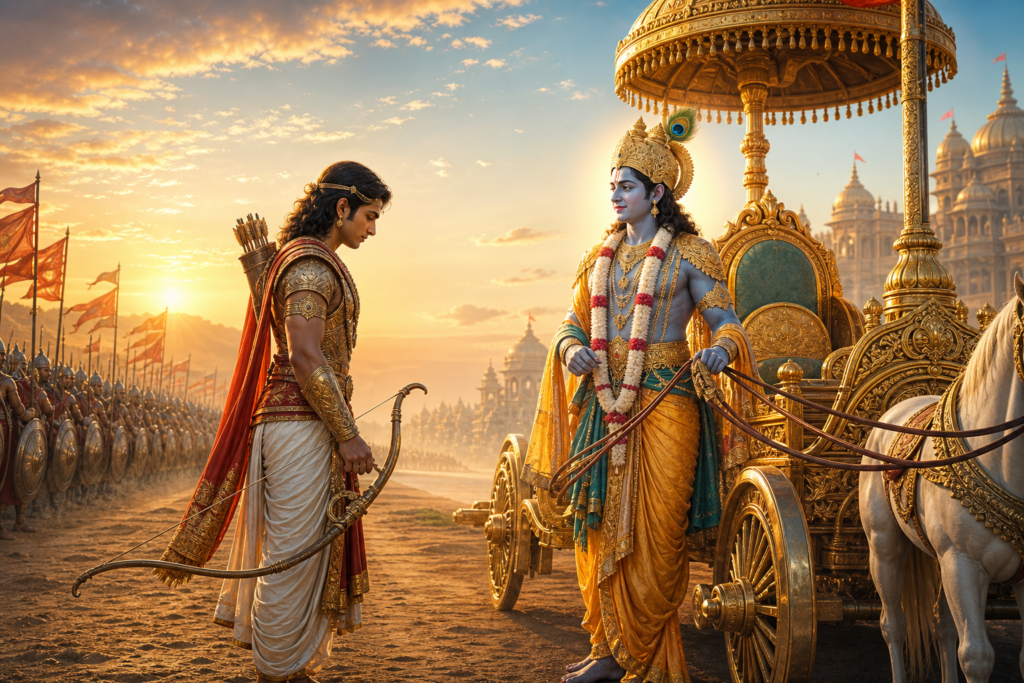
The Bhagavad Gita radicalizes this ethos within a battlefield of ethical ambiguity. Arjuna, overwhelmed, disputes the very course of action Krishna outlines and demands a reasoned account. What follows is a systematic expositionkarma-yoga, jnana-yoga, bhakti-yoga, and the nature of dharmathat restores agency to the seeker. Most striking is the Gita’s license for autonomy: after receiving comprehensive teaching, Arjuna is explicitly invited to reflect fully and act as he deems right. Here, divine instruction refuses coercion; enlightenment is inseparable from discerning freedom.
Another celebrated episode from the MahabharataKirata-Arjunacasts confrontation in vivid relief. Arjuna contends with a mysterious hunter over a quarry, only to discover the hunter is Shiva. The conflict purges pride, refines intent, and culminates in Shiva’s boon of the Pashupatastra. The battle is not blasphemy; it is tapas made visible. Through trial and humbling clarity, the aspirant’s will is aligned with the cosmic will.
The Govardhan episode in the Bhagavata tradition reframes divine worship through ethical ecology. When Krishna persuades the Vraja community to suspend ritual offerings to Indra and honor Govardhanthe sustaining mountain and ecosystemIndra’s retaliatory deluge is met by Krishna’s protective grace. The narrative models a sacred confrontation with inherited authority to re-anchor worship in dharma: gratitude to the land, care for cattle, and communal responsibility. When Indra yields, reverence is not abolished but purified and deepened.
In the Vamana–Bali narrative, a mortal king negotiates with the divine incarnation. Bali’s expansive generosity and steadfast integrity lead him to surrender all that is his, yet the outcome is not annihilation; it is transfiguration. Bali is honored with Sutala, the protection of Vishnu, and the enduring cultural memory of Onam. Confrontation here is moral and metaphysical: asserting agency before the divine to realize a higher order of trust, humility, and protection.
Bhakti literature often dramatizes confrontation as the test of inner truth. Episodes such as Durvasa’s pursuit of King Ambarisha, resolved only when the sage submits to the devotee’s steadfast dharma and the Lord’s grace, demonstrate that spiritual authority is not a license for arbitrary power. Divine favor coheres with ethical rectitude; confrontation exposes the measure of sincerity and the supremacy of compassionate law.
These narratives are not isolated. They encode a sophisticated philosophical grammar. Nyaya legitimizes rigorous debate and inference; Mimamsa advances methods for scriptural interpretation and the ethical force of duty (dharma) without collapsing inquiry into skepticism. Vedantaand especially the Upanishadic neti-netitrains the seeker to deconstruct false identifications and remain steadfast in experiential verification. The classical triad of pramana (means of knowledge), prameya (objects of knowledge), and pramatr (knower) secures a multidisciplinary approach: one neither dismisses revelation nor abdicates reason.
This ethos extends across the broader dharmic spectrum. In Buddhism, the Buddha’s confrontation with Mara signifies mastery over inner afflictions rather than a violent rupture with the sacred. The Kalama Sutta underwrites critical inquiry into teachings based on experience, ethical outcomes, and wisdom (prajna), ensuring that faith remains accountable to compassion (karuna) and clarity. Jainism advances anekantavada and syadvada, acknowledging the multi-faceted nature of truth. By situating devas within samsara rather than at liberation’s apex, Jain philosophy dignifies disciplined questioning and self-effort as the surest vehicle to kevala-jnana. Sikhism’s Sidh Gosht records searching dialogues with yogis, while the centrality of Shabad, vichar (reflective contemplation), and seva marries devotion with relentless moral and intellectual clarity. Across these traditions, sacred confrontation is an instrument of truth, not rebellion for its own sake.
Psychologically, deities can be read as archetypal forcescourage, restraint, insight, abundancewhose disharmony manifests as inner conflict. Confronting a deity in scripture often maps to confronting an aspect of the self: anger, pride, fear, or ignorance. Through sadhana and dialogue, those energies are integrated. The threefold sufferingadhyatmika (internal), adhibhautika (external), and adhidaivika (cosmic)finds resolution not in passive fatalism but in active alignment, where the seeker participates in restoring inner and outer order.
This confrontational mode is ethically bounded. Ahimsa and satya are non-negotiable guardrails; truth-speaking without cruelty and dissent without egoic aggression are central. Traditional discourse terms like purva-paksha (the opponent’s view) and siddhanta (settled conclusion) formalize respectful debate. In this light, questioning the divine is not license for disrespect but a commitment to the most rigorous possible reverenceone that refuses to mask confusion or injustice with pious slogans.
Scriptural pedagogy supports this method. The Gita commends approaching a teacher with humility, service, and inquiry; the Upanishads are dialogical from start to finish. Viveka (discernment) and vairagya (non-attachment), alongside inner wealth such as tranquility and forbearance, constitute the sadhana-chatushtaya that readies the mind for transformative inquiry. Together, they temper confrontation so it becomes clarifying rather than destabilizing.
In contemporary practice, this tradition remains alive. Devotees and practitioners across Hinduism, Buddhism, Jainism, and Sikhism often report that moments of crisisserious illness, moral injury at work, or family griefprovoke fierce questioning. Instead of dismissing such questioning as disloyal, dharmic frameworks validate it and provide methods to refine it: svadhyaya (self-study), satsanga (community of practice), and guided contemplation on ishta (chosen ideal) that channels turbulent emotion into insight and compassionate action.
For those engaging this path today, several practical principles emerge. First, ground inquiry in dharma: the more a question enhances compassion, truthfulness, and responsibility, the more auspicious its pursuit. Second, triangulate insight with guru–shastra–satsaṅga, preventing solipsism. Third, measure progress not merely by intellectual satisfaction but by reductions in greed, anger, and delusion, and by increases in steadiness, empathy, and clarity. In short, the validity of sacred confrontation is verified by its ethical fruits.
Pluralism is the natural horizon of this method. The concept of ishta-deva within Hinduism, the Buddhist emphasis on skillful means, the Jain celebration of many-sided truth, and the Sikh insistence on living, ethical God-consciousness all converge on one axiom: multiple paths can be true because reality is inexhaustibly rich. Sacred confrontation thus supports unity in diversity, making space for varied lineages, languages, and practices to learn from one another without erasing distinctive insights.
Ultimately, what appears as a human–divine clash is a disciplined dialogue aimed at unveiling the Self. Confrontation, when purified of ego and anchored in dharma, refines devotion, steadies wisdom, and empowers service. Across the dharmic traditions, this is the grammar of liberation: approach the sacred with devotion and courage, ask the hardest questions without malice, and let the answers be tested by reason, scripture, and compassionate action. In that crucible, enlightenment ceases to be an abstraction and becomes a lived, shared reality.
Inspired by this post on Hindu Blog.