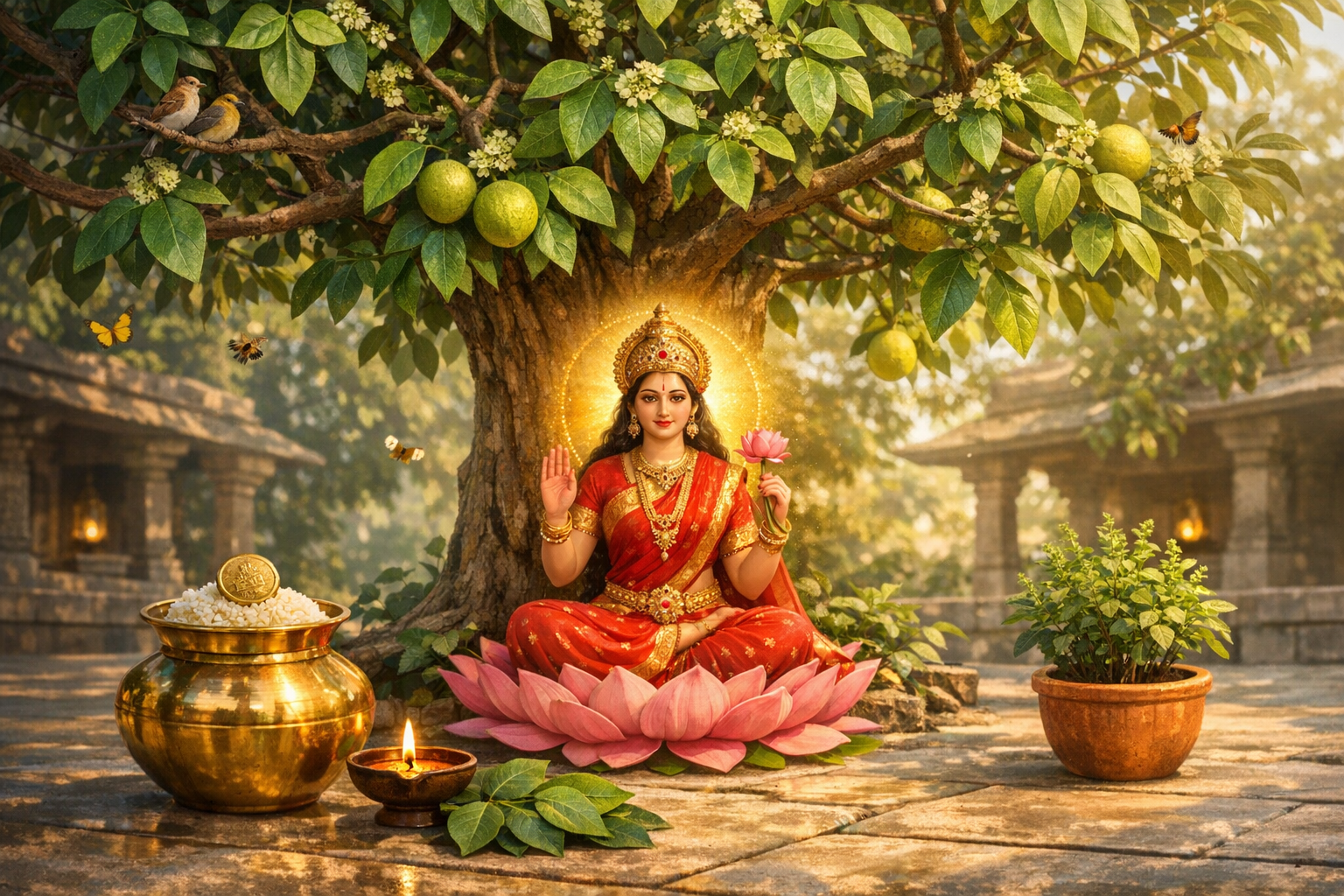
The Bilva tree (Aegle marmelos), also known as bael or bilva, occupies a revered place in Hinduism as a living symbol of auspiciousness, abundance, and sanctity. While widely recognized as especially dear to Lord Shiva, classical lore, temple customs, and household traditions across regions also uphold the Bilva as a sacred abode of Goddess Lakshmi (Mahalakshmi), the bestower of wealth, prosperity, and well-being. This dual veneration discloses an integrative vision of Sanatana Dharma in which divine energies are complementary rather than competitive, and in which a single sacred tree can embody the graces of both Shiva and Sri.
Understanding the Bilva–Lakshmi relationship begins with the insight that prosperity in the dharmic sense exceeds material gain. Lakshmi’s shrī is plenitude aligned with dharma—ethical prosperity that sustains families, protects communities, and nurtures the living world. In this light, the Bilva’s hard, nourishing fruit, long lifespan, and resilience during droughts become eloquent metaphors for durable prosperity grounded in restraint, balance, and interdependence.
Botanically, Aegle marmelos belongs to the Rutaceae (citrus) family. Native to the Indian subcontinent and naturalized across South and Southeast Asia, the tree thrives in semi-arid to tropical conditions, tolerates poor soils, and supports pollinators with its fragrant flowers. Its distinctive trifoliate leaves, fibrous bark, and globose fruits have inspired layered symbolic readings in ritual and literature. Correct identification is essential: Aegle marmelos (bael) is distinct from the unrelated “wood apple” (Limonia acidissima), a frequent source of confusion.
Ecologically, the Bilva is invaluable. Deep roots stabilize soil, the canopy moderates microclimates, and the fruit feeds birds and small mammals. In temple precincts and household courtyards, the tree participates in a living sacrament: the precinct becomes a ritual ecology in which spiritual practice and biodiversity reinforcement coincide. This is a characteristic expression of the Hindu way of life, where veneration and conservation are mutually reinforcing.
Scriptural and ritual literature preserves sustained praise of the Bilva. Puranic sections devoted to Bilva-mahima (the glory of the Bilva) and temple paddhatis (manuals) in both Śaiva and Vaiṣṇava lineages endorse its worship, often noting that honoring the tree pleases not only Shiva but also Mahalakshmi. In many regional sthala-purāṇas and households, Lakshmi is invoked at the Bilva’s base or through offerings of Bilva patra during Lakshmi-related vrata and pūjā, reflecting a shared sanctity that bridges sectarian lines.
The symbolism of the Bilva patra—three leaflets united on a single petiole—maps readily onto dharmic triads essential to Lakshmi’s bestowal of prosperity. It is read as the harmony of the three guṇas (sattva, rajas, tamas), the three śaktis (icchā, jñāna, kriyā), or the triple pursuit of dharma, artha, and kāma under the higher discipline of mokṣa. By offering Bilva leaves in Lakshmi worship, practitioners affirm that artha (wealth) must be balanced by knowledge, right intention, and responsible action.
In household practice, the Bilva’s Lakshmi association surfaces in several ways. During Varalakshmi Vratam in parts of South India, Bilva leaves may be included in pushpāñjali (flower offerings) where family lineage or local custom sanctifies this usage. In Eastern India, during Śarad Pūrṇimā (Kojagari Lakshmi Puja), some families place bael fruit or consecrated Bilva leaves near the kalasha to signify fullness and protection of stored grains and wealth. Such practices, though regionally varied, converge on a common intuition: the Bilva amplifies the auspicious field (śrīkṣetra) around Lakshmi worship.
Ayurveda deepens the Bilva–Lakshmi nexus by illuminating the tree’s role in sustaining embodied well-being. The unripe bael fruit is traditionally indicated for digestive support, while the ripe pulp is refreshing and restorative; leaves and root-bark appear in classical formulations used with physician guidance. The tree’s reputation for stabilizing agni (digestive fire) and promoting balance mirrors Lakshmi’s stabilizing, prosperity-yielding energy in the home. As always, Ayurvedic remedies should be undertaken with qualified advice, distinguishing sacred symbolism from clinical application.
Temples frequently cultivate Bilva in sacred groves alongside tulasī gardens. This spatial dialogue—Bilva with its Śaiva resonance and tulasī dedicated to Viṣṇu and Lakshmi—materializes the theological complementarity that permeates Hindu practice. The result is an architecture of unity: devotees circumambulate living shrines that silently teach synthesis across traditions.
Ritual manuals and customary law emphasize ethical harvesting. Bilva leaves are selected whole, fresh, and clean, ideally in the morning, without harming new buds. Worm-eaten, torn, or desiccated leaves are avoided; a gentle rinse and respectful handling preserve ritual purity (śauca) and ecological care. This ethic of reverence extends to never littering sacred precincts with used offerings and to returning leaf remnants to the soil or a plant bed after pūjā.
For home Lakshmi worship incorporating Bilva, a simple, textually consonant sequence is often observed:
Step 1 – Saṅkalpa (intention): After a brief ācamana, one articulates a clear intention that prosperity be righteous, shared, and beneficial to all beings—aligning wealth with dharma rather than desire alone.
Step 2 – Prakṣālana (purification): The altar is purified with water and a lamp is lit. A small vessel (kalasha) is established with water, rice, and a coin, invoking Mahalakshmi’s presence.
Step 3 – Avāhana (invocation): While reciting Śrī Sūktam or Lakshmi Ashtottara Sata Namavali, Bilva leaves are gently touched to the kalasha or presented before an image of Lakshmi, acknowledging the tree as a locus of her śakti.
Step 4 – Archana (offering): Whole Bilva patra are offered with each name or verse, affirming the integration of icchā, jñāna, and kriyā—the threefold power through which abundance is created and stewarded.
Step 5 – Naivedya (offering of food): Fruits, milk sweets, or simple cooked foods are presented with the resolve that the household’s resources be used in service and compassion.
Step 6 – Pradakṣiṇa and Namaskāra: Circumambulation and final salutations seal the worship with gratitude; prasāda is then shared with family and neighbors, weaving prosperity into community bonds.
This home rite underscores a foundational dharmic principle: offering to Lakshmi through the Bilva affirms that wealth is sacred trust, not private entitlement. By foregrounding gratitude, restraint, and sharing (dāna), the ritual transforms the psychology of possession into a culture of service.
Lore associating the Bilva with Lakshmi is reinforced by its use in vrata narratives and regional festivals where the tree is treated as a guardian of granaries, wells, and thresholds. Such practices produce a continuous thread between metaphysics and daily life: sacred trees guard real stores of food and water, and ritual respect encourages long-term care of the sources of subsistence.
Textual memory further connects the Bilva to a vision of inter-deity harmony. In Puranic storytelling and later stotras, pleasing Shiva through Bilva worship is sometimes said to concurrently invite Lakshmi’s favor, because peace (śānti) and balance in the heart are the true foundation of prosperity. This is not theological compromise but an enactment of unity-in-diversity, the hallmark of Hinduism’s civilizational wisdom.
A practical note for seekers and temple volunteers concerns identification and sourcing. Aegle marmelos leaves are trifoliate with an aromatic, slightly resinous scent when crushed; in contrast, similar-looking leaves from other species may lack this fragrance. For ritual integrity and ecological responsibility, cultivate a Bilva sapling at home or support temple groves where the supply is maintained sustainably.
The Bilva’s cultural life also includes foodways that preserve both health and heritage. Ripe bael pulp forms the base of summer beverages; sun-dried slices flavor teas in parts of South and Southeast Asia; and preserves crafted from the fruit exemplify mindful consumption—using seasonal abundance to nourish families while reducing waste.
From an ethical standpoint, the Bilva–Lakshmi association invites a rethinking of prosperity. Lakshmi’s grace is not merely the arrival of resources; it is the wisdom to deploy them toward household stability, education, care for elders, and community resilience. Planting a Bilva, conserving water, supporting local biodiversity, and practicing dāna are all expressions of Lakshmi-pūjā by other means.
Unity across dharmic traditions—Hinduism, Buddhism, Jainism, and Sikhism—emerges clearly in reverence for trees, sacred groves, and ethical stewardship of nature. While the Bilva’s ritual centrality belongs primarily to Hindu practice, the shared values of ahiṁsā, compassion, and gratitude toward the living world resonate across these traditions. The Bilva thus operates as a bridge symbol: a culturally specific form that gestures to an inclusive ecological ethic foundational to the wider dharmic family.
Common misconceptions deserve brief clarification. First, equating prosperity exclusively with wealth contradicts Lakshmi’s broader mandate, which integrates virtue, health, learning, and social harmony. Second, restricting Bilva solely to Śaiva worship overlooks a long record of Vaiṣṇava and household customs in which Bilva accompanies Lakshmi-Puja. Finally, confusing Aegle marmelos with other “wood apple” species can lead to ritual and medicinal inaccuracies; careful identification resolves this.
Integrating Bilva worship into Lakshmi observances requires attentiveness to lineage guidance. Families are well served by consulting elders or temple priests regarding local paddhati, festival timetables, and permissible substitutions where Bilva is scarce. Such dialogue strengthens intergenerational memory and preserves the integrity of practice while allowing for regional variation.
In temple architecture and landscape planning, placing Bilva near Lakshmi shrines symbolically completes a circle: tulasī invokes devotion (bhakti) and sattva; Bilva connotes steadiness and fullness. Together they teach that wealth must be rooted in devotion and disciplined by balance. That lesson is amplified when temple communities lead tree-planting, seed-saving, and seasonal conservation drives as forms of collective pūjā.
Ultimately, the Bilva’s significance as a dwelling of Goddess Lakshmi rests on an elegant logic shared by scripture, ritual, and lived experience. A tree that survives heat and scarcity, that nourishes bodies and shelters beings, and that sanctifies domestic and temple spaces, becomes a natural emblem of śrī—prosperity that lasts. Honoring Bilva with knowledge, care, and reverence is therefore a practical theology: it transforms belief into habits that uplift households and ecosystems alike.
In sum, the Bilva tree and Goddess Lakshmi together articulate a comprehensive doctrine of prosperity: metaphysical (as Lakshmi’s abiding presence), ritual (through Bilva patra offerings and kalasha worship), ethical (through sharing and restraint), medical (through Ayurveda’s careful use), and ecological (through conservation and cultivation). Embracing this whole spectrum allows devotees and communities to move from wishful acquisition to wise abundance—precisely the auspicious path Lakshmi intends.
Inspired by this post on Hindu Blog.