
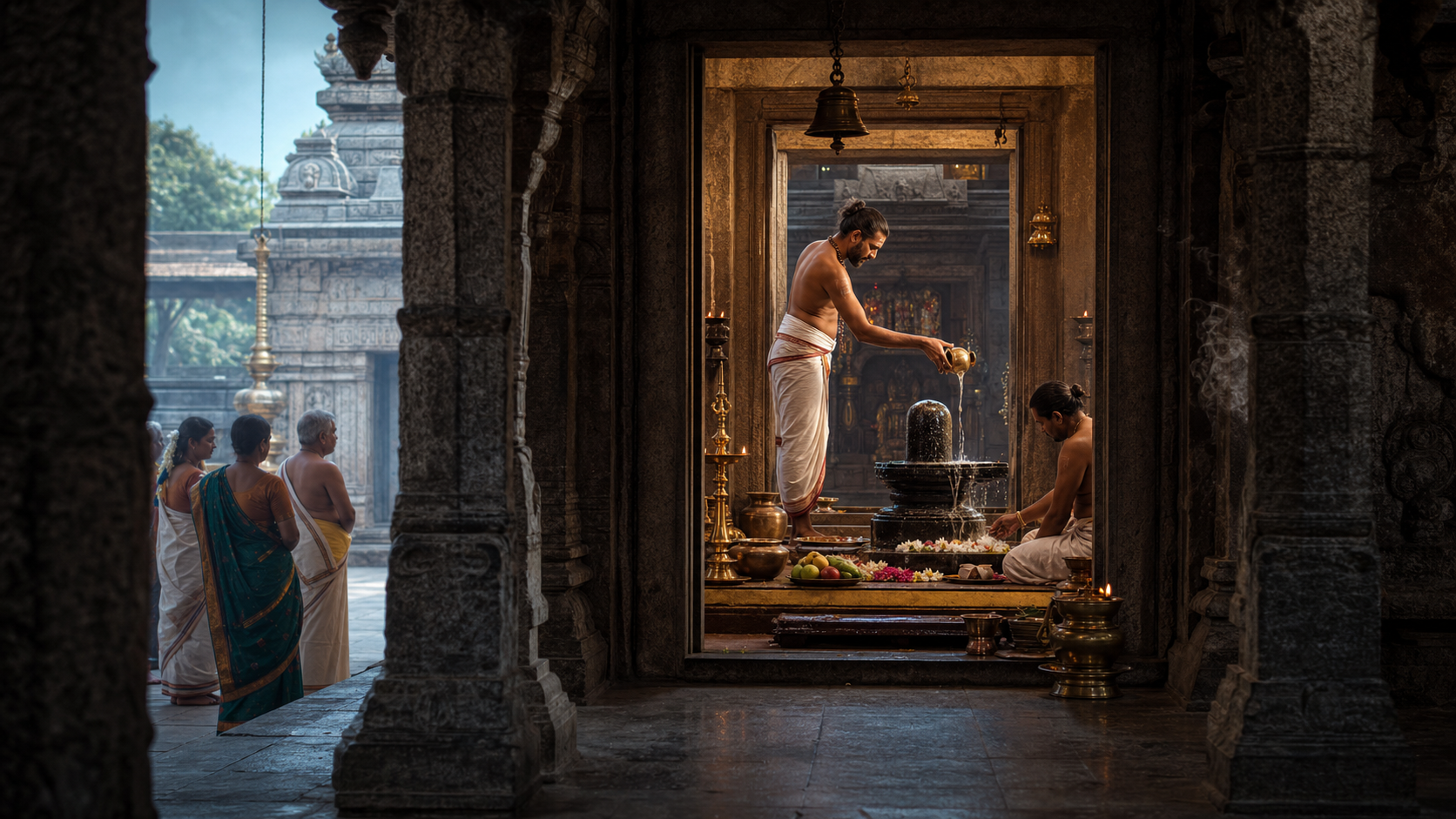
You enter a temple during abhiṣeka. The bell, mantra, water, incense, lamp, clothing and offerings appear in a deliberate order. You may wonder why this deity has this form, why the priest follows this sequence, or why a practice familiar from another temple is absent here.
The Agamic lens gives you a better answer than ‘that is simply our custom.’ It lets you read the temple as a coherent sacred system. Once you know what to look for, you can distinguish legitimate diversity from inconsistency, ask better questions of temple authorities, and support continuity without demanding that every Hindu temple become identical.
The ritual is only one part of the Agamic system
Āgama means that which has come down through authoritative transmission. In temple life, it refers neither to one book nor to a loose collection of old habits. It names families of transmitted teachings that integrate theology, contemplative discipline, ritual procedure, personal conduct, architecture, iconography and institutional service.
A recurring fourfold framework makes that integration easier to understand. Jñāna concerns the nature of the deity, the soul, bondage, liberation and reality. Yoga concerns inner discipline and meditation. Kriyā includes mantra, consecration, offerings, yantra, mudrā and other ritual operations. Caryā governs conduct, vows, service and the duties through which a sacred institution remains functional. These are not four unrelated departments. Each gives the others their meaning.
This is why technical precision does not sit opposite devotion. It gives devotion a stable, embodied form. A measurement in a sanctum, a feature of a mūrti, the order of offerings and the discipline of an arcaka belong to one ritual grammar. If one component is changed casually, the result may still look religious while no longer expressing the system that made the temple intelligible.
Agamic authority also should not be reduced to a contest between ‘Vedic’ and ‘non-Vedic’ Hinduism. Nigama and Āgama have often been treated as complementary: revealed wisdom and its ritual-architectural enactment. Within the lineages that preserve them, the Agamas function as pramāṇa, or valid means of knowledge. The Agamapramanya attributed to Yamunacharya in the 10th–11th century, for example, defends the validity of the Vaishnava Pañcarātra system and its consonance with Vedic principles. That defence does not erase differences among Hindu schools. It shows why a simplistic Veda-versus-Agama binary cannot explain living temple practice.
The expression ‘temple science’ needs the same care. Here, science means a systematic and transmissible body of knowledge with defined procedures, measurements, qualifications and expected ritual relationships. It is not a claim that every theological proposition is a finding of modern experimental science. Keeping that distinction clear protects the Agamic traditions from both casual dismissal and exaggerated apologetics.
Identify the lineage before you compare two temples
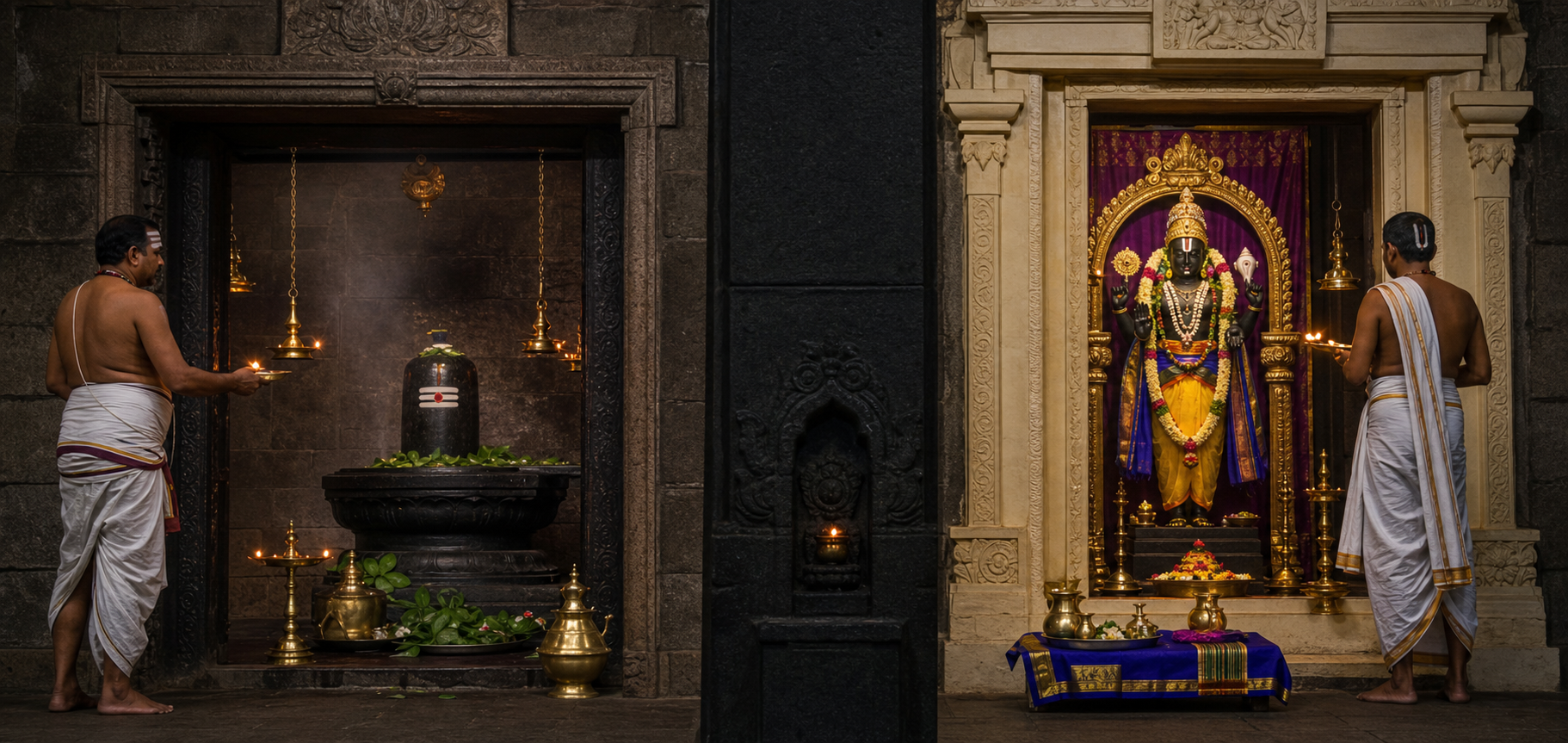
There is no single undifferentiated ‘Agamic ritual.’ Shaiva, Vaishnava and Shakta traditions preserve related but distinct corpora, priestly disciplines and theological frames. Even within one devotional family, more than one authorized system may exist. The first useful question is therefore not, ‘Why does this temple fail to do what the other temple does?’ It is, ‘Which Agama or paddhati governs worship here?’
| Tradition | Characteristic Agamic frame | What a visitor should not misread |
|---|---|---|
| Shaiva Siddhānta | Twenty-eight Mūlāgamas, including Kāmika, Ajita, Suprabheda, Mr̥gendra and Raurava; the Pati–paśu–pāśa framework; exacting rules for icons, consecration and worship | Abhiṣeka, alaṅkāra and arcana are not ornamental additions. Their order expresses a definite theology. |
| Non-dual Shaiva streams | Teachings centred on consciousness, spanda and recognition, alongside mantra, mudrā and yantra | A meditative influence from these streams does not necessarily mean that a temple’s public liturgy follows the same manuals; temple worship may remain Siddhāntic. |
| Vaishnava Pañcarātra | Saṁhitās joining vyūha theology, bhakti, meditation, image consecration, temple-sevā and festival cycles | A Pañcarātra sequence should not be judged by treating a different Vaishnava system as the universal standard. |
| Vaikhānasa | Lineage-based arcaka qualifications and carefully graded daily and festival worship of Viṣṇu and his forms | Its distinct rules for abhiṣeka, naivedya and utsava are a sign of lineage continuity, not incomplete Pañcarātra practice. |
| Shakta and Śrīvidyā | Devī as supreme consciousness and power, with precise mantra practice, Śrīcakra geometry, iconography and contemplative worship | A yantra is not generic sacred decoration. Its form and ritual use belong to a transmitted theological system. |
The terminology changes with the lineage. Shaiva and Shakta communities may use Āgama and Tantra for overlapping bodies of teaching. Vaishnava communities commonly speak of Saṁhitās. Pañcarātra examples include the Sātvata, Ahirbudhnya and Jayākhya Saṁhitās, while Vaikhānasa practice traces its textual lineage to the ṛṣi Vikhanasa and his disciples. These names help you locate a practice; they are not competing brand labels.
You may also hear the word paddhati rather than the name of a parent Agama. A paddhati is a working procedural digest through which arcakas learn and execute the tradition. The distinction matters. A temple can be Agamically grounded while its daily practitioners rely on a lineage-specific digest rather than opening an extensive parent corpus before every service.
This plurality gives you a practical rule: compare a temple first with its own authorized lineage and stated discipline. Only then compare it with another temple. Hindu civilizational unity does not require procedural sameness. It requires enough knowledge to recognize how different lineages organize sacred space, divine presence and communal worship.
Read the temple through space, form, presence and time
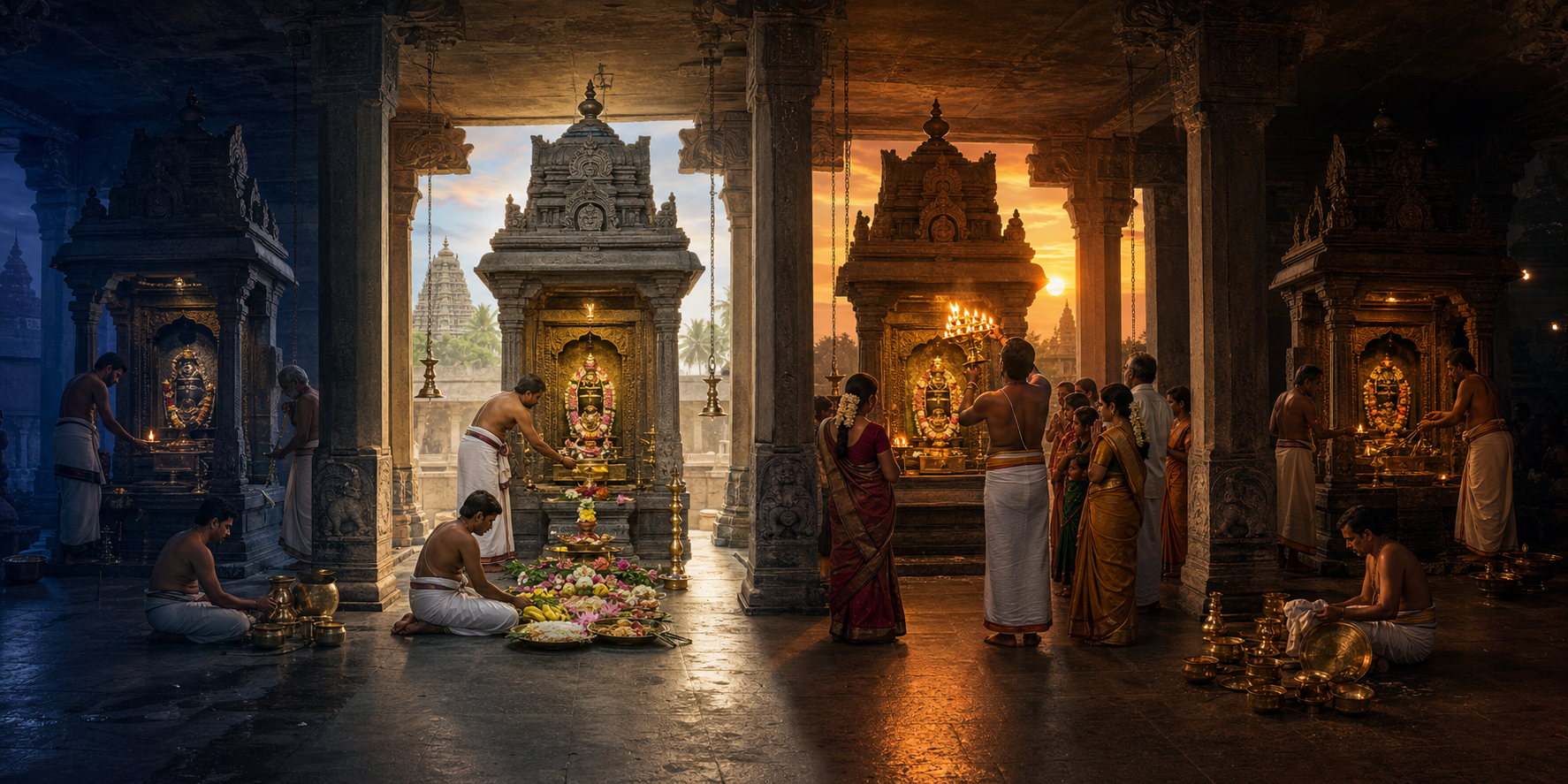
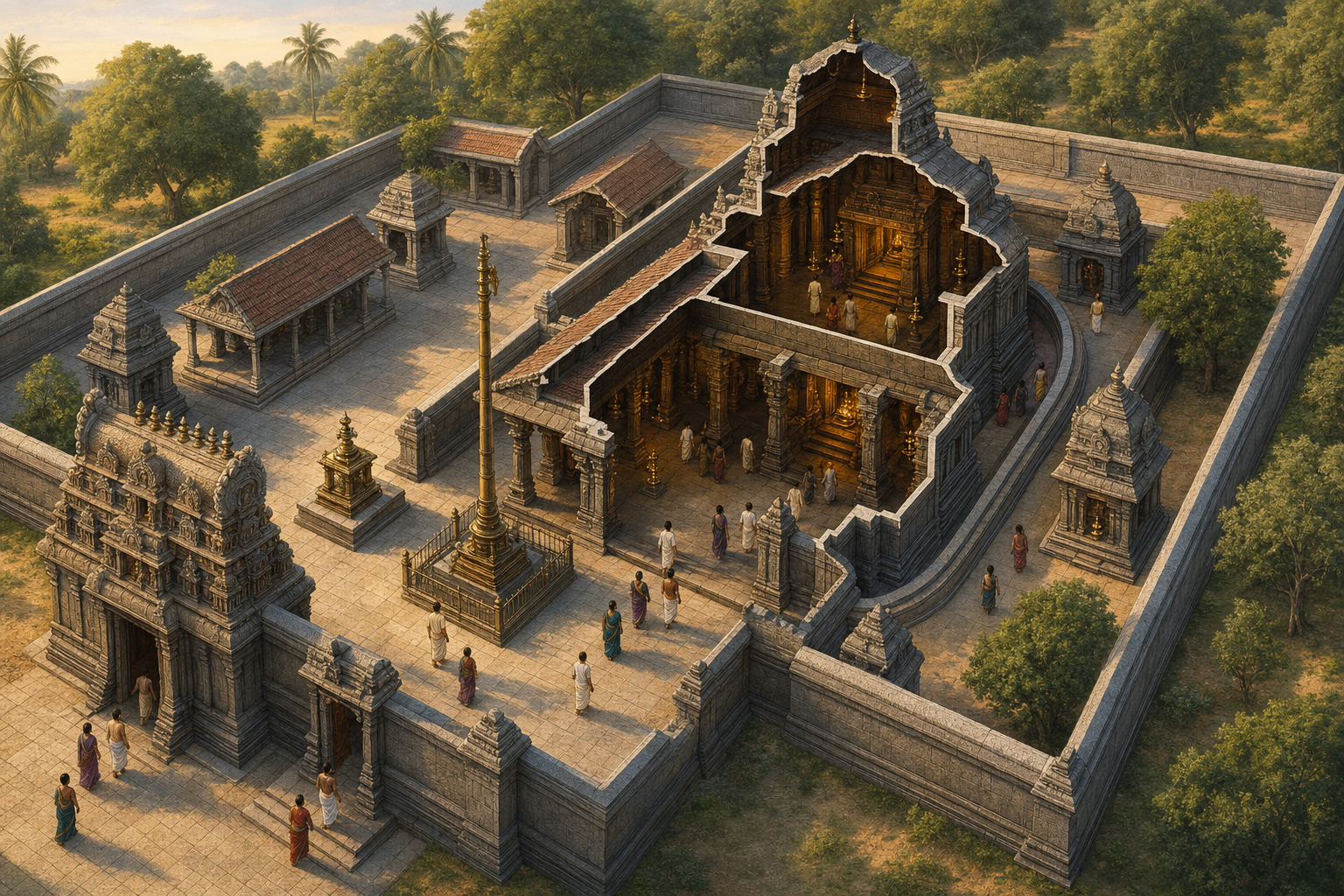
An Agamic temple is not a collection of independently chosen religious objects. Architecture prepares the field for the mūrti; iconography makes theology visible; consecration establishes the arcā-mūrti as the temple’s focal presence; recurring service sustains the relationship. You can read that system through four connected layers.
- Read the space. Site selection, orientation and the vāstupuruṣa-maṇḍala establish the architectural field. The proportions and relationships of the garbhagṛha, vimāna, gopura and prākāra coordinate access, ritual movement and symbolism. Allied Vāstu and Śilpa traditions, including the Mānasāra and Mayamata, support this work. Measurements and āyādi calculations therefore belong to sacred design, not merely to structural convenience.
- Read the form. Pratimā-lakṣaṇa governs the mūrti’s canonical characteristics. Tāla-based proportions, stance, mudrā and attributes identify the deity and express the relevant theology. The image is not meant to be an unrestricted portrait produced from an artist’s private preference. Craftsmanship operates within a disciplined iconographic language.
- Read the establishment of presence. Prāṇa-pratiṣṭhā joins homa, mantra, nyāsa and ablutions in the consecration of the arcā-mūrti. This is why a consecrated mūrti cannot be understood simply as an art object placed in an impressive building. Consecration also begins an ongoing obligation: the installed deity is to receive the services prescribed by the temple’s tradition.
- Read sacred time. Daily service may include snāna or abhiṣeka, alaṅkāra, dhūpa, dīpa, naivedya and ārati. Weekly observances and annual utsavas expand that recurring service into a public narration of the temple’s theology. A festival sequence may therefore look very different from an ordinary morning service without contradicting it.
Mantra, yantra and mudrā operate across these layers. Mantra gives vocal form to the deity’s presence. Yantra orders a sacred field through geometry. Mudrā aligns bodily action with ritual intention. The synchronisation of voice, gesture, bell, conch, incense and lamp turns worship into an embodied discipline involving attention, memory and the senses.
On your next visit, observe one complete service rather than collecting isolated visual moments. Notice what is prepared before the curtain opens, how the mūrti’s presentation changes, when sound intensifies, when food or light is offered, and when devotees receive darśana or prasāda. You do not need to decode every mantra. The aim is to notice the sequence and the relationships before forming a judgement about any single act.
Visit respectfully and preserve the system intelligently
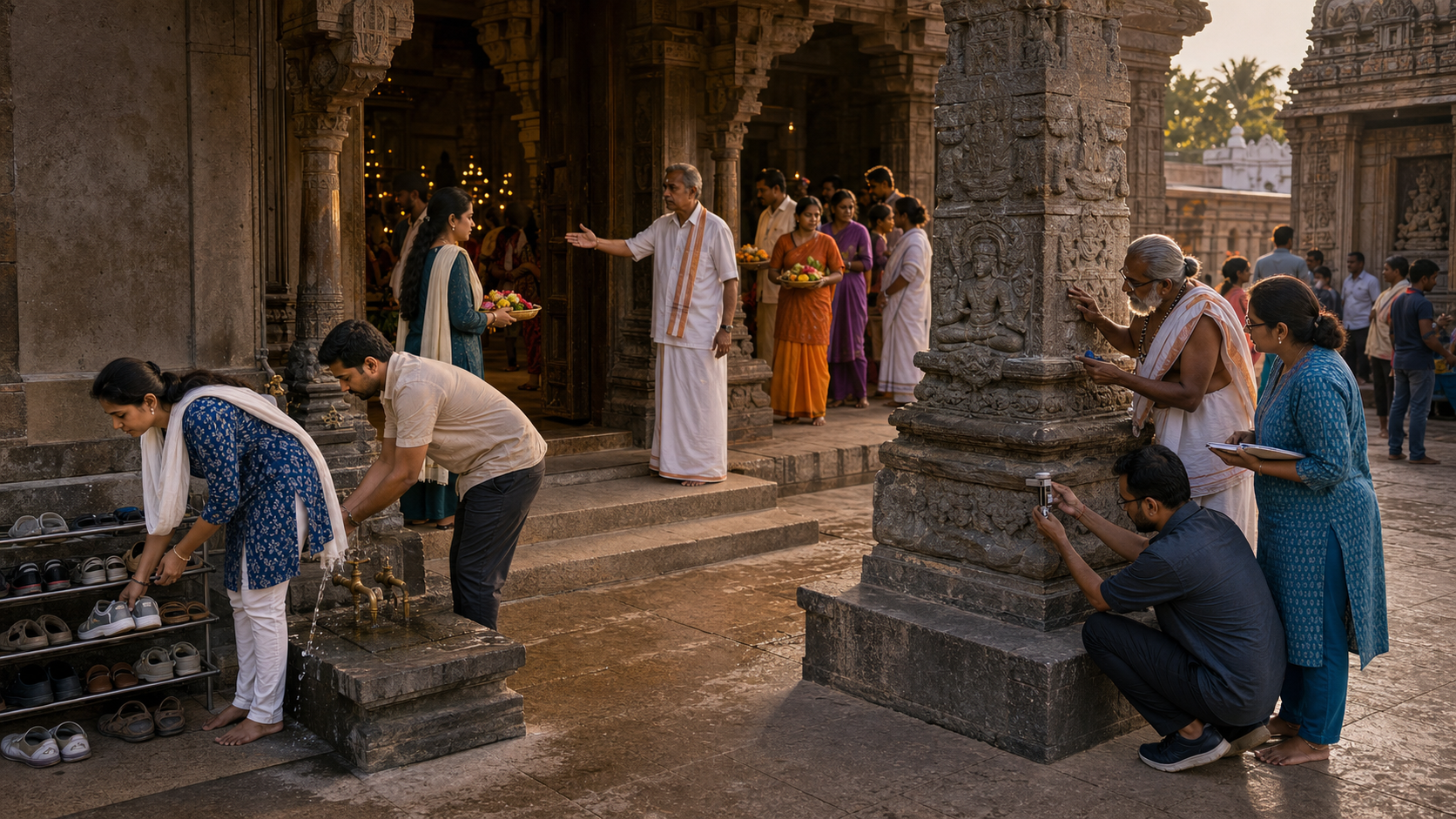
If you are visiting
- Identify the principal deity and, where possible, the governing lineage. Temple signage, an official schedule or a respectful question to a knowledgeable person may tell you whether worship is Shaiva Siddhānta, Pañcarātra, Vaikhānasa, Śrīvidyā or another established stream.
- Check the named service before arriving. Daily worship, a special abhiṣeka and an annual utsava have different purposes and levels of public participation. Do not treat one visit as a complete sample of the temple’s discipline.
- Follow that temple’s guidance on dress, thresholds, movement, offerings and photography. These practices can differ. Familiarity with another temple does not give you authority to override the local lineage.
- Do not touch a mūrti, yantra, ritual vessel or sanctum structure unless temple authorities explicitly permit it. In an Agamic setting, placement and handling can carry ritual significance beyond the object’s visible appearance.
- Let the arcaka complete the service. Ask a precise question afterward: ‘Which Agama or paddhati is followed here?’, ‘Is this a daily or festival alaṅkāra?’, or ‘What stage of the worship did we just witness?’ A focused question is more likely to produce a useful answer than a debate framed around what another temple does.
If you help govern, fund or renovate a temple
The central question is continuity, not visual grandeur alone. Prāṇa-pratiṣṭhā creates a long-term liturgical responsibility. Before undertaking a new installation, confirm that the institution can sustain the required arcakas, daily schedule, offerings, materials and festivals. A large consecration followed by weak daily service reverses the Agamic order of priorities.
- Record the governing Agama, paddhati and recognized lineage authorities in the temple’s operational documents. Do not leave this knowledge dependent on one person’s memory.
- Evaluate arcaka preparation against the temple’s actual tradition. Generic familiarity with Hindu worship is not automatically competence in a specific corpus of mantras, measurements, purity disciplines and ritual sequences.
- Review architectural changes together with ritual function. Altering a sanctum, doorway, subsidiary shrine, processional path or mūrti placement should not be treated as an ordinary decorating decision when architecture, iconography and liturgical movement have been designed as one system.
- Separate Agamic requirement, authorized local custom and administrative convenience in committee records. Qualified arcakas and lineage holders should help classify them. This prevents a temporary convenience from being declared sacred and an inherited discipline from being discarded as mere habit.
- Fund transmission as seriously as construction. Training, paddhati preservation, manuscript cataloguing, critical editing and digitisation keep knowledge usable across generations. Preserving a manuscript image without sustaining people capable of understanding its ritual vocabulary protects an object but not the whole tradition.
- Document the authority and reasoning behind necessary adaptations. Living traditions have regional recensions and institutional histories, but a transparent decision is easier for the next generation to evaluate than an unexplained alteration.
The manuscript heritage preserved on palm leaf and paper shows that Agamic continuity has always required copying, commentary, teaching and regional application. Institutions such as the French Institute of Pondicherry and the Sarasvati Mahal Library in Thanjavur hold important parts of that heritage. Temple communities still carry the complementary responsibility: maintaining competent practice where the knowledge is meant to live.
Key takeaways
- An Agamic temple joins theology, meditation, ritual, conduct, architecture and community service; it is not defined by ritual performance alone.
- Identify the temple’s lineage before comparing its worship with another temple. Pañcarātra and Vaikhānasa, for example, are distinct Vaishnava systems rather than two versions of one universal procedure.
- Architecture, mūrti and liturgy form a single sacred grammar. A change to one can affect the coherence of the others.
- Prāṇa-pratiṣṭhā is the beginning of sustained service, not merely the ceremonial completion of a building project.
- Continuity depends on trained arcakas, reliable daily worship, documented procedures, responsible renovation and preservation of textual knowledge.
At your next temple visit, learn the name of its tradition and follow one service from preparation to completion. If you serve a temple committee, put two questions on the next agenda: which Agama or paddhati authorizes current practice, and how will the institution transmit that competence to the next generation? Those small acts of attention are where informed reverence begins.
References
