A recent allegation by Sharad Pawar that the Warkari movement is witnessing “radicalisation” ignited a political flashpoint in Maharashtra, with several Hindutva leaders and Warkari organisations publicly contesting the charge. The debate quickly spilled into broader discussions on Maharashtra politics, Shiv Sena (UBT) versus Shiv Sena alignments, and the role of devotional communities in an era of polarised discourse. Set against this backdrop, a careful, academically grounded assessment is essential: What does the Warkari Sampradaya historically represent, what does security scholarship mean by “radicalisation,” and how can society preserve social cohesion and dharmic unity while evaluating politically charged claims?
The Warkari Sampradaya is a centuries-old Bhakti tradition centred on Vitthal (Vithoba) of Pandharpur, sustained by the philosophy and practice of saints such as Sant Dnyaneshwar, Sant Tukaram, Sant Eknath, and Sant Namdev. Known for its annual Pandharpur Vari on Ashadhi and Kartik Ekadashi, the movement emphasises collective devotion, kirtan, abhang, seva, and humility. Its social ethic historically affirms simplicity, non-violence, and egalitarian participation, drawing in devotees across caste and class lines within a broad Sanatan Dharma framework.
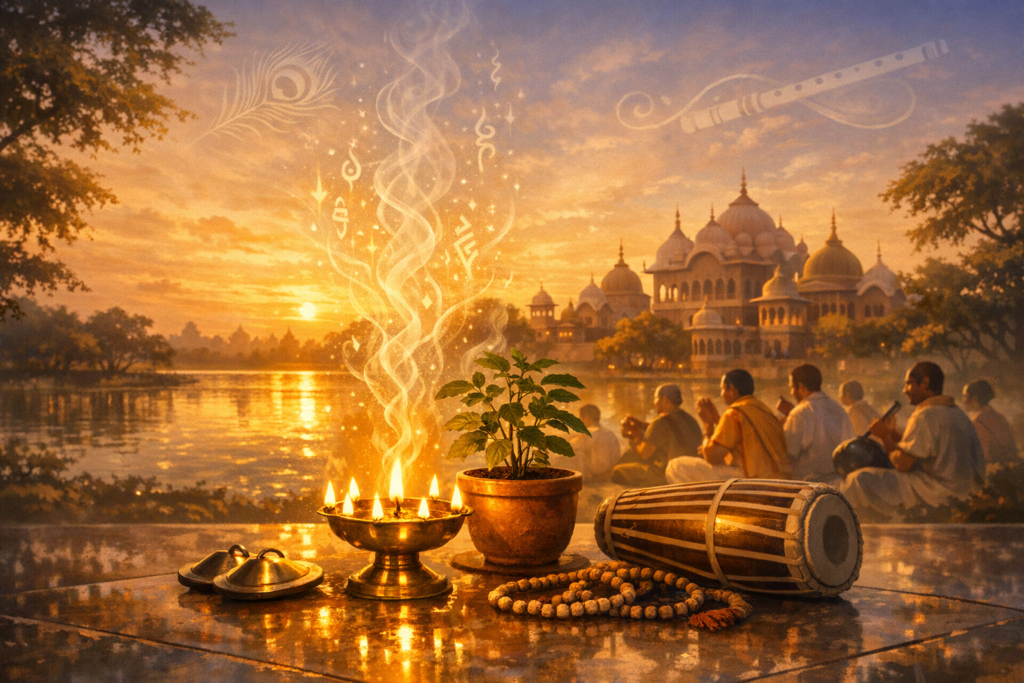
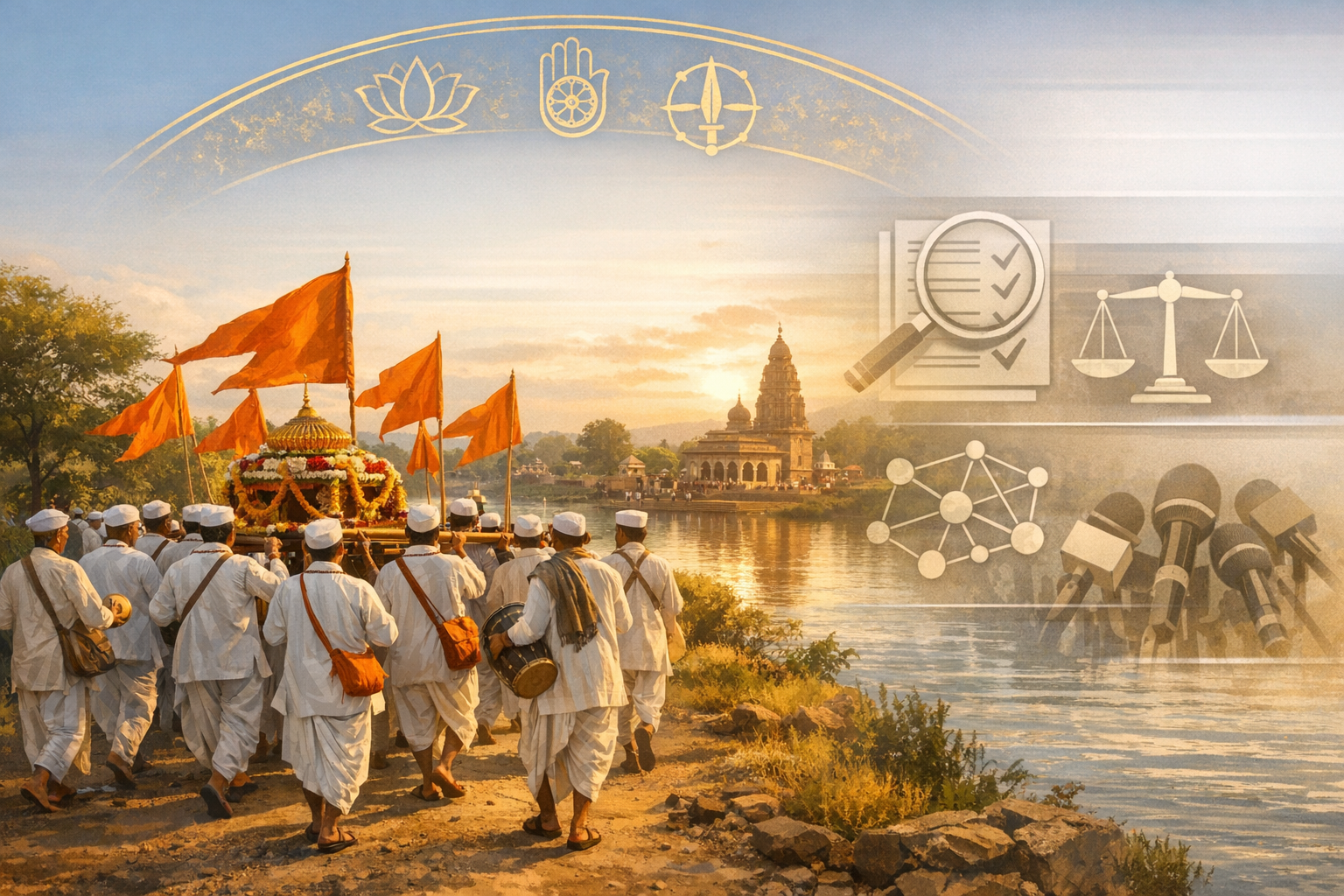
Ritually and socially, Warkari practice is markedly public, disciplined, and community-oriented: dindi processions, palkhis of Sant Tukaram and Sant Dnyaneshwar, and shared singing of abhang cultivate a devotional habitus that privileges inner transformation over political mobilisation. In this sense, “bhakti first” functions not only as a spiritual priority, but as a social guardrail: affection among pilgrims, moral self-regulation, and group accountability dilute the appeal of confrontation and sectarian antagonism. These are not incidental features; they are the normative heart of the Warkari movement.
Viewed through a broader dharmic lens, Warkari values resonate with the inclusive currents of Hinduism, Buddhism, Jainism, and Sikhism. Musical devotion and collective remembrance (kirtan and abhang) echo the Sikh tradition of shabad kirtan; compassion and restraint reflect Buddhist metta and Jain ahimsa; shared service (seva) mirrors practices across these traditions. This interlacing of ethical commitments underlines why the movement is frequently cited as a living expression of religious pluralism in India and a bridge for dharmic unity rather than a locus of sectarianism.
Security and counterterrorism literature typically construes “radicalisation” as a process by which individuals adopt beliefs that may legitimate violence, often progressing from grievance to moral disengagement to operational facilitation. Frameworks such as Moghaddam’s “staircase” and Borum’s cognitive models caution against conflating strong identity or conservative piety with violent intent. In plural, public-facing devotional cultures like the Warkari Sampradaya, indicators would require rigorous, independently verified evidence across multiple dimensions—ideological shift toward violence, recruitment pathways, logistical capability, and behavioural change—rather than isolated incidents or rhetorical inference.
Within this evidentiary frame, sweeping claims about Warkari “radicalisation” carry a high burden of proof. At the time these statements were contested, no broad, independently substantiated corpus in the public domain indicated a systematic link between Warkari institutions and organised violence. As with any mass movement, individual deviations can occur, but attributing intentionality or coordinated extremism to a devotional lineage requires more than anecdote. Methodologically, one must distinguish between the tradition’s normative teachings, the conduct of formally recognised bodies, and the unsanctioned acts of individuals who may be culturally proximate but organisationally unaffiliated.
It is also necessary to parse Maharashtra’s political context. The competitive dynamics involving Shiv Sena (UBT) and Shiv Sena, coalition arithmetic, and heightened media attention to identity-driven narratives can encourage securitised framings of religious life. In such environments, devotional credibility and moral capital become political signifiers, and claims about communities risk being instrumentalised. A dispassionate approach prioritises transparent sourcing, independent corroboration, and a careful separation of doctrinal ethos from episodic political friction.
Hindutva leaders, along with voices from Warkari Sangathan, publicly rejected the “radicalisation” characterisation, pointing to the Bhakti tradition’s stress on humility, seva, and social harmony. Political figures associated with both Shiv Sena and Shiv Sena (UBT)—including Ambadas Danve and Sanjay Shirsat—were among those who contested the framing and urged restraint in conflating devotional groups with security concerns. Across statements and responses, a common throughline emerged: preserve the dignity of the Warkari movement while allowing space for lawful scrutiny of any specific wrongdoing without indicting the tradition as a whole.
For media, civil society, and policymakers, responsible discourse on “radicalisation” in devotional contexts can follow a principled protocol: (1) independently verify claims with primary evidence, (2) separate individual actions from institutional intent, (3) consult peer-recognised scholarship on Bhakti traditions, (4) triangulate community testimony with neutral oversight, and (5) track patterns across time rather than extrapolating from singular events. Such steps protect both security interests and the integrity of religious communities, reducing the risk of stigma and reactive polarisation.
Constructive, unity-first pathways are equally important. Dharmic-dialogue initiatives that jointly showcase Warkari abhang, Sikh kirtan, Buddhist metta meditation, and Jain bhajans can deepen mutual understanding and counter stereotypes. Shared seva—community kitchens, rural health camps, river clean-ups—offers visible proof of ethical alignment across Hinduism, Buddhism, Jainism, and Sikhism. Educational modules on the history of the Warkari Sampradaya and the broader Bhakti Tradition can equip younger generations to recognise the difference between devotion-driven social reform and politically induced mischaracterisations.
Institutionally, consultative councils that include Warkari representatives, local administration, and independent observers can craft voluntary codes for large gatherings—crowd management, grievance redressal, and transparent liaison with law enforcement—without diluting the movement’s spiritual autonomy. When specific offences arise, addressing them through due process and precise attribution, rather than civilisational generalisations, safeguards both public order and India’s constitutional commitment to religious freedom.
Beyond procedures and policy, the lived experience matters. Anyone who has witnessed the Pandharpur Vari has seen elders guiding youths in disciplined procession, families sharing water with strangers, and voices rising in abhang that speak of humility and love. Such scenes capture a moral economy that runs counter to narratives of enmity: they are rooted in service, restraint, and the pursuit of inner transformation. Recognising this texture of devotion is vital to evaluating charged claims with sobriety and fairness.
In sum, the Warkari “radicalisation” row illustrates the need for evidence-led analysis, careful language, and a commitment to dharmic unity. Maharashtra’s political debates will continue to be robust, but devotional traditions such as the Warkari Sampradaya deserve engagement that is proportionate, factual, and respectful of their Bhakti ethos. Upholding these standards not only strengthens social trust in a plural society, but also honours India’s distinctive heritage of religious pluralism in which Hinduism, Buddhism, Jainism, and Sikhism continue to find shared ground in compassion, seva, and self-restraint.
Inspired by this post on Struggle for Hindu Existence.