
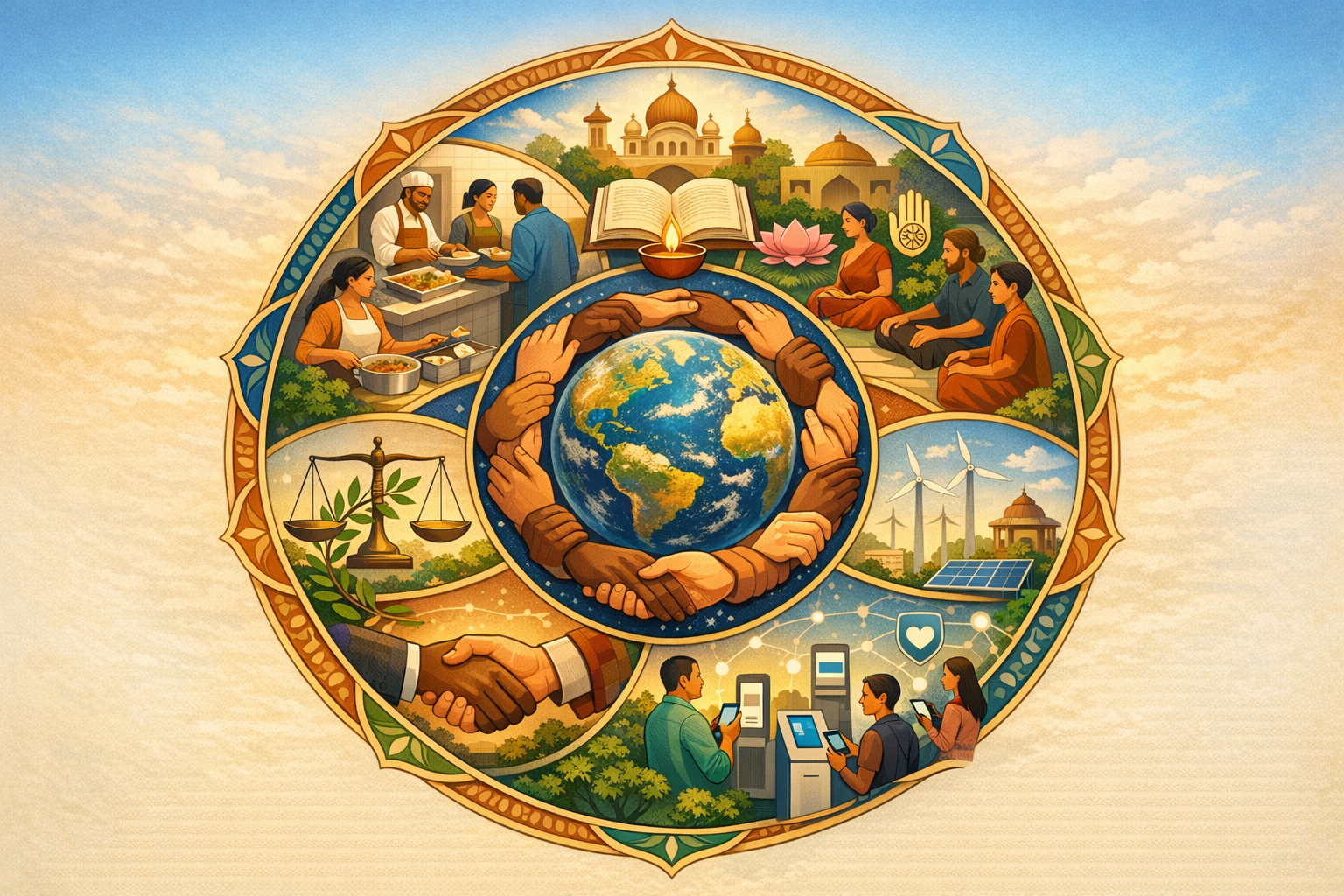
Vasudhaiva Kutumbakam the conviction that the world is one family has re-emerged as a practical framework for governance, diplomacy, and social cohesion in twenty-first-century India and beyond. Far from a poetic abstraction, it can be read as a design principle for public policy, interfaith relations, and global cooperation. In a world marked by complex interdependence, the most effective force is not a conventional army but a constantly renewing citizenry motivated by belonging, dignity, and the simple yet profound “salary” of happiness. When individuals feel respected and included, they volunteer knowledge, care, and courage the very capacities most needed to heal societal fractures and build resilient futures.
Classical sources ground this vision. The line ayam nijah paro veti ganana laghuchetasam, udara-charitanam tu vasudhaiva kutumbakam is preserved in the Maha Upanishad and popularized in later nīti literature such as the Hitopadesha. Its philosophical arc harmonizes with dharmic traditions across Hinduism, Buddhism, Jainism, and Sikhism, each of which articulates an ethic of universal care: karuṇa in Buddhism, Ahimsa and Anekantavada in Jainism, Ishta and plural paths in Hindu thought, and Sarbat da Bhala the welfare of all in Sikh praxis. This shared civilizational grammar renders the one-family ideal both ethically compelling and operationally adaptable.
India’s recent diplomatic vocabulary, including the G-20 Summit theme “One Earth, One Family, One Future,” signals a deliberate attempt to translate Vasudhaiva Kutumbakam into policy. The concept aligns naturally with inclusive development, climate responsibility, and technology for the public good. It resonates with GlobalSouth priorities and provides a culturally rooted, future-facing alternative to transactional geopolitics: a model that prizes dignity, dialogue, and durable partnerships.
Pluralism is a technical as well as ethical competence in this framework. Hindu philosophy’s acceptance of Ishta recognizes distinct temperaments and spiritual methods; Anekantavada teaches that truth is many-sided and requires synthesis rather than erasure of difference; Buddhist metta cultivates goodwill toward all beings; Sikh seva makes compassion a community institution; Jain Ahimsa provides a rigorously non-violent ethic. Together, these principles operationalize universalism without flattening diversity a vital distinction for a large, complex democracy and a multi-civilizational world.
Ethical statecraft in an interdependent era must balance security with empathy. Dharmic discourse has long discussed just conduct, proportionality, and restraint, qualities echoed in modern international humanitarian law. A Vasudhaiva Kutumbakam lens therefore supports strong rule of law, human security, and counter-extremism strategies centered on community trust, social inclusion, and prevention not merely coercion. Security, in this reading, is the emergent property of a society seen and treated as family.
Institutionally, the approach scales through three design principles: dignity by default in public services, dialogue-first in conflict management, and distributed leadership in community development. A dignity-first state reduces friction in access to education, health, and finance; a dialogue-first posture leverages Interfaith Dialogue and cultural diplomacy; and distributed leadership empowers temples, gurdwaras, viharas, and community organizations to co-create solutions with local administrations.
India’s Digital Public Infrastructure provides a concrete test-bed. When identity, payments, and data-sharing rails are governed for inclusion, privacy, and accountability, they enable cooperative markets and targeted welfare while curbing leakage and exclusion. Properly stewarded, such systems embody the ethic of “family” in service delivery: quick, fair, and transparent. Yet the same infrastructure must be vigilantly protected from misinformation and polarization; a dharmic response entails satya in communication, Ahimsa in discourse, and institutional safeguards for trust and verification.
The economy of a planetary family must also be future-proof. Circular economy strategies, Repair culture, and Right to repair shift production and consumption toward responsibility. RenewableEnergy adoption and just, regionally coordinated Energy Transition reduce ecological debt while creating dignified work. These are not only environmental imperatives but civilizational ones, honoring Prakriti and the intergenerational duties embedded in dharmic thought.
Within India, social cohesion remains the decisive variable. Curricula that introduce Anekantavada, Ishta in Hinduism, Buddhist ethics of metta, Jain Ahimsa, and Sikh Sarbat da Bhala can cultivate informed respect for multiple paths. Civic programs that pair shared service from langar-inspired community kitchens to collaborative environmental drives with open, empathetic conversation convert abstract tolerance into lived solidarity. Diaspora networks amplify this ethos globally, linking Indian traditions to broader movements for justice, sustainability, and human flourishing.
The metaphor of the “largest army” becomes intelligible here as the collective strength of citizens, professionals, and volunteers whose motivation is meaning, not merely material gain. Teachers who nurture curiosity, doctors who treat with compassion, engineers who build for inclusion, and artists who bridge divides constitute the commandos of a humane order. They do not retire, because the rewards connection, purpose, and happiness are renewable. Their enlistment terms are simple: dignity for all and duty to truth.
Operationalizing Vasudhaiva Kutumbakam benefits from measurable targets. Social cohesion indices, reductions in hate crimes, expansion of interfaith and intercultural programs, and improvements in equitable access to public services offer concrete indicators. Climate metrics such as carbon intensity and biodiversity restoration map stewardship; Digital inclusion measures track reach and fairness; wellbeing indicators, including adaptations of Bhutan’s Gross National Happiness, gauge whether prosperity is genuinely shared.
Contemporary case narratives illustrate the approach at work. Sikh langar mobilizing food security in crises exemplifies institutionalized compassion; Buddhist peace education programs demonstrate scalable non-violence; Jain-led Ahimsa and vegan initiatives pioneer ethical consumption; Hindu community seva integrates education, healthcare, and disaster relief. Each tradition strengthens the same moral spine: universal care expressed through action.
Regionally, this framework recommends confidence-building across South Asia through humanitarian coordination, cultural exchange, and resilient supply chains that prioritize essential goods. Platforms like BIMSTEC and targeted bilateral mechanisms can advance disaster response, green energy corridors, and knowledge transfer. A family-minded geopolitics remains firm on sovereignty and law while maximizing zones of cooperation.
Education policy becomes pivotal. Learner-centered, inquiry-driven programs that marry philosophy of religion with ethics, comparative civilizations, and environmental literacy build cognitive empathy. Sanskrit and Pali sources, Sikh gurbani, Jain āgamas, and classical Indian philosophy texts can be taught alongside modern science and social science, making students fluent in both critical thinking and compassionate action.
Urban and rural development alike benefit from “sarvodaya urbanism” neighborhoods designed for shared spaces, walkability, green commons, and community institutions that function as service hubs. Temples, gurdwaras, viharas, and dharmic centers already operate as anchors for social capital; formal partnerships with local governments can broaden their contributions to health camps, skill training, and ecological restoration.
Ultimately, Vasudhaiva Kutumbakam is not a call for uniformity but for mature unity. It champions Universal Religion as a moral horizon while protecting the diversity of practices that make civilization resilient. It seeks strong institutions guided by compassion, secure borders complemented by open hearts, and prosperity calibrated by responsibility. In this synthesis, India’s civilizational wisdom meets modern necessity, offering a credible, scalable pathway to a safer, kinder, and more prosperous world family.
Inspired by this post on Hindu Pad.
