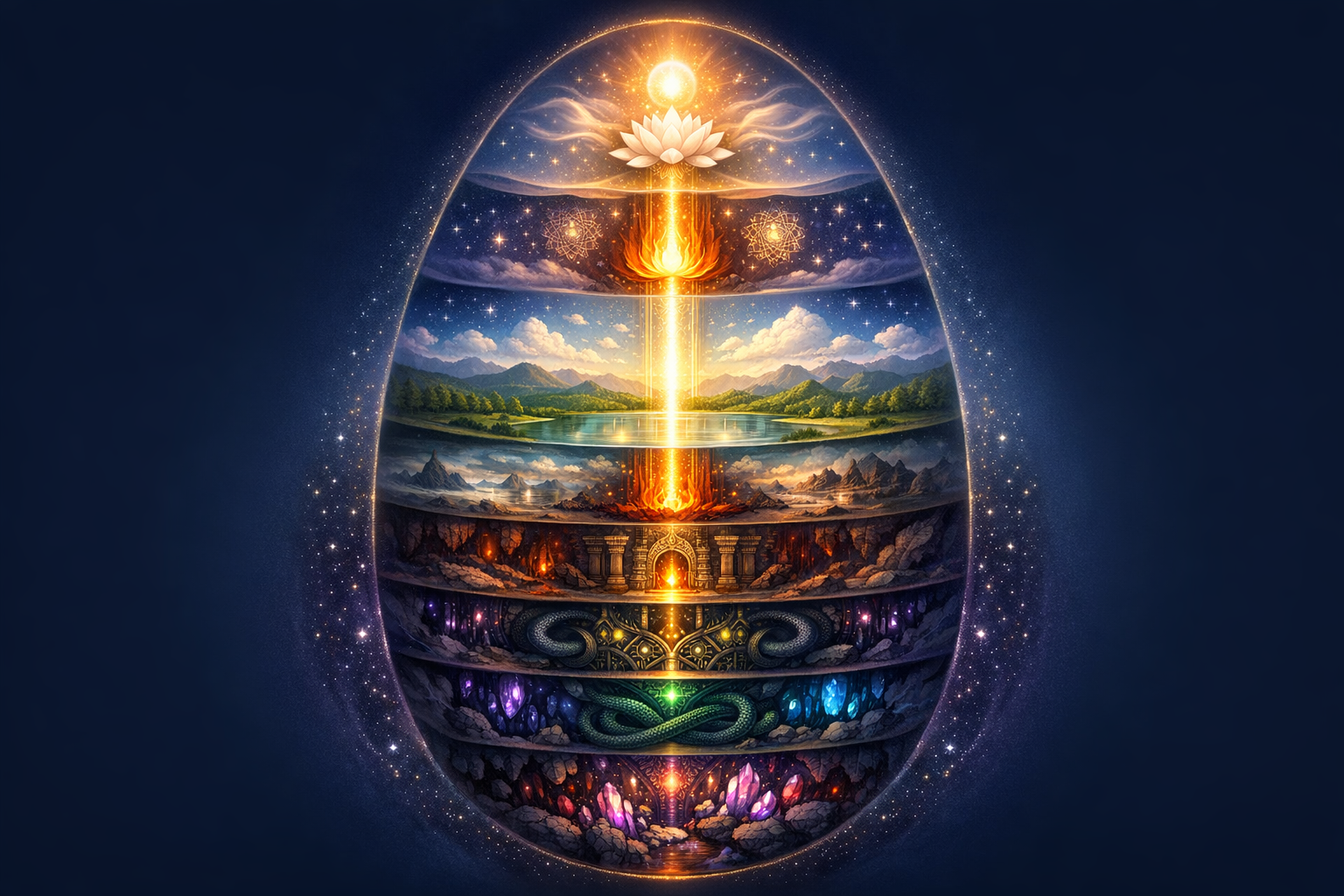
Hindu cosmology presents a finely layered architecture of existence called the fourteen worlds or lokas, arranged as seven upper realms (Urdhva lokas) and seven lower realms (Adho lokas). Far from being a mere celestial map, this structure in Hindu philosophy functions as a coherent account of how consciousness, ethics, and experience unfold within Sanatana Dharma.
The term loka, from the Sanskrit root lok (to see, to perceive), indicates a field of experience or a horizon of awareness. Accordingly, the fourteen lokas are not simply places but patterned conditions in which beings live out karma, cultivate merit, refine knowledge, and move toward liberation (moksha). Read in this way, Hindu scriptures offer both a cosmological and psychological grammar: an outer universe that mirrors an inner ascent of consciousness.
Scriptural sources for this cosmology are distributed across the Hindu scriptures (shastras), especially the Puranas (for example, Bhagavata Purana, Vishnu Purana, and others), while the Vedas and Upanishads contribute key terms and soteriological aims. The Vedic triad “Bhūr, Bhuvaḥ, Svaḥ,” embedded in Gayatri recitation, anticipates the lower rungs of the upper worlds and situates daily practice within a sacred cosmic order.
Descriptions vary across texts and sampradayas, a reminder that Hinduism’s plural hermeneutics favor complementary perspectives. While some accounts emphasize ontological geography (with Mount Meru and the Brahmanda, the cosmic egg), others adopt phenomenological language, treating the lokas as progressive states of awareness aligned with dharma, the gunas (sattva, rajas, tamas), and yogic realization.
The seven Urdhva lokas chart an ascent from embodied duty toward increasingly subtle knowledge and contemplative steadiness. They are traditionally enumerated as Bhuloka (Bhūr), Bhuvarloka (Bhuvaḥ), Svargaloka (Svaḥ), Maharloka, Janaloka, Tapoloka, and Satyaloka (Brahmaloka). Each marks a refinement in how reality is known and lived.
Bhuloka (Bhūr) is the terrestrial plane in which embodied life, social duties, and ethical responsibility are primary. It is the privileged field for karma-yoga, where action and consequence ripen swiftly, and where the synthesis of Vedic ritual, Yoga, and Vedanta can be actively pursued.
Bhuvarloka (Bhuvaḥ), often rendered as the atmospheric or intermediate region, is associated with pranic vitality, mantra, and subtle influences that bridge the physical and the celestial. In contemplative readings, it corresponds to gaining mastery over breath and mind through practices such as prāṇāyāma and pratyāhāra.
Svargaloka (Svaḥ) is the realm of the devas, merit, and refined enjoyments. The Puranas underscore that svarga, though radiant, is not ultimate; when accumulated merit is expended, beings return to lower spheres. This transience educates the seeker to prefer lasting knowledge to temporary reward.
Maharloka is described as the sphere of great sages (maharshis), where stability in contemplation and the pursuit of higher knowledge predominate. It signifies a turn from merit-seeking to wisdom-seeking: tapas (disciplined ardor) matures into insight that anchors the mind in sattva.
Janaloka is the locus of advanced beings aligned with pure creativity and subtle cognition. Here, consciousness becomes resilient and expansive, reflecting not only the content of experience but the luminous ground in which experience appears.
Tapoloka epitomizes sustained austerity, inward fire (tapas), and unwavering absorption. The heat of insight refines residual impressions (samskaras), illuminating how attachment, aversion, and ignorance (avidyā) perpetuate cyclic becoming (samsara).
Satyaloka (Brahmaloka) is the highest of the upper worlds, the realm of abiding truth (satya) and the subtlest knowledge. Many traditions describe it as proximity to Brahman; in nondual readings, it gesturally points beyond any realm to the unconditioned, from which liberation (moksha) is neither a place nor a state, but the recognition of one’s Self-nature.
The seven Adho lokasAtala, Vitala, Sutala, Talatala, Mahatala, Rasatala, and Patalaare not “hells” in the simplistic sense but denser, subterranean or underworld domains. In Puranic narrative they host powerful beings (daityas, danavas, nagas), advanced arts, and formidable energies. In psychological interpretation, they symbolize experiential layers dominated by compulsion, fascination, and the consolidation of egoic force.
Atala is associated with sensory enticement and the bewitching play of appearances. It emblemizes how desire proliferates when discrimination (viveka) is weak, drawing attention to the discipline required for clarity in Hindu spiritual traditions.
Vitala is portrayed with subterranean fires and transformative energies. Read inwardly, it suggests the alchemical possibility that even intense drives can be turned by yoga into fuel for steady awareness.
Sutala is famed as the realm granted to Mahabali, whose humility before Vāmana turned power into surrender and gained divine proximity. This narrative teaches that ethical reversal and grace can reorganize even a formidable karmic inheritance.
Talatala is linked to ‘Maya’ in some traditionsa symbol of engineering, artifice, and visionary architecture. The lesson is not condemnation of skill but the reminder that form, however brilliant, must serve truth rather than obscure it.
Mahatala is associated with serpent beings and deep instinctual reserves. It points to the importance of befriending, regulating, and ultimately spiritualizing primal energies through dharmic cultivation.
Rasatala often denotes fierce, asuric dispositions intent on domination. Yet the very force that binds, when illumined, can be returned to the service of dharma, a recurring ethic of transformation in Hinduism.
Patala (sometimes called Naga-loka) is richly described as gem-lit and opulent, home to potent naga lineages. It invites reflection on how beauty and power, without humility and wisdom, can become subtle traps; with discernment, they become offerings to the Real.
It is important to distinguish these Adho lokas from Naraka, which texts portray as retributive states in which specific karmas ripen as corrective experiences. The Adho lokas are vast domains with their own beings, disciplines, and possible transformations, not merely punitive stations.
Read through the lens of the gunas, the Urdhva lokas sketch an ascent toward sattvaclarity, balance, luminositywhile the Adho lokas explore the intensities of rajas and tamas when not yet harmonized by dharma. This does not moralize geography; it maps habitual tendencies and their likely horizons of experience.
In yogic practice, this ladder becomes interior. Yama and niyama regulate conduct, prāṇāyāma harmonizes life-force, pratyāhāra recollects attention, dhāraṇā and dhyāna stabilize insight, and samādhi discloses nonduality. Practitioners frequently report that contemplating the lokas as inner landscapes sharpens motivation, organizes practice, and makes ethical choices intelligible as steps in consciousness.
Correlative models sometimes align the lokas with the three bodies (sthula, sukshma, karana) or the five sheaths (pañca-kosha) to underscore how gross, subtle, and causal identifications fall away in sequence. Such mappings vary by lineage; their shared intention is pedagogical clarity rather than rigid system-building.
A simple contemplation, frequently advised in traditions centered on the Gayatri, is to synchronize breath, mantra, and visualization: “Bhūr, Bhuvaḥ, Svaḥ” grounding attention; then allowing awareness to grow lucid, tranquil, and inclusive. This is not a literal ascent through space but a measured refinement of the mind-heart.
Vedantic schools read the lokas through their respective lenses: Dvaita and Vishishtadvaita tend to preserve robust ontological distinctions among realms and beings, while Advaita interprets them as conditioned appearances within consciousness. These are not mutually exclusive but complementary pedagogies serving aspirants of differing temperaments.
Parallels across the wider dharmic family reinforce a shared spiritual grammar. Buddhism describes thirty-one planes of existence across kāmadhātu, rūpadhātu, and ārūpyadhātu, pedagogically similar in showing how conduct and meditation condition experience. The analogy is not identity, but the comparative intuition is strong and illuminating.
Jainism envisions a tripartite cosmos (Urdhva Loka, Madhya Loka, Adho Loka) culminating in Siddhashila, the abode of perfected beings. The structural kinship with the Hindu Urdhva–Adho polarity supports a civilizational insight: ethical discipline and meditative clarity determine one’s experiential altitude.
Sikh teachings, while distinct in theology and practice, echo the vastness and moral architecture of reality“Pataala Pataal, lakh agaas aagaas”and describe progressive spiritual domains such as Dharam Khand, Gyan Khand, Saram Khand, Karam Khand, and Sach Khand. The dharmic traditions thus converge on a shared intuition: reality is layered, ascent is ethical and contemplative, and love of truth binds communities.
Ethically, this cosmology underwrites loka-sangraha, the care and cohesion of worlds through righteous action. When responsibility is honored on Bhuloka, attention refines, communities flourish, and ananda is tasted not as private escape but as radiance that improves the shared world.
Modern readers sometimes attempt to equate lokas with astrophysical structures. While comparative curiosity can be fruitful, the primary register of the fourteen lokas is spiritual-phenomenological. Their measure is transformation: increased clarity, compassion, equanimity, and a stable intuition of the Self.
Taken together, the fourteen lokas offer a rigorous, integrative map in Hinduism for understanding existencefrom the densest compulsions to the highest wisdom. They honor plurality across Hindu scriptures and align with adjacent insights in Buddhism, Jainism, and Sikhism, sustaining unity in spiritual diversity while keeping the aim of freedom unmistakably clear.
Ultimately, whether considered as cosmic regions or as states of consciousness, the fourteen lokas provide a living guide to practice. They invite seekers to align action with dharma, energy with insight, and knowledge with compassion, so that ascent is not escape but realizationlucid, ethical, and universally beneficent.
Inspired by this post on Hindu Blog.