
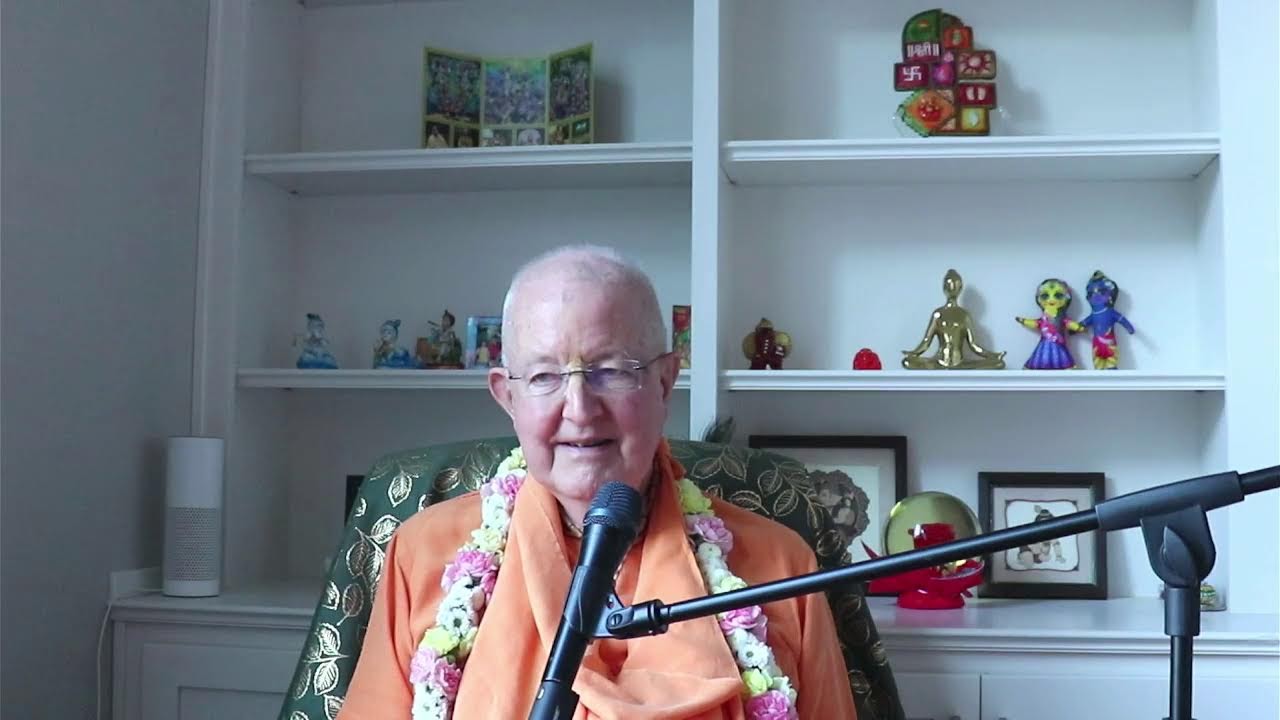
Respect, when examined through the lens of dharmic spirituality, is far more than social politeness or outward civility. It is a disciplined recognition of the dignity of the soul, the seriousness of spiritual practice, and the shared moral responsibility that binds communities together. The Sunday feast lecture titled Respect Seminar, Part 2, delivered by HH Romapada Swami, invites careful reflection on this principle as a foundation for devotional life, ethical conduct, and harmonious relationships.
HH Romapada Swami is presented as a disciple of Srila Prabhupada, an initiating spiritual master, and a sannyasi who has accepted the renounced order of life. His public teaching work has included lectures in devotional communities, educational institutions, and corporate settings. This broad field of engagement is significant because respect is not confined to temples, monasteries, or explicitly religious spaces. It is equally relevant in families, classrooms, workplaces, and civic life, where human beings repeatedly face the challenge of honoring others while remaining faithful to truth.
In the Vaishnava and wider Sanatana Dharma tradition, respect begins with a theological assumption: the living being is not merely a temporary body, social role, profession, opinion, or identity marker. The person is understood as atma, an eternal conscious self, and therefore cannot be reduced to immediate behavior, status, success, failure, agreement, or disagreement. This view does not excuse harmful conduct, but it changes the starting point of engagement. Correction, disagreement, accountability, and guidance can all exist without contempt.
The technical importance of respect in bhakti is especially visible in the relationship between humility and spiritual receptivity. A person may study scripture, repeat sacred names, attend lectures, and participate in rituals, yet still remain inwardly blocked if pride, cynicism, or habitual criticism dominate the heart. Respect softens that inner rigidity. It creates the psychological and spiritual conditions in which one can hear, learn, serve, and transform. In this sense, respect is not ornamental; it is functional. It protects the process of spiritual growth.
Srila Prabhupada’s teaching legacy placed strong emphasis on devotional service, scriptural learning, disciplined conduct, and compassion for others. Within that framework, respect is inseparable from Krishna consciousness because devotion is not a private sentiment alone. It is expressed through speech, behavior, responsibility, restraint, and care. The quality of a community can often be measured by how its members speak about those who are absent, how they treat those with less authority, and how they respond when differences arise.
A respect seminar is therefore not merely a moral reminder. It functions as a form of community education. It asks participants to examine patterns that are easy to normalize: dismissive speech, impatience with newcomers, rivalry among practitioners, overconfidence in one’s own understanding, and the tendency to confuse firmness with harshness. Such patterns may appear minor in isolation, but over time they can weaken trust, discourage sincere seekers, and obscure the compassionate purpose of spiritual life.
From an academic perspective, respect may be analyzed at three interconnected levels: metaphysical, ethical, and practical. At the metaphysical level, respect arises from recognition of the sacred nature of life. At the ethical level, it becomes a duty to treat others with fairness, restraint, and empathy. At the practical level, it appears in listening, punctuality, gratitude, truthful speech, honoring commitments, and avoiding unnecessary injury through words or actions. A mature spiritual culture requires all three levels.
Dharmic traditions have long recognized that speech carries moral weight. Words can clarify, heal, instruct, and uplift; they can also humiliate, divide, and harden the heart. Respectful communication does not mean avoiding truth. Rather, it means presenting truth with an awareness of time, place, circumstance, and the inner dignity of the person receiving it. This principle is essential in guru-shishya relationships, family life, interfaith dialogue, and public discourse.
The subject also has special relevance for unity among Hinduism, Buddhism, Jainism, and Sikhism. These dharmic traditions differ in theology, metaphysics, ritual culture, and institutional history, yet they share a serious concern for self-discipline, compassion, ethical living, spiritual practice, and liberation from ego-centered existence. Respect allows these traditions to be studied and honored without collapsing their differences or turning difference into hostility. It supports unity without demanding uniformity.
In lived religious communities, respect is often tested most intensely not in formal ceremonies but in ordinary interactions. A newcomer may arrive with limited knowledge. A senior practitioner may carry heavy responsibilities. A child may ask questions that sound naive. A volunteer may make mistakes. A teacher may need to correct without discouraging. A student may need to inquire without arrogance. These situations reveal whether respect has become a practiced virtue or remains only an admired concept.
The renounced order of life, sannyasa, adds another dimension to the discussion. A sannyasi is traditionally expected to live with detachment, discipline, and dedication to spiritual instruction. When such a teacher speaks on respect, the topic carries the weight of lived renunciation rather than abstract etiquette. The focus is not merely how to appear refined, but how to cultivate a consciousness that does not exploit others for prestige, emotional satisfaction, control, or personal validation.
Respect also requires boundaries. A common misunderstanding equates respect with passive approval or silence in the face of error. Dharmic ethics does not support that conclusion. The Bhagavad Gita, the Mahabharata, the lives of saints, and many teachings within the bhakti tradition show that compassion and correction can coexist. True respect may require honest guidance, principled disagreement, or protective action. The difference lies in motivation: correction should aim at restoration and clarity, not humiliation or domination.
This distinction is particularly important in modern public life, where disagreement often becomes performance. Digital media rewards speed, outrage, mockery, and simplified judgment. A dharmic approach to respect resists these tendencies by asking whether speech is truthful, necessary, beneficial, and appropriately delivered. Such discipline is demanding because it requires mastery over impulse. It is easier to react than to respond; easier to label than to understand; easier to win an argument than to preserve a relationship.
Respect in spiritual life also includes reverence for knowledge. Sacred teachings are not treated as casual intellectual property or decorative quotations. They are approached through parampara, disciplined study, reflection, and practice. In the Vaishnava tradition, the guru-shishya relationship protects this transmission by linking learning with character formation. Knowledge is not merely collected; it is received, tested through practice, and embodied through service.
At the same time, respect for knowledge should not become intellectual arrogance. Spiritual learning can be distorted when scriptural familiarity produces superiority rather than humility. A person may know terminology such as bhakti, dharma, karma, atma, and seva, yet fail to manifest patience or kindness. The deeper measure of learning is transformation of conduct. Respect therefore becomes a diagnostic tool: it reveals whether knowledge has entered the heart or remained at the level of vocabulary.
The seminar context also highlights the role of community culture. Institutions and congregations do not become respectful by accident. They require norms, teaching, modeling, accountability, and repeated reminders. Leaders must embody the standards they teach. Members must learn how to welcome newcomers, honor elders, protect children, value service, and resolve conflict without gossip or factionalism. Respect becomes sustainable when it is woven into the habits of the group.
There is also an emotional dimension. Many people approach spiritual life after experiencing alienation, disappointment, grief, or moral confusion. A respectful devotional environment can become a place of healing because it communicates that the person is more than past wounds or present struggles. Such an environment does not sentimentalize pain, but it offers dignity, structure, and hope. The result is a form of compassion grounded in discipline rather than mere emotionalism.
Respect for different spiritual paths, when properly understood, does not require abandoning one’s own convictions. A Vaishnava may remain deeply committed to Krishna consciousness while still honoring sincere practitioners in other dharmic traditions. A Hindu, Buddhist, Jain, or Sikh practitioner may preserve distinctive teachings while recognizing shared ethical concerns. This balance is essential for interfaith respect in India and across the global diaspora, where communities often live side by side and must cooperate without erasing their identities.
The educational value of HH Romapada Swami’s presentation lies in bringing a foundational virtue into deliberate focus. Respect is frequently assumed until its absence causes harm. By treating it as a subject worthy of seminar-level attention, the lecture format suggests that respect must be studied, practiced, corrected, and refined. It is not simply a personality trait possessed by the gentle and lacking in the assertive. It is a discipline available to every serious practitioner.
For contemporary readers, the practical lesson is clear. Respect begins in perception, matures in speech, and becomes credible through action. It asks for humility without weakness, conviction without aggression, and compassion without sentimentality. In devotional life, it protects the heart from pride. In community life, it protects relationships from corrosion. In interfaith life, it protects unity from becoming superficial. In personal life, it offers a path toward steadier, more thoughtful, and more dharmic conduct.
Respect Seminar, Part 2 thus stands as more than a recorded Sunday feast lecture. It points toward a comprehensive spiritual ethic in which reverence for Krishna, respect for the guru, care for the community, and honor for the dignity of every living being are mutually reinforcing. Such respect is not passive politeness. It is a sacred discipline, a form of inner training, and a necessary foundation for any society that seeks truth, harmony, and spiritual progress.
Inspired by this post on Dandavats.






Leave a Reply
You must be logged in to post a comment.